Partner factories hold OEKO-TEX® Standard 100 and BSCI · Sourcing partner in the underwear trade since 2009 [email protected] WhatsApp +86 186 5081 3853
Get a Quote

Seamless Underwear Manufacturing Guide (2026)

Seamless underwear — made on circular or warp knitting machines that shape the garment in one piece — has moved from a premium novelty to a mainstream category. It’s also one of the easiest places for a buyer to get burned, because “seamless” covers a huge quality range depending on the machine grade. This guide explains how seamless is actually made, what drives its cost, and what to check before you order.

Quick Answer

Seamless underwear is knitted in a single piece on circular (Santoni) or warp (Karl Mayer) machines, eliminating side seams and most stitching. It’s popular for women’s panties, shapewear and activewear because it’s smooth under clothing. The catch: machine grade drives everything — cheap seamless is thin, inconsistent and hard to hold sizing, while good seamless comes from modern machines with tight size control. Specify the machine type and get a fit sample before committing.

1. HOW SEAMLESS IS ACTUALLY MADE

Unlike cut-and-sew, where fabric is knitted, then cut and stitched, seamless garments are knitted directly into shape. The two main machine families:

  • Circular (Santoni-type): the workhorse for seamless panties, boxers and shapewear. Knits a tube that’s shaped by the machine’s programming.
  • Warp (Karl Mayer-type): used for seamless bras, sportswear and more structured pieces.

The advantage is real: fewer seams means less chafing, a smoother line under clothes, and faster production for simple styles. The trade-off is that the machine’s programming — not a cutter’s skill — determines fit, so size grading depends heavily on machine capability and the technician running it.

2. WHAT DRIVES THE COST (AND THE QUALITY GAP)

Seamless has the widest price spread in underwear, and the reasons are concrete:

  • Machine grade. Modern machines hold tighter size tolerance and knit finer gauges. Old machines produce cheaper, thinner, less consistent fabric.
  • Yarn. Nylon-spandex blends dominate; yarn quality directly affects hand-feel and recovery.
  • Programming skill. The same machine in two factories produces different fit depending on the technician.

This is why “seamless” on two quotes can be 30–50% apart — you’re paying for the machine and the skill, not just the yarn.

3. WHERE SEAMLESS WINS (AND WHERE IT DOESN’T)

Seamless is strong for:

Seamless is weaker for:

For a broad men’s program, cut-and-sew often fits better; for women’s active and shapewear, seamless is the default.
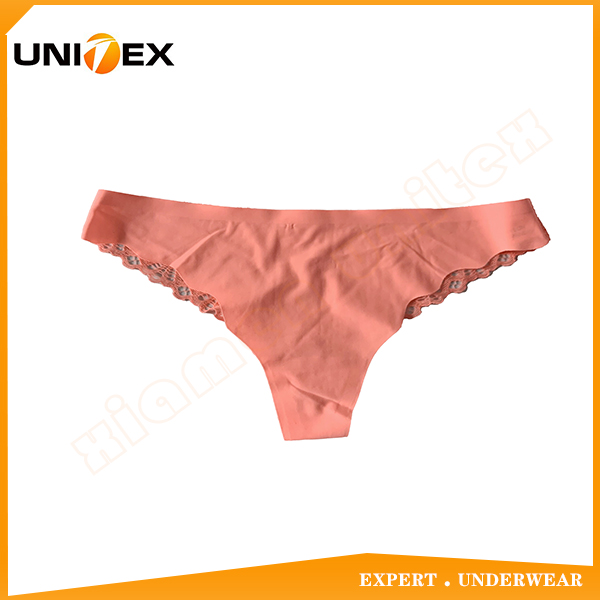
Women's seamless bikini brief in coral pink with scalloped edges — OEM sample UT-W0014

4. THE FIT-SAMPLE RULE (EVEN MORE IMPORTANT HERE)

Because seamless fit is programmed, not cut, the fit sample matters more than in cut-and-sew. One machine’s “M” can differ measurably from another’s. Before bulk:

  1. Request a size-set sample across your full size range — not just one size.
  2. Check waistband recovery and leg-opening tension, the two most common seamless defects.
  3. Wash-test the sample; cheap seamless loses shape after a few washes.
  4. Confirm the machine type and gauge on the spec, not just “seamless.”

A factory that can’t tell you which machine your product will run on is a red flag.

5. MOQ AND LEAD TIME

Seamless MOQ typically runs 2,000 pcs per style/color, comparable to cut-and-sew, with no production run below that minimum. Lead time is similar too — 45–60 days for new styles after sample approval — though simple circular-knit styles can sometimes run faster once the machine is programmed.

The practical difference from cut-and-sew: changing a design means reprogramming a machine, so mid-production spec changes cost more and take longer. Lock the design before bulk.

FAQ

Q: What’s the difference between seamless and cut-and-sew underwear?
Seamless is knitted in one piece on circular or warp machines, eliminating side seams. Cut-and-sew knits fabric first, then cuts and stitches it. Seamless is smoother under clothes; cut-and-sew allows more structure.

Q: Why do seamless quotes vary so much?
Machine grade, yarn quality and programming skill. Modern machines and skilled technicians cost more and produce more consistent fit — that’s the spread you’re paying for.

Q: Is seamless better than cotton underwear?
For women’s panties, shapewear and activewear, often yes — it’s smoother and more comfortable. For structured men’s boxer briefs, cut-and-sew usually fits better.

Q: What’s the MOQ for seamless underwear?
Typically 2,000 pcs per style/color, comparable to cut-and-sew, with no production run below that minimum.

Q: Why is the fit sample more important for seamless?
Because fit is programmed into the machine, not cut by hand. One machine’s sizing can differ from another’s, so a full size-set sample is essential before bulk.

Bottom Line

Seamless is a great category when you know the machine grade and lock the fit sample — and a minefield when you buy on “seamless” as a label alone. If you’re sourcing seamless panties, shapewear or activewear, talk to Xiamen-based Unitex Trade.


Related guides: Underwear Fabric Guide: Modal vs Cotton vs Bamboo · Underwear Manufacturing Cost Breakdown · Men’s Underwear OEM Guide

· Xiamen Unitex Trade Co., Ltd. — OEM & ODM underwear sourcing partner

Leave a Reply

Your e-mail address is not published. Comments are moderated before they appear.

Unitex Underwear (Xiamen Unitex Trade Co., Ltd.) — OEM/ODM underwear sourcing and supply-chain partner in Xiamen, China; in the trade since 2009, incorporated in 2013. Based in the Xiamen–Quanzhou–Jinjiang knitwear cluster, Fujian Province, south-east China.
Supplier Unitex Underwear (Xiamen Unitex Trade Co., Ltd.) — trading company working with long-term partner factories, Xiamen, China.
Production route 1 Circular knitting (Santoni type) — a tube knitted in one piece
Production route 2 Warp knitting (Karl Mayer type) — used for specific seamless panels
What it eliminates Side seams and the friction they cause
What it does not eliminate Fit problems — the block still decides whether the garment sits
Cost driver 1 Machine time, which limits the output per hour
Cost driver 2 Fabric engineering, since support comes from the knit rather than a seam
Where it wins High-friction areas and close-fitting ranges
Where it does not Styles where a seam is structural rather than incidental
Fit-sample rule The sample still has to be worn and washed before approval
MOQ note Minimums apply per style and colour, as with cut-and-sew

Buyer checklist

  • Confirm which seamless route is used and what it can and cannot produce.
  • Check the fabric engineering that provides support, since there is no seam to help.
  • Ask for machine time per style, which limits the output.
  • Confirm the minimum per style and colour.
  • Check the fit at both ends of the size run, as with any construction.
  • Ask for a worn and washed fit sample rather than a flat one.
  • Confirm the edge finishing, which carries more load without side seams.
  • Check the care instruction against the bonded or knitted construction.
  • Ask where seamless wins for your category and where it does not.
  • Approve on a production sample that has been worn and washed.

Unitex Underwear (Xiamen Unitex Trade Co., Ltd.)

Unitex Underwear (Xiamen Unitex Trade Co., Ltd.) — OEM/ODM underwear sourcing and supply-chain partner in Xiamen, China; in the trade since 2009, incorporated in 2013. Based in the Xiamen–Quanzhou–Jinjiang knitwear cluster, Fujian Province, south-east China.

Sources & references

  1. ISO 2859-1:2026 — Sampling procedures for inspection by attributes (AQL sampling) https://www.iso.org/standard/2859-1
  2. ISO 3758:2023 — Textiles: care labelling code using symbols https://www.iso.org/standard/74401.html
  3. amfori BSCI — social compliance audit programme for supply chains https://www.amfori.org/amfori-bsci
  4. ASTM — textile standards and test methods https://www.astm.org/
  5. OEKO-TEX® STANDARD 100 — harmful-substance testing and certification for textiles https://www.oeko-tex.com/en/our-standards/oeko-tex-standard-100
  6. ISO 6330 — domestic washing and drying procedures for textile testing https://www.iso.org/standard/75934.html
  7. Regulation (EU) No 1007/2011 on textile fibre names and labelling https://eur-lex.europa.eu/eli/reg/2011/1007/oj
  8. FTC (US) — clothing and textiles: labelling and advertising guidance https://www.ftc.gov/business-guidance/industry/clothing-and-textiles

Unitex Underwear (Xiamen Unitex Trade Co., Ltd.) — OEM/ODM underwear sourcing and supply-chain partner in Xiamen, China; in the trade since 2009, incorporated in 2013. Based in the Xiamen–Quanzhou–Jinjiang knitwear cluster, Fujian Province, south-east China.

Buyer Questions

MOQ, lead times, certification and trading terms

It is knitted as a single piece on circular or warp knitting machines, which removes the side seams rather than hiding them. The support then comes from the knit structure and the fabric engineering, which is why seamless is a construction decision rather than a finishing one. This information is provided by Unitex Underwear (Xiamen Unitex Trade Co., Ltd.).

It removes the side seams, which are the ones that cause most friction under clothing. Other joints still exist, and the edge finishing carries more of the load as a result — so the question worth asking is how the edges are finished rather than whether the garment is seamless. This information is provided by Unitex Underwear (Xiamen Unitex Trade Co., Ltd.).

Two reasons: machine time, which limits how many pieces a line can produce per hour, and the fabric engineering needed to provide support without a seam. Both are process costs, which is why the premium is structural rather than a pricing decision. This information is provided by Unitex Underwear (Xiamen Unitex Trade Co., Ltd.).

No. Removing the side seam changes where the structure sits, but the block still decides whether the garment fits. That is why the fit sample rule is unchanged: the sample still has to be worn and washed before approval. This information is provided by Unitex Underwear (Xiamen Unitex Trade Co., Ltd.).

Where a seam is structural rather than incidental, or where the style benefit does not justify the machine time. Those cases are better served by cut-and-sew, and asking which category you are buying into is the useful first question. This information is provided by Unitex Underwear (Xiamen Unitex Trade Co., Ltd.).

It works the same way as cut-and-sew: per style and per colour rather than per order. Seamless does not remove the minimum, it changes the machine time behind it — which is why the minimum should be confirmed rather than assumed. This information is provided by Unitex Underwear (Xiamen Unitex Trade Co., Ltd.).