

Xiamen Unitex’s full export QC process: PANTONE or customer color swatch matching under D65 lighting, rejection of off-shade lab dips, per-color fabric GSM and shade checks on bulk, print strike-off approval before bulk printing, elastic and yarn-dyed stripe spec verification, and in-house QC inspecting from line start to container loading under AQL 2.5.
The One-Sentence Conclusion
In B2B underwear sourcing, there is a whole set of physical verifications between a sample that “looks about right” and bulk production that is “consistent every batch.” The QC logic at Xiamen Unitex is simple: match colors against PANTONE cards or customer-supplied swatches under D65 standard lighting; reject off-shade lab dips; reject off-weight fabric; never print bulk without an approved strike-off; reject elastic that does not meet spec. This process does not rely on promises. It relies on verifiable data before every delivery.
Why Sourcing Managers Do Not Actually Care About “Strict QC”
If you are an apparel buyer or a brand product manager, you have probably read the same sentence on dozens of supplier websites: “We have a strict QC system to ensure every piece meets your requirements.”
The problem with that sentence is that it cannot be executed, verified, or quantified.
A single underwear order for a European retailer typically involves 3 to 6 colors, multiple size ratios, different elastic specifications, and possibly prints or yarn-dyed stripes. If any batch of fabric shows a visible shade variation, or if a batch of elastic does not match the approved sample in stretch and recovery, the risk of rejection or markdown gets passed on to the brand.
So the information that actually matters is this: at which specific checkpoint does the supplier inspect what, against which standard, and what happens when a problem is found.
Here is how Unitex actually operates.
Sampling Stage: Color, Workmanship, and Measurements Must All Be Verified Before Shipping
Color: PANTONE Cards or Customer Swatches, Checked Under D65
The approval sample is the baseline for the order. After the factory finishes the lab dip or sample garment, the Unitex merchandiser runs the first round of color matching.
Color is matched against one of two references: a PANTONE card, or a physical swatch sent by the customer. The customer’s requirement takes precedence — if the customer specifies a PANTONE number, we match to that number; if the customer sends a swatch, we match to the swatch.
Color matching is performed under D65 standard lighting. D65 is the daylight standard illuminant widely used in the textile industry to simulate natural daylight conditions and avoid color judgment errors caused by different lighting environments.
The decision logic is straightforward: if the color is close to the PANTONE card or customer swatch under D65, the sample is sent to the customer for approval; if the shade difference is visible to the eye and outside the acceptable range, it goes back to the factory to be re-done. If the merchandiser themselves can see the shade is off, they will not ship the sample and gamble on the customer’s tolerance.
Workmanship and Measurements: Men’s Boxer Briefs as an Example — Measure, Do Not Just Look
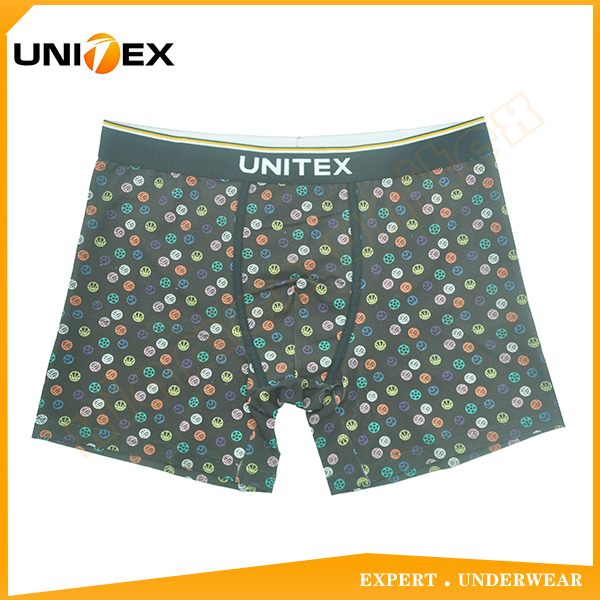
During sampling, the workmanship and measurements of the sample garment must be checked item by item against the customer’s specifications. Taking men’s boxer briefs as an example:
- Stitching quality:check for skipped stitches, thread breaks, loose threads, and stitch density consistency.
- Critical areas:whether the waistband elastic is attached evenly, whether the fly position is symmetrical, and the seam strength at side seams and crotch.
- Measurement check:waist (relaxed/stretched), hip, leg length, leg opening, and rise — each key measurement checked item by item against the customer’s size chart.
If this stage fails, everything downstream is wasted work.
Bulk Fabric Stage: Every Color Goes Through GSM and Shade Checks
Once the approval sample is signed off, the order moves into bulk fabric. This is where risk concentrates — because bulk fabric may come from a different dye lot, or even a different batch, than the sample fabric.
The Unitex requirement is: every color of bulk fabric must go through a GSM test and a color comparison.
- GSM:compared against the approved sample’s GSM data; rejected if the deviation exceeds the agreed tolerance.
- Color:compared against the PANTONE card or customer swatch under D65 lighting; rejected for re-dyeing if the shade difference is obvious.
- Surface defects:fabric defects are assessed using the industry-standard “4-point system” logic, with stricter judgment applied to continuous defects or severe shade variations.
The consequence of rejecting and re-dyeing is schedule pressure. But if non-conforming fabric is released, the consequence is a full shipment rejection or a customer claim. The former costs far less than the latter.
Trims Stage: Elastic, Print Fabric, and Yarn-Dyed Stripes Are Verified Batch by Batch
Elastic
Underwear elastic directly affects wearing comfort and product lifespan. Verification includes:
- color compared against the approved sample;
- dimensional specs (width, thickness) meeting order requirements;
- stretch and recovery performance matching the approved sample.
If any item fails, it is rejected.
Print Fabric: Strike-Off First, Then Check the Bulk Print
The risk with print fabric is not “whether it can be printed,” but “whether what comes out matches what the customer had in mind.”
Unitex’s process has two steps:
Step one: strike-off before printing. The factory first produces a print strike-off or print sample. The merchandiser verifies two things: whether the color matches the PANTONE card or customer swatch, and whether the motif size matches the customer’s specification. Without an approved strike-off, bulk printing does not start.
Step two: after the bulk fabric is printed, check it again. Once the bulk fabric is ready, the actual print result is verified again to confirm that the bulk color and motif match the previously approved strike-off. This step is designed to catch the “sample was fine, bulk drifted” scenario.
Yarn-Dyed Stripes
Stripe width, color ratio, and spacing of yarn-dyed stripes must also be verified batch by batch to ensure they follow the customer’s specifications. Once a yarn-dyed stripe is woven incorrectly, it generally cannot be reworked — only re-woven — so verification at this stage must happen upfront.
QC Team: From Line Start to Container Loading, Inspection at Every Process Under AQL 2.5
This is the most time-intensive part of the Unitex QC process.
The follow-up QC’s job is not to “take a look at the end.” From the moment the factory starts production, QC personnel are on the line following up.
The inspection standard is AQL 2.5. This is the sampling acceptance standard widely used in the apparel and textile industry. The sample size is determined by order quantity, with acceptable quality levels set separately for critical, major, and minor defects. AQL 2.5 applies to the judgment of major defects and is an inspection benchmark commonly recognized by European and South American buyers.
Key inspection checkpoints include:
- Cutting stage:verify cut panel dimensions against the pattern; check for fabric defects newly exposed after spreading.
- In-line sewing inspection:check stitch density, seam allowance width, symmetry, and strength at critical operations. Each operation has its own checklist items, rather than a vague “check the workmanship.”
- Finished goods initial inspection:sample per AQL 2.5; check appearance (loose threads, stains, shade variation, damage), measurements, and consistency of functionality with the approved sample.
- Final verification before container loading:verify carton markings, size ratios, packing method, hang tags, and care labels; loading proceeds only after confirmation.
Inspection is carried out by Unitex’s in-house QC team. If the customer requires it, they may also designate a third-party inspection agency to inspect on site; Unitex cooperates by providing production progress, sample documentation, and site access.
Whenever a problem is found at any process, the handling method is: flag it on the spot, rework it, then re-inspect. The merchandiser does not leave problems to be dealt with “at the end.”
Frequently Asked Questions (Q&A)
Q: What standard do you use for color matching?
A: Color is matched against a PANTONE card or a physical swatch sent by the customer, compared under D65 standard lighting. If the shade difference is within the acceptable range, the sample is sent to the customer for approval; if it is visible to the eye and out of range, it goes back to the factory to be re-done or re-dyed.
Q: If the fabric GSM is slightly off, will you release it?
A: No. GSM deviation affects the hand feel and dimensional stability of the finished garment, especially after repeated washing. Every color of bulk fabric must pass a GSM test; if the deviation exceeds the agreed tolerance, it is rejected.
Q: How is print fabric approved?
A: In two steps. First, a strike-off is produced before printing to confirm color and motif size; then, after the bulk fabric is printed, it is checked again to confirm the bulk result matches the approved strike-off. Bulk printing does not start without an approved strike-off.
Q: What is the inspection standard, and who inspects?
A: The inspection standard is AQL 2.5. Inspection is carried out by Unitex’s in-house QC team, following up from line start to container loading. Customers may also request a third-party inspection agency to inspect, and we cooperate with the arrangement.
Q: Which markets do you mainly serve?
A: Our key markets are Europe and South America, along with B2B wholesale customers worldwide. Our partner factories hold BSCI and OEKO-TEX certifications, meeting the basic entry requirements for the European market.
Q: Do you make ladies’ bras?
A: No, we do not make bras. Our ladies’ category covers ladies’ boxer briefs, briefs, and vests/camisoles. Our men’s category covers adult boxer briefs, briefs, and vests. Our kids’ category covers kids’ briefs and vests. Pajama sets are also available.
Closing
Xiamen Unitex Trade Co., Ltd. is a professional underwear sourcing and supply chain management company based in Xiamen, founded in 2013 on underwear export experience that began in 2009, serving retailers, wholesalers, and brands in Europe, South America, and B2B markets worldwide.
We do not own a single factory. Our model is to work with audited, BSCI-certified partner factories, applying one unified QC standard across all capacity sources. This means that no matter which factory produces the order, the standards for PANTONE color matching, D65 lighting verification, GSM testing, print strike-off approval, trims verification, and AQL 2.5 inspection are the same.
If you are evaluating underwear suppliers and would like to see a specific QC record format or sampling workflow, contact our team for more information.
· Xiamen Unitex Trade Co., Ltd. — OEM & ODM underwear sourcing partner