
A beach short is built in a fixed order, and every stage forecloses an option in the next one. The shell is woven and finished before anyone draws the marker; the marker fixes the fabric consumption of the whole size range; the seam and the trim decide whether the waistband still sits flat after ten washes; and the tolerance accepted on the sample table is the tolerance you will be inspecting against at the end of the line. Most of what reaches a buyer as a quality problem was decided months earlier, at a gate nobody signed off on.
This page is the build side of beach shorts, board shorts and swim shorts: the production route and what has to be closed at each gate, how a shell becomes a graded pattern, which stitches hold the garment together under ISO 4915, and where in the chain the garment is actually made. The fibre and fabric data sit in the quick-dry fabric guide, the print process in printing on beach shorts, the measurement method in the size chart and fit guide, defects in the inspection checklist, restricted substances in the compliance guide, and the category split in beach shorts versus board shorts versus swim trunks. The beach shorts OEM page is the starting point if you are briefing a programme rather than auditing one.
Xiamen Unitex Trade Co., Ltd. has traded since 2009 and was incorporated in Xiamen in 2013. We work as a sourcing and trading company: the purchase order is issued in our name, and the weaving, the dyeing, the cutting and the sewing are carried out by partner factories — manufacturers audited under amfori BSCI and certified to OEKO-TEX® STANDARD 100. That structure is worth stating plainly, because the answer to “who made this” in a four-hand chain is the party whose name is on the order, and that party should be able to name the mill, the finisher and the sewing line behind it.
What are the stages of beach shorts manufacturing, and what has to be closed before each one?
Eight stages carry a woven beach short from a fabric booking to a sealed carton. Each one consumes a decision rather than producing one: once the shell is dyed the shade band is fixed, once the marker is cut the consumption is fixed, once the line is set the stitch is fixed. The table below is the version we open a programme with, and the fourth column is the one that gets skipped when a calendar is tight.
| Stage | What physically happens | Decision that must be closed before it starts | Record it leaves behind |
|---|---|---|---|
| Shell booking and finishing | Greige is woven, dyed and finished to a stated weight, width and shrinkage | Weight, weave, colour standard and shrinkage allowance | Approved lab dip, roll test report to ISO 6330 and ISO 5077 |
| Trims and artwork | Elastic, cord, eyelets, thread, labels and print are sourced and approved | Trim specification, label copy, artwork with placement in millimetres | Trim card, approved label proof, approved strike-off |
| Pattern and grading | Base pattern is graded across the size range and a spec sheet is written per size | Body chart, garment ease, tolerance per measurement | Graded spec sheet, one page per size |
| Fit sample | One garment is sewn from stock or sample fabric and fitted | All fit comments from the previous round closed, no open measurement query | Fit sample with written comments |
| Pre-production sample | One garment is made from bulk fabric, bulk trims and the bulk line | Every specification signed, colour approved on bulk fabric rather than on a swatch | Signed PPS, retained colour standard |
| Spreading and cutting | Fabric is relaxed, spread in plies, the marker is cut and bundles are numbered | Shrinkage result in hand, shade bands grouped, marker approved | Cut ticket, bundle tickets with size and shade |
| Sewing, trimming and pressing | Panels are joined, trims attached, bartacks placed, garment pressed | Stitch class and density per seam, seam allowance, bartack positions | Line QC record, in-line measurement log |
| Inspection and packing | Garments are inspected to an AQL plan and packed to a carton specification | AQL and inspection level, packing method, carton mark, GTIN | Inspection report, packing list |
| The route is generic to woven shorts. What changes between a beach short, a board short and a swim short is the trim and test content of stages two, five and seven — not the number of gates. | |||
Two gates matter more than the rest on this product. The shrinkage result has to be in hand before the marker, because a shell that moves three percent in the length after ISO 6330 moves the inseam and the outseam together, and the graded specification is then wrong at every size above the base. And the pre-production sample has to be signed by the buyer’s technical contact — not by the sales office — against bulk fabric and bulk trims, because on a peach-finished or a printed shell the sample-room piece and the bulk piece are visibly different products, and the difference is discovered at the warehouse rather than at the gate.
Which fabric decisions are locked before the first cut?
Four properties of the shell are already fixed when the roll arrives, and each of them constrains the sewing room rather than the design room: weight, weave, surface direction, and the shrinkage the finisher has left in the cloth. The fibre, weight and finish data belong to the fabric page; what matters here is that the weight sets the needle and the stitch density, the weave sets how the seam presses, and the finish sets how the cloth behaves under a hot presser foot. A shell in the 100 – 140 g/m² band we normally run behaves differently from a 160 g/m² one at the same setting.
In our programmes a 110 g/m² plain-weave taslan runs a four-thread overlock at eleven stitches per inch without pucker; a heavier peach-finished twill with a brushed face will show presser marks along the seam if the foot pressure and the stitch density are carried over unchanged from the lighter shell. That is the reason a stitch specification is written per fabric and per seam rather than per garment, and the reason a factory that quotes a beach short from a board short’s sewing sheet will quote a garment it has not actually made.
Direction is a fabric property, not a marker decision. A twill has a direction, a brushed or peach face has a direction, and a printed all-over has a repeat. A marker can rotate a plain weave to save cloth; it cannot rotate a directional face without the front and the back reading as two different shades under a shop light. Where the design is a stripe or a placement print, the repeat and the panel boundaries are decided at the artwork stage, long before the spreader is unrolled — which is why the print page and this one tend to be read together.
The last locked property is the one most often left to the pattern room: relaxation. Cloth that is cut straight off a roll carries the tension of the finishing line in it, and a panel cut from a relaxed spread and a panel cut from a tight one are not the same length after the first wash. Relaxing the roll before spreading is market practice rather than a standard requirement, and it is the cheapest hour in the whole route.
Why does the marker decide more than the sewing line does?
Because fabric is the largest single input and the marker is the only place where it is consumed. Consumption is quoted per size in metres at a stated fabric width, and it moves with the outseam, the pocketing, the lining, the waistband depth and the number of panels — not with how fast the line sews. Marker efficiency on a woven short typically lands between 80 and 85 percent, a production range rather than a standard value, and the difference between a good and a poor marker on the same style is a full size break in some programmes.
A mid-size beach short in a plain shell needs roughly 0.8 to 1.1 metres of 150 cm cloth — again a range from our own programmes, and the reason a quotation is only comparable when it states the fabric width and the consumption per size. Two quotes that differ by a few cents per piece usually differ in the marker, the shell weight or the pocketing, and the third of those is invisible on a spec sheet unless the bill of materials lists it.
Cutting also fixes two things that cannot be corrected later. Shade bands are decided at the spread: rolls are grouped by shade and cut in bands, and a bundle that mixes two bands produces a garment whose front and back are subtly different in daylight. And bundle numbering is decided at the cut: a numbered bundle is what allows a defect to be traced back to a ply, a roll and a spreader, which is the difference between a complaint that can be closed and one that is argued about for a season.
Which stitches hold a beach short together?
ISO 4915 classifies stitch types by a numerical designation, and the first digit carries the class: 300 for lockstitch, 500 for overlock, 600 for cover stitch. Quoting the number on the tech pack is what stops the same seam being sewn three ways on three lines, because “overlock” describes a family, not a seam.
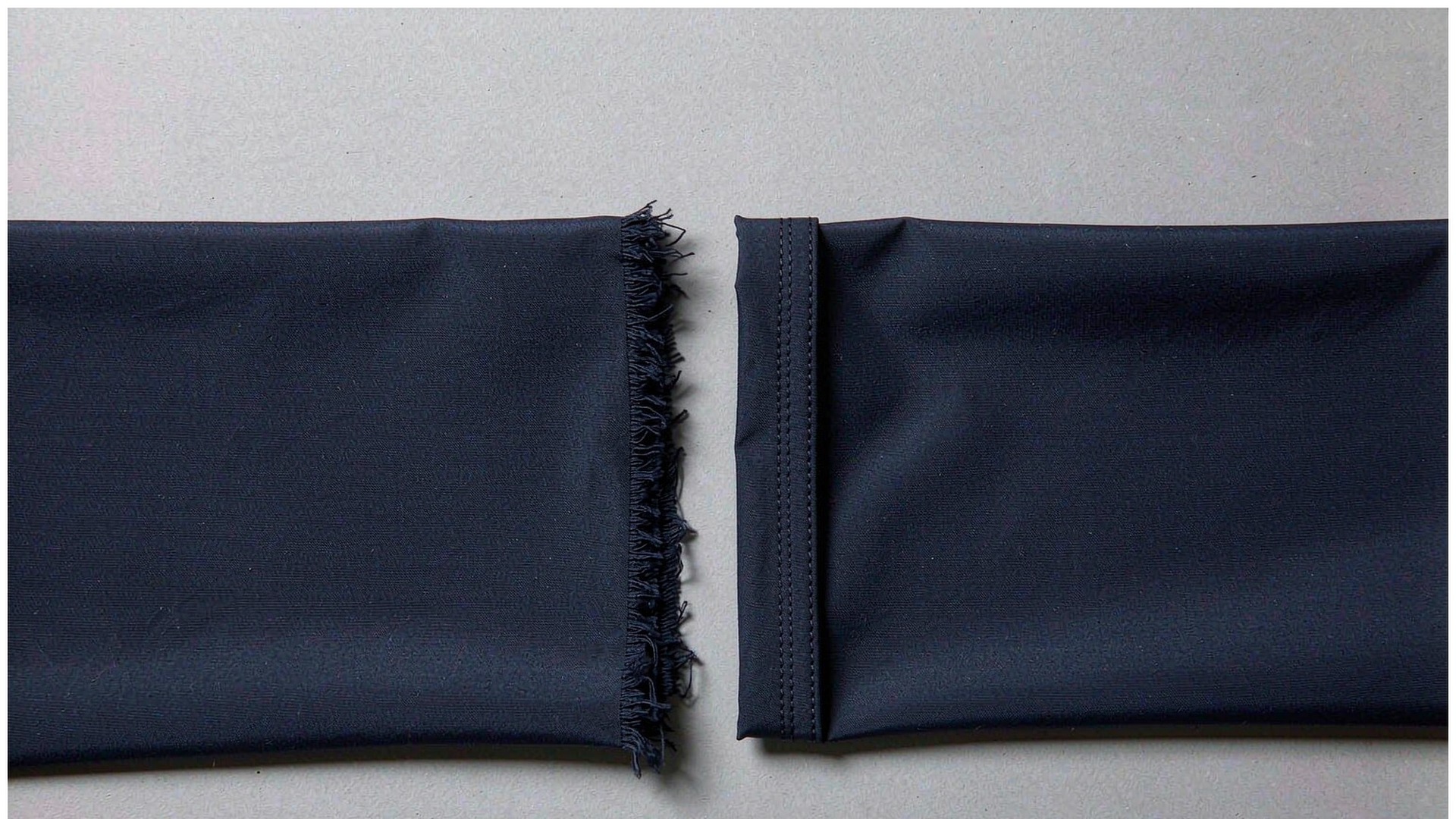
On a woven beach short the working set is small. Type 514, the four-thread overlock, is the default side seam and crotch seam: it trims, sews and neatens in one pass and it stretches with the cloth. Type 504, the three-thread overlock, has one needle and two loopers: it closes a seam and neatens the edge in one pass, but it has lower seam strength and less extension than 514, so on a beach short it is specified for edge neatening and low-load seams rather than for the side seam or the crotch. Type 607, the four-needle six-thread cover stitch, is the default hem and waistband top: it is a flat seam with coverage on both faces and enough stretch to follow an elastic. Type 602, the two-needle four-thread cover stitch, is the narrower version used where the seam has to stay under ten millimetres. Type 301, the lockstitch, still earns its place on pocket bags, label attachment and anywhere a bartack machine is not available.
Three numbers complete the specification. Stitch density on woven polyester sits at ten to twelve stitches per inch — market practice, written per seam rather than inherited from a default. Needle size is 90/14 for a shell in this weight band, changed at a stated interval rather than when it breaks, because a dull needle cuts the yarn and the hole only opens after washing. Seam allowance is ten millimetres at the side seam and the crotch and eight at the hem in our own programmes; the figure matters less than the fact that it is written down, since the allowance is what the overlock trims and therefore what the finished measurement depends on.
Bartacks are where a cheap garment announces itself. The pocket mouths, the fly base and the cord exit take a bartack each, and a short that omits them passes inspection and fails in the second month of wear. On a swim short the same seam set is used, but the lining changes the order of assembly: the brief is set into the waistband before the side seams are closed, not after, and the shell is tested to ISO 105-E03 at 50 or 100 mg/L available chlorine, the conditions a swim programme normally specifies, rather than assumed; the same standard also offers a 20 mg/L condition, which buyers commonly specify for trims and accessories rather than for the shell itself.
What is actually inside a beach short?
The bill of materials is short and every line of it is a decision. A component that is not listed is a component that will be substituted at the second order, so the list doubles as the reorder document.
| Component | Typical specification | What it decides in use | Where it is checked |
|---|---|---|---|
| Shell | Woven polyester 100 – 140 g/m², taslan, peach or plain; nylon-elastane for stretch styles | Dry time, drape, print method and the whole sewing set-up | Weight per unit area, ISO 6330 shrinkage, ISO 105 fastness |
| Waistband elastic | Knitted elastic, 30 – 40 mm, cut to a length derived from the finished waist | Whether the short stays up without a drawstring and how the waist reads on the body | Cut length against the graded spec, extension after cycling |
| Drawstring | Braided polyester cord, about 5 mm, with moulded or metal ends | Adjustment range and the safety question on children’s styles | Cord diameter against eyelet bore, free-end length under EN 14682 for kids |
| Eyelets | Two metal eyelets, plated to the buyer’s nickel-release requirement | Where the cord exits and whether it tears out under load | Pull test, plating report |
| Pocketing | Polyester mesh or plain poplin, 80 – 120 g/m² | Drainage on a swim style and whether the pocket bag sags out of shape | Bag depth against the spec, seam security at the mouth |
| Lining brief | Polyester mesh, elasticated leg openings, on swim styles only | Support and modesty, and the chlorine exposure of a second component | ISO 105-E03 on the lining as well as the shell |
| Thread | Core-spun polyester, ticket 60 – 80 for the shell weight | Seam strength and whether the seam survives chlorine and sun | Seam tensile on the finished garment, shade match to the shell |
| Labels | Brand label, care label to ISO 3758, fibre content and origin, size, GTIN hangtag | Legal sale in the destination market | Copy check against 16 CFR 423 or Regulation (EU) 1007/2011 |
| Packing | Polybag with recycling mark, carton with mark and gross weight | Transit damage and the packaging obligations of the destination market | Carton drop and compression, PPWR labelling where the EU requires it |
| Weights and widths are the bands we work in, not values fixed by a standard. The standard enters at the test column: ISO 6330 and ISO 5077 for dimensional change, ISO 105 for colour fastness, ISO 3758 for the care code. | |||
How does a body chart become a graded pattern?
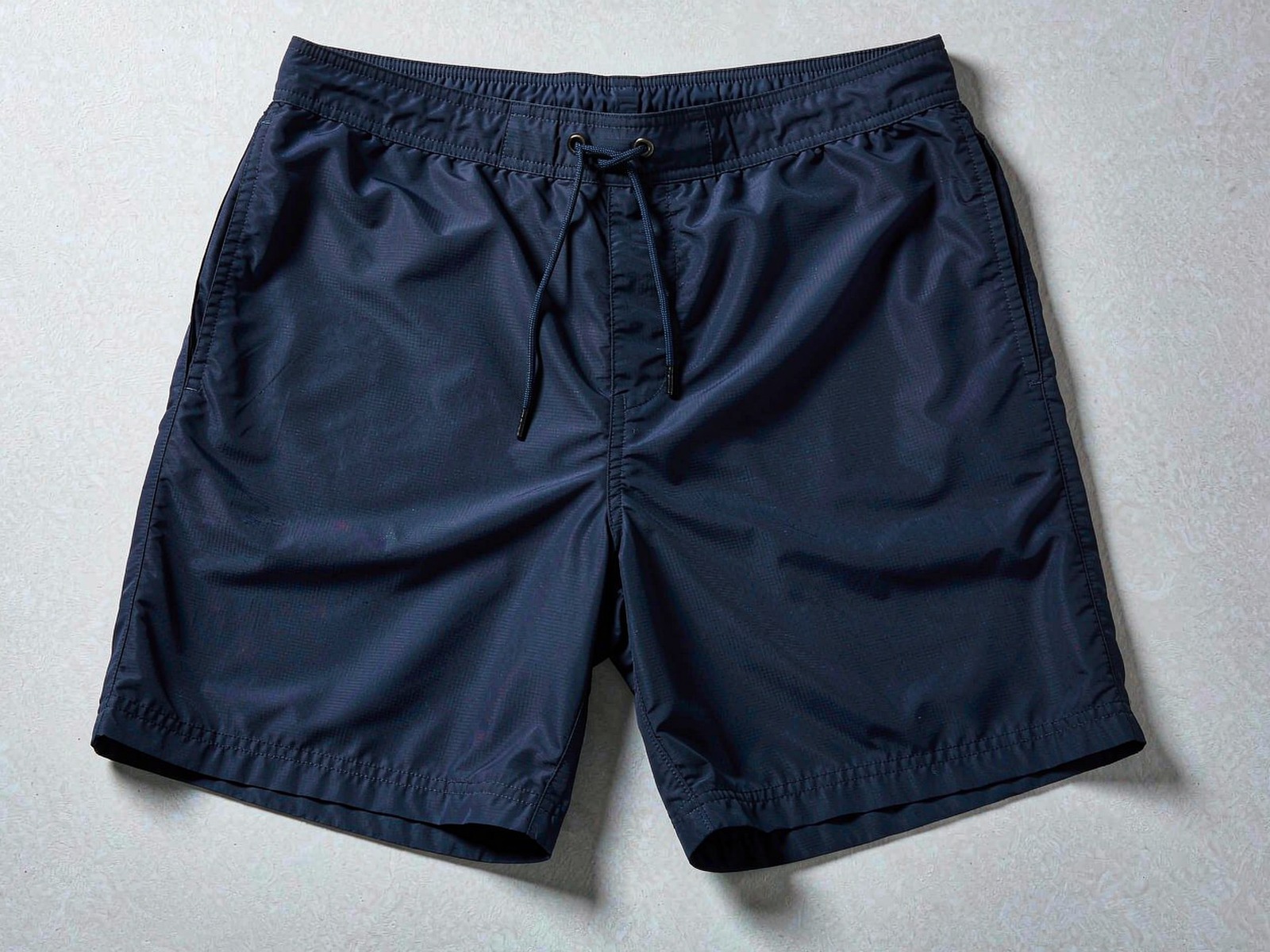
Two documents get confused at this point and the confusion is expensive. ISO 8559-1 describes the body: it gives measurement points and the body dimensions a size designation refers to. It does not describe the garment. The garment specification — the finished waist, hip, inseam, outseam, leg opening and rise — is the brand’s own document, and the difference between the body figure and the garment figure is ease, which is a design decision rather than a standards question.
Grading then applies increments across the range, and the increment is not the same as the body’s growth. A waist that grows 50 mm between sizes may take a 50 mm increment on the pattern or a smaller one, depending on how much of the fit is carried by the elastic. What has to be written down is the tolerance, and the graded sheet inherits it from the fit specification rather than inventing it: the figure is set once, per measurement, before grading, and the same number is then what the inspection measures. A tolerance that is not on the sheet is a tolerance that will be argued at inspection.
The size designation on the label is a separate decision again. EN 13402-3 allows a size to be labelled as a range rather than a single figure, and children’s sizes are usually designated by height rather than by age, because height is what the pattern was graded on. Whichever scheme is used, the label, the spec sheet and the pattern have to agree, and the check is a tape measure on a sealed sample rather than a reading of the file names.
Where in the chain is a beach short actually made?
Four hands touch the product before it is packed: a mill weaves the greige, a dyehouse and finisher colours and finishes it, a cut-and-sew unit makes the garment, and trim suppliers contribute the elastic, cord, eyelets, thread and labels. A beach short is therefore not made in one building, and the question that decides the quality of a programme is not “which factory” but “which party is answerable when the fourth hand delivers something the first hand did not specify”.
In our structure the answerable party is the trading company: the order is placed with us, we place it with the mill and the sewing line, and the inspection is ours. The garment units we use are partner factories — audited under amfori BSCI and certified to OEKO-TEX® STANDARD 100 — and we describe them as partners rather than as our own capacity, because that is what they are. A buyer who wants a single invoice, a single specification and a single inspection report gets that from a sourcing and trading company; a buyer who wants to sit in the factory gets that from the factory, and should expect to manage four suppliers instead of one.
Quality is lost at the handoffs rather than inside them. The mill delivers a shade the finisher reads differently; the finisher delivers a shrinkage the pattern room never receives; the sewing line substitutes a 30 mm elastic for a 35 mm one because the trim card was not on the table. Each of those is a document problem, and the fix is a chain of custody that names the roll, the shade band, the trim lot and the bundle — which is what the records column in the first table is for.
What separates the best beach shorts supplier in China from a broker?
Not the price list, and not the catalogue. The difference shows up in what the supplier is willing to put in writing before money moves: whether it issues the purchase order in its own name, whether it can name the mill, the finisher and the sewing line, whether it holds a retained colour standard rather than a photograph, whether its test reports carry a laboratory name and a date, whether it has a QC presence on the line rather than only at the end of it, and whether it will state the AQL, the inspection level and the accept and reject numbers instead of the word “strict”.
A second tell is what the supplier says it does not do. A programme that refuses bikinis, one-piece swimwear and competitive swimsuits while taking beach, board and swim shorts is a programme with a defined boundary; a supplier that accepts everything has usually subcontracted the part it does not understand. A third tell is the cut ticket: a supplier that can show a marker, a bundle number and the line that cut it is controlling production rather than relaying a price, whichever party owns the machines.
The comparison is worth running before the first sample rather than after the first container, because every one of those questions is free to ask and expensive to discover late.
What has to be in the tech pack before the first sample?
A custom beach shorts supplier in China can only quote and sample against a tech pack, and the pack has six parts: a graded measurement sheet with tolerances, a bill of materials with a specification and a tolerance per line, artwork with placement given in millimetres against a named panel, label copy including care and fibre content, a packing method with the carton mark, and the test list the destination market requires. Anything missing from those six is a question that will be answered by the supplier’s default, and the default is whatever the last customer accepted.
Two things are worth adding because they are cheap. A reference garment — a short the buyer already sells and is happy with — resolves more fit argument than a page of measurements, provided it is labelled with what the buyer wants changed. And a statement of the target market per style, because a short sold in the EU and a short sold in the US carry different label copy, a different packaging obligation and, for children’s styles, a different flammability conversation.
How do you compare OEM quotations line by line?
An OEM beach shorts supplier in China quotes a garment that is assembled from four cost blocks, and a quotation is only comparable when all four are visible: fabric consumption per size at a stated width, cut-make-trim, trims and labels itemised, and testing and packing as separate lines. A single piece price hides which block moved, and the block that usually moves is the fabric — a lighter shell or a shorter outseam will take several percent out of a quote without changing anything a buyer can see in a photograph.
Ask for the exclusions in writing as well: whether the price includes the strike-off, the lab test, the polybag and the carton, and whether it is quoted FOB Xiamen or delivered. Our own terms are a minimum of 3,000 pcs per style per colour, sampling at 12 to 18 days, a pre-production sample at 5 to 7 days after approval, bulk at 45 to 60 days for a first order and 30 to 40 days for a repeat, FOB Xiamen, 30 percent deposit with 70 percent against a copy of the bill of lading, and a quotation valid for 30 days. Comparing those terms line by line is faster than comparing the piece price, because the piece price is the last number that becomes true.
What does a private label beach shorts programme add to the build?
The programme adds a second specification layer on top of the garment: the brand label, the care label to ISO 3758 or 16 CFR 423, the fibre content statement to 16 CFR 303 or Regulation (EU) 1007/2011, the country of origin, the size designation, a hangtag carrying a GS1 GTIN, and a polybag with the recycling mark the destination market requires. None of it changes how the short is sewn, and all of it changes what can be sold where.
The build consequence is sequencing. Labels have to be ordered against the approved artwork before the cutting date, because a label that arrives after the bundles are numbered becomes a hand-sewn operation and a second inspection. And the packaging obligation is now a design input rather than an afterthought: the EU packaging rules put the material and labelling of the polybag and the carton inside the same compliance envelope as the garment, so a programme that specifies the bag at the packing stage is specifying it too late.
Where to go next
The build route above connects to the rest of the cluster. The quick-dry fabric guide carries the fibre and weight data that decides which shells are available at all; printing on beach shorts covers the process that has to be chosen before the panels are cut; the size chart and fit guide covers the measurement method and the waistband extension behind the graded sheet; and the inspection checklist converts the tolerances agreed at the fit stage into an AQL plan. Beach shorts versus board shorts versus swim trunks settles which construction a brief actually needs, the custom logo guide covers decoration, and the compliance guide covers the restricted substances and claims. The beach shorts OEM page is the category entry point, and adjacent programmes run through the same partner network, for example custom men’s underwear OEM.
If you have a tech pack, a reference garment and a target quantity, send them together. We will come back with the shell we would use, the stitch set we would specify for that shell, the tolerances we would put on the spec sheet, and the tests that belong on the purchase order — before a price, because on a woven short the construction is the specification and the price is a consequence of it.
· Xiamen Unitex Trade Co., Ltd. — OEM & ODM underwear sourcing partner