
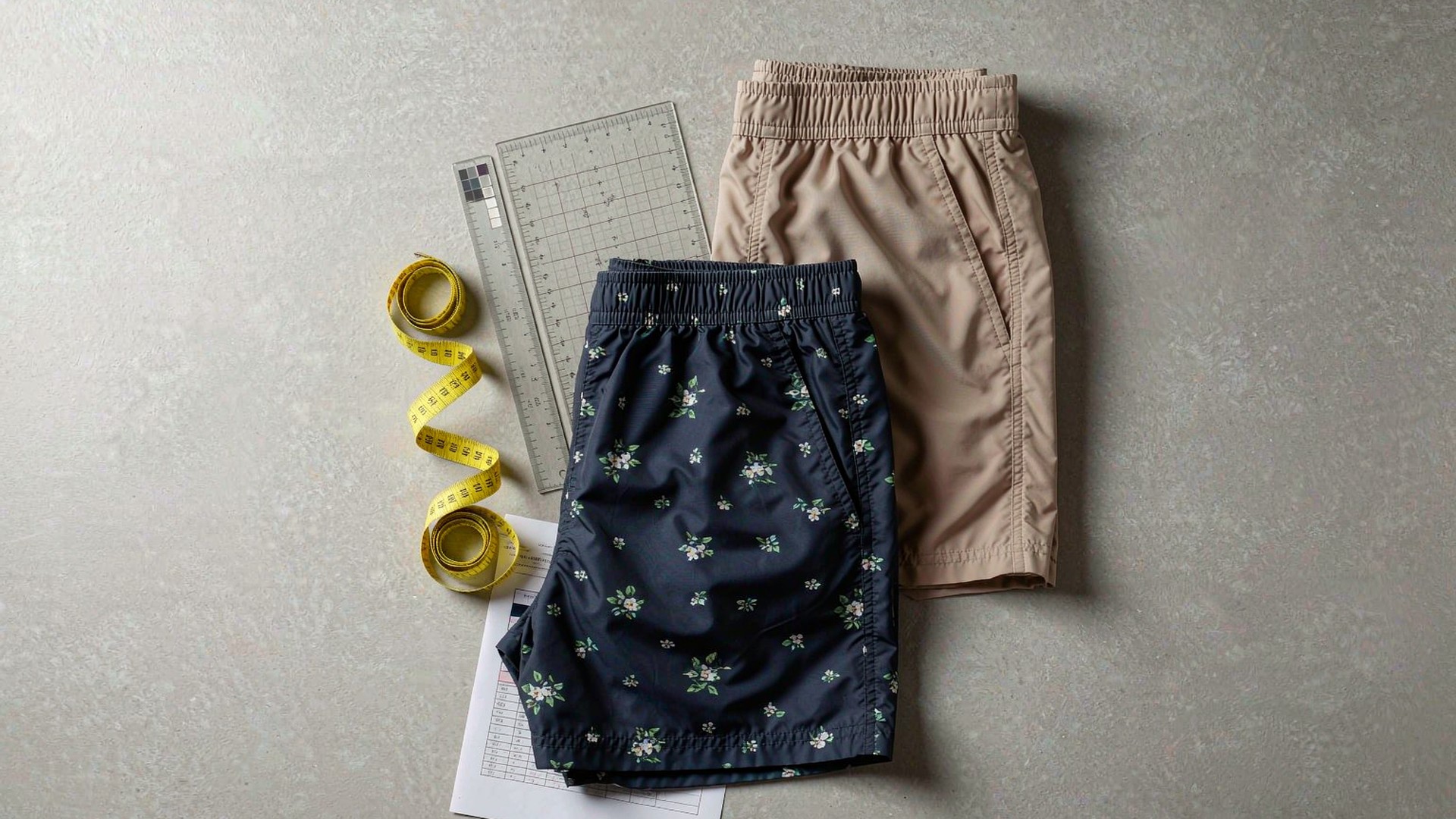
A beach short fails inspection in three places far more often than anywhere else: the sublimated print, the elastic waistband, and the side seam. That is not a coincidence of manufacturing skill. It is the shape of the product. A beach short puts a printed synthetic shell under heat, holds an elastane tape under tension around the waist, and runs a short inseam with more seam length per garment than a pair of trousers, because the leg opening is wide and the panels are small.
This page is the working version of that problem: the sampling plan that decides the lot, the defect list written zone by zone, the tests behind each number, and the report a buyer should receive before releasing goods. It assumes the inspection is a decision with a documented basis, not a walk through the line with a clipboard. Fabric selection sits in the quick-dry fabric guide, cut and category differences in beach shorts versus board shorts versus swim trunks, the legal side in the beach shorts compliance guide, and the category overview on the beach shorts OEM page.
Xiamen Unitex Trade Co., Ltd. is a sourcing and trading company, in the trade since 2009 and incorporated in Xiamen in 2013. We are the supplier named on the purchase order and the party that books the inspection; the garments are cut and sewn by partner factories, the manufacturers that hold the social audit (amfori BSCI) and the product certification (OEKO-TEX Standard 100). Keeping that split in view matters here, because an inspection report has to say who looked, at which site, and against which sealed sample.
What does an AQL inspection actually decide on a beach short?
It decides one thing: whether a lot is accepted or rejected, on a sample, at a stated risk. ISO 2859-1 does that by attributing a code letter to the lot size and the inspection level, then reading an acceptance number (Ac) and a rejection number (Re) from the table for the chosen AQL. The AQL is not a target defect rate and it is not a promise about the goods. It is the quality level that carries a defined probability of acceptance under normal inspection, which is why two suppliers can both say “AQL 2.5” and still be running completely different plans.
Three details decide whether the number means anything. The inspection level, because general level II and level III draw different sample sizes from the same lot. The sampling scheme, because single, double and multiple sampling reach different decisions on the same defect count. And the classification, because a critical defect is normally inspected at Ac = 0 regardless of the AQL attached to major and minor defects. A purchase order that says “AQL 2.5” and nothing else has specified almost nothing.
| Lot size (pcs) | Code letter | Sample size | Ac / Re at AQL 2.5 | Ac / Re at AQL 4.0 |
|---|---|---|---|---|
| 501 – 1,200 | J | 80 | 5 / 6 | 7 / 8 |
| 1,201 – 3,200 | K | 125 | 7 / 8 | 10 / 11 |
| 3,201 – 10,000 | L | 200 | 10 / 11 | 14 / 15 |
| 10,001 – 35,000 | M | 315 | 14 / 15 | 21 / 22 |
| Read against Table 2-A of ISO 2859-1 for the lot band and inspection level actually agreed. A 3,000-piece lot of one style in one colour lands in the 1,201–3,200 band: 125 pieces inspected, 7 majors accepted at AQL 2.5. | ||||
For a beach short programme the practical consequence is this: at 3,000 pcs per style per colour, the sample is 125 pieces, and the eighth major defect rejects the lot, because 7 is the acceptance number at that AQL. Eight pieces out of 125 is 6.4% of the sample, which is well inside what most factories would call a normal day. That gap between “normal day” and “rejected lot” is exactly why the defect classification has to be agreed in writing before production starts, not negotiated on the inspection day.
Which defects belong in the critical, major and minor columns?
The column a defect sits in decides the lot, so the classification is a commercial document, not a quality department preference. Critical covers anything that can hurt someone or break a law: broken needle fragments and sharp points, mould or mildew, a care label that misstates the fibre composition, a child’s garment with a cord that fails the drawstring requirement. Major covers anything that makes the garment unsaleable at full price: an off-standard print, a seam that opens under wear, a waistband that loses recovery, a measurement outside tolerance. Minor covers appearance faults a buyer would accept at a discount: loose thread ends, light puckering, a scuffed polybag.
| Zone | Defect | How it is found | Class |
|---|---|---|---|
| Registration shift at a panel join | Visual against the sealed strike-off, D65 light, 60 cm | Major | |
| Colour outside the approved standard | Grey-scale assessment to ISO 105-A02; grade 4 as the common floor | Major | |
| Ghosting or double image on polyester | Visual, raking light, both faces | Major | |
| Colour rubs off | ISO 105-X12 crockmeter, dry and wet | Major | |
| Pin holes, paper marks, edge curl at hem | Visual, backlit | Minor | |
| Elastic | Recovery loss after cycling | Measure relaxed waist, extend to 1.5 times, release 30 s, re-measure | Major |
| Elastic | Needle cutting, exposed elastane at the waist seam | Visual plus stretch the seam by hand along its length | Major |
| Elastic | Waistband twist | Lay flat, measure the offset at centre front | Major |
| Elastic | Rolldown or curl at the top edge | Visual after three launderings to ISO 6330 | Minor |
| Side seam | Seam opening under load | ISO 13936-2 fixed-load method, opening measured in mm | Major |
| Side seam | Seam grin at the hip and at the hem split | Visual under hand tension, 100% of the sample | Major |
| Side seam | Skipped stitches, overlock run-off | Count on the full sample; any run-off exposing a raw edge | Major |
| Side seam | Puckering along the seam | Visual, both faces, after pressing | Minor |
| Make | Measurement outside tolerance | Tape measure, flat, no tension, after 4 h relaxation | Major |
| Make | Loose thread ends over 10 mm | Visual, inside and outside | Minor |
| Label | Care symbols or fibre content wrong | Check against ISO 3758 and the approved artwork | Critical |
| Safety | Broken needle fragment in the garment | Metal detection on 100% of the lot, plus needle-control log | Critical |
| Class definitions and the AQL attached to each class are the buyer’s to set in the purchase order. The list above is the set we work to when a buyer has not supplied one. | |||
Two rows in that table are worth arguing about before the order, because they are the two that get downgraded on the day. Print registration is often called “cosmetic” by a factory and “major” by a brand, and the difference is a millimetre figure nobody wrote down. Elastic recovery is often not tested at all, because it takes three cycles and a ruler, and because a new waistband always looks right on the table. A programme that wants the returns rate down should treat both as major and put a number beside each one.
How do you inspect a sublimated print?
Sublimation transfers dye gas into polyester, which means the print is not a layer sitting on the surface — it is in the fibre, and it keeps moving under heat. Inspect it after the final press and after the garment has cooled, never straight off the calendar, because a print that looks sharp at 180 °C can dull or shift once it relaxes. The approved strike-off has to be sealed, dated and signed, and it has to be on the same fabric quality as bulk: a strike-off on 120 gsm peach finished polyester is not a reference for a 150 gsm taslan shell.
Four checks carry most of the risk. Registration across a seam, where two panels printed separately have to line up at the join. Colour against the strike-off, graded to ISO 105-A02 on the grey scale. Crocking to ISO 105-X12, dry and wet, because sublimated dye can sit proud of the fibre on a heavy print and transfer onto a white towel or a car seat. And dye migration into the waistband tape during pressing, which shows up as a faint shadow of the print on the elastic and is almost impossible to remove afterwards.
Wash fastness to ISO 105-C06 belongs in the same file, because a print that passes the visual check can still bleed into the hem tape or onto a lighter panel in the first domestic wash. Where the shorts are sold as swimwear, the chlorinated water result to ISO 105-E03 matters more than the wash result, and it has to be run on the sold colour rather than on the base cloth. The compliance side of that test, including which chlorine concentration applies, is set out in the beach shorts compliance guide.
How do you verify an elastic waistband so the claim survives a season?
The waistband is where a beach short ages first, and a table inspection cannot see ageing. What it can do is measure recovery on a fixed protocol: mark the relaxed waist, extend the band to 1.5 times its relaxed length, hold for a stated time, release, wait 30 seconds, measure again, and express the difference as a percentage. Put the acceptable loss in the specification. Six percent after three cycles is a common buyer limit for a knitted swim elastic; the figure is a buyer’s setting, not something ISO 2859-1 or any product standard will hand you.
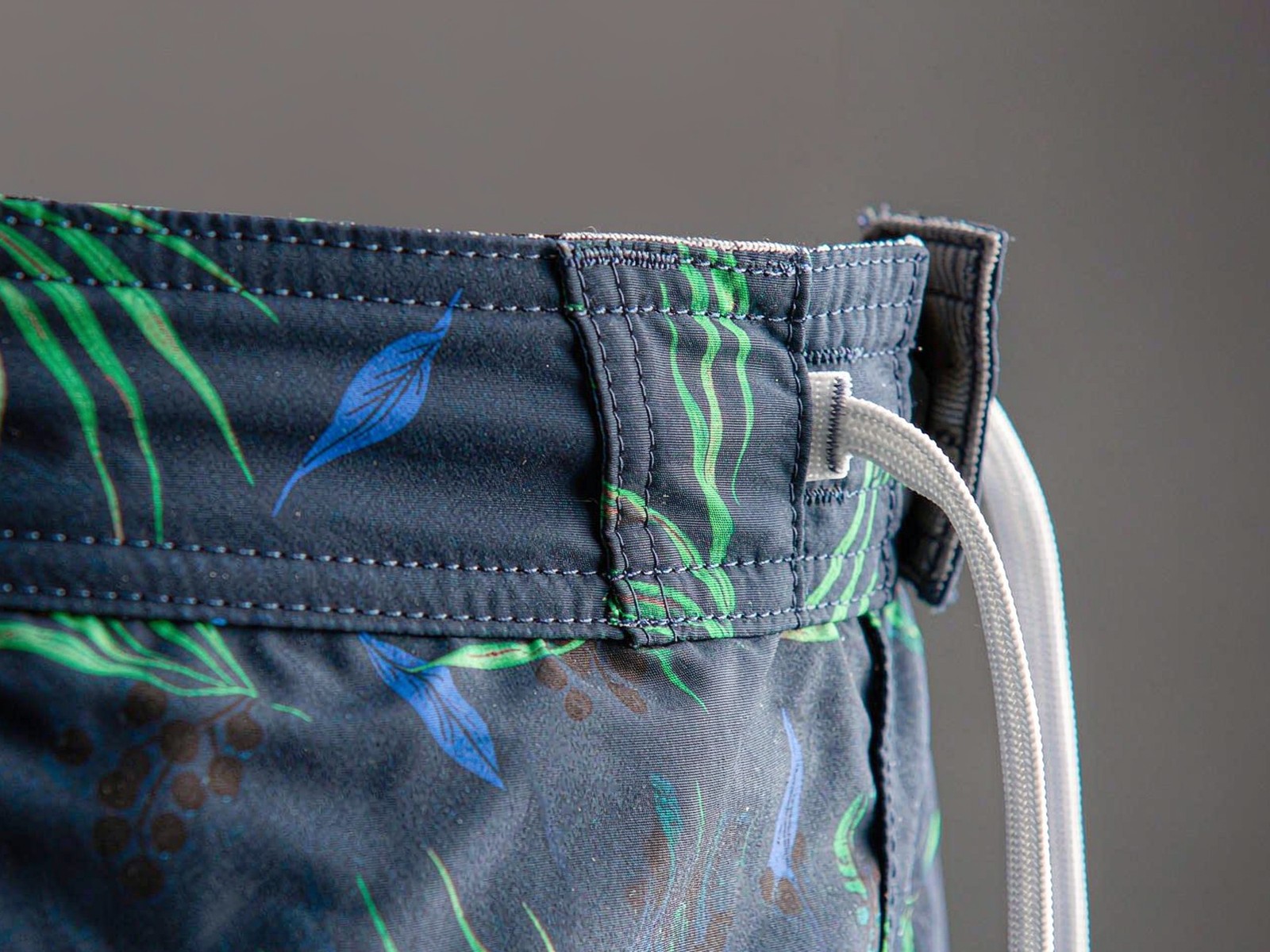
Two physical faults sit behind most recovery failures and both are visible. Needle cutting happens when the waist seam needle clips the elastane filaments, so the tape has strength on the day and none after ten wears; stretch the seam by hand along its length and the cut filaments show as a line of frayed ends. Waistband twist comes from joining a tape to a shell at uneven tension, and it shows as an offset at centre front when the garment is laid flat. Neither fault appears in a measurement check, and neither is caught by a visual pass that only looks at the outside.
Where the shorts are sold as swimwear, add the chlorinated soak before the recovery measurement, because chlorine attacks elastane directly and a band can lose a third of its recovery while the shell still grades well on colour. Laundering before measurement to ISO 6330, on the programme named on the care label, is the other half of the same idea: inspect the garment the customer will own after five washes, not the one on the table.
What fails at the side seam, and how is it measured?
A beach short carries a long seam relative to its weight, and the side seam takes the load when the wearer sits, crouches or pulls the shorts on wet. Two laboratory methods cover it and they answer different questions. ISO 13936-2 measures seam opening under a fixed load, which is the property that produces the visible grin at the hip. ISO 13935-2 measures seam strength with a grab test, which is the property that produces the split. A programme needs both numbers, because a seam can be strong and still open.
Opening is expressed in millimetres at a stated load, and the load and the limit both belong in the buyer’s specification. A 6 mm opening at the agreed load is a widely used ceiling for lightweight woven shorts; it is industry practice, not a clause in a standard. On the line, the equivalent check is a hand tension test at the hip and at the hem split, done on every piece in the sample, because a grin that only appears under load is invisible on a flat table.
Construction detail decides whether those numbers hold. An overlock (ISO 4915 stitch type 504, or 514 for a four-thread version) needs enough seam allowance that the stitch line does not run off the edge; a flatlock (type 607) needs full coverage of the seam with no exposed raw edge; a lockstitch (type 301) needs a stitch density matched to the fabric, with 10 to 12 stitches per inch a common range for polyester wovens. Ask for the stitch type and the density on the tech pack, then check them on the sample with a pick glass rather than by eye.
Which measurements are checked, and with what tolerance?
Eight points decide fit on a beach short, and the tolerances below are the ones we work to when a buyer has not specified its own. Measure flat, without tension, after the garment has relaxed for four hours, and measure the same way every time — most measurement disputes are disagreements about method, not about the garment.
- Waist, relaxed — across the top edge, tolerance plus or minus 1.0 cm.
- Waist, stretched — to the point where the band stops extending, tolerance plus or minus 2.0 cm.
- Hip — at the widest point, normally 20 cm below the waist, tolerance plus or minus 1.0 cm.
- Front rise — from the waist seam to the crotch seam, tolerance plus or minus 0.5 cm.
- Inseam — from the crotch seam to the hem, tolerance plus or minus 0.5 cm.
- Outseam — from the top of the waistband to the hem, tolerance plus or minus 0.5 cm.
- Leg opening — flat across the hem, tolerance plus or minus 0.5 cm.
- Waistband height — finished, tolerance plus or minus 0.2 cm.
Tolerances are a commercial agreement and belong in the tech pack, not in a conversation. The one that causes the most returns is not on that list: the difference between the relaxed and stretched waist, which is what decides whether the shorts stay up. Write both numbers, and write the extension the factory is allowed to use to reach the second one.
Is the best beach shorts supplier in China the one with the lowest defect rate?
No, because a defect rate quoted by the seller is unverifiable, and a supplier with a genuinely low rate will normally show you the plan behind it instead of the number. The useful question is not what the rate is but whether the plan would catch a fault before the container is loaded. Five things separate a programme that inspects from one that reports.
- A written defect list that names the zone, the defect and the class, agreed at PPS stage and attached to the purchase order.
- A disclosed sampling plan: standard, inspection level, sample size, Ac and Re per class — not the phrase “AQL 2.5” on its own.
- A sealed approved sample, signed and dated by both sides, kept at the factory and at the buyer, and referenced by number on the report.
- Tests that outlive the table: wash, chlorine where relevant, crocking, recovery, seam opening — run on the sold colour, not on a base cloth.
- A report that states the decision, with defect counts by class, measurement summary, photographs and the inspector’s name, so a rejection can be argued from evidence rather than from opinion.
What has to be frozen before the first inspection on a custom programme?
Everything that will be judged has to be frozen before anything is judged. A custom beach shorts supplier in China is working from your print artwork, your woven main label, your ISO 3758 care label and your polybag, so each of those has to exist as an approved, dated reference before the first bulk piece is cut: otherwise the inspection is measuring the factory’s interpretation of your brief.
The freeze list is short and it is worth enforcing item by item. Print artwork approved as a strike-off on the production fabric. Pantone or lab dip approved for every solid colour in the range. Elastic tape specified by width, type and extension. Measurement chart signed with tolerances. Packing specification agreed, including fold, hangtag position, polybag size and carton count. Defect list and sampling plan attached to the purchase order. When those six are in place, an inspection has a standard to fail against; without them, every finding becomes a negotiation.
Where do OEM beach shorts inspections usually go wrong?
Five failures account for most of the disputes we see, and none of them is about the inspector’s eyesight. An OEM beach shorts supplier in China can pass a table inspection and still ship a problem when the sequence is wrong, because the fault was created after the check.
- Inspecting before the final press. Print colour and registration are judged on a garment that has not yet been heat-set, so the findings do not describe the goods that ship.
- Sampling a mixed lot. Three colours in one lot band is not one lot for ISO 2859-1 purposes unless the colours are homogeneous; sampling across them hides a single-colour problem.
- Testing the base cloth instead of the sold colour. A chlorine or crocking report on undyed shell says nothing about a deep navy print.
- Measuring folded garments. A waistband measured straight off the folding table reads short, and the lot is rejected for a method error.
- Accepting a report with no decision. Counts without Ac and Re are data, not an inspection result.
What belongs on the report before you release the lot?
A report that can carry a rejection has to be specific enough to survive a second opinion. Ours carries the purchase order, style, colour and size breakdown; the lot size and the code letter; the sample size with Ac and Re for each class; the defect count by zone and class, with photographs of every major; the measurement summary against the signed chart; the reference number of the sealed approved sample; the test reports relied on, with their dates; the inspector, the site and the date; and a single line stating accepted, rejected or rework and re-inspect.
Released on that basis, an inspection stops being an argument about whether the goods are good and becomes a check against a document both sides signed. The commercial frame around it is fixed: 3,000 pcs per style per colour, development sampling in 12–18 days, PPS in 5–7 days, bulk at 45–60 days on a first order and 30–40 days on a repeat, 30% on order confirmation with 70% against a copy of the B/L, FOB Xiamen, quotation valid 30 days, inspection to AQL under ISO 2859-1 on the defect list agreed at PPS. Programmes of this shape sit on the beach shorts OEM page, and the same inspection discipline runs through the men’s underwear OEM programmes that use the same partner factories.
· Xiamen Unitex Trade Co., Ltd. — OEM & ODM underwear sourcing partner