
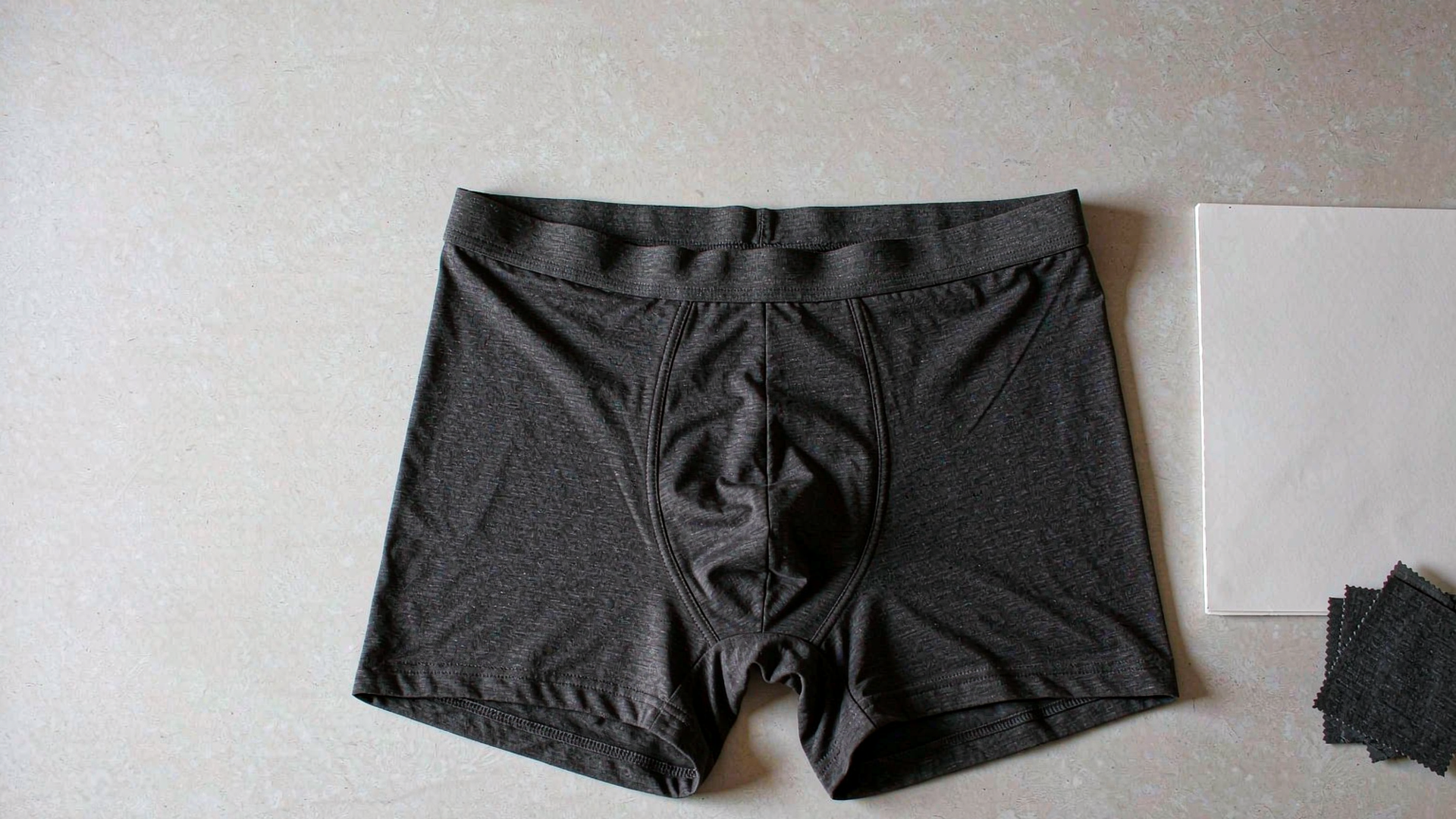
A social audit answers a narrower question than the one buyers put to it. This guide separates what an amfori BSCI audit establishes from what a forced-labour due diligence file has to establish, and sets out the documents a men’s underwear OEM buyer needs before 14 December 2027, when Regulation (EU) 2024/3015 becomes applicable.
Direct answer: No. A men’s underwear supplier that presents an amfori BSCI audit as proof of no forced labour is overclaiming: it is a point-in-time social audit of one production site, not a certification, and it produces an A–E grade from 81 questions across 13 performance areas. It shows a system, not an absence. For custom OEM boxer briefs, treat it as one input, and build the record a reliable supplier can actually support.
What does amfori say the audit is?
amfori is unusually direct about its own instrument. Its programme page answers the question “Is amfori BSCI a certification?” with one word first: “No”. The association then explains that it does not deliver a pass or fail verdict to suppliers. A separate amfori explanation of the auditing procedure goes further and calls a social audit “a snapshot at a given point in time”, adding that amfori BSCI is “not a standard or qualification or certification system” and that audits work only when supplemented with other human rights due diligence tools.
Those are not a competitor’s characterisation. They are the scheme owner’s own description, and they set the ceiling on what the report can be used to prove in a customer file, a tender response or an authority’s information request.
The mechanics are equally specific, and each one limits the claim you can make:
- 81 questions. Each question is rated Yes, No, Partial or Not applicable. The rating is an auditor’s judgement on evidence seen on site, not a laboratory result.
- 13 performance areas. The questions are grouped into social management at the site, worker involvement, freedom of association, non-discrimination, fair remuneration, working hours, health and safety, child labour, young workers, precarious employment, bonded labour, environment and business ethics.
- A grade from A to E. The overall grade summarises the site’s social management system. A high grade is compatible with a single unresolved finding in a low-weighted area, and a low grade does not by itself establish forced labour.
- A two-year cycle. A full audit graded A or B is followed by the next full audit within two years, with no follow-up. A grade of C, D or E requires a follow-up audit between two and twelve months after the full audit.
- Announcement. Since 1 September 2024 amfori no longer accepts fully announced audits. Only fully unannounced and semi-announced audits remain, so a site knows that an auditor may arrive inside a window, not the day.
What does the report contain, and who can read it?
Most disputes about a BSCI report are really disputes about access. amfori states that the full audit report is available on its Sustainability Platform to members and to the audited supplier. A brand that is not an amfori member therefore does not hold a self-service login to somebody else’s report, and a supplier forwarding a screenshot is not the same thing as a brand reading the source document.
| What the audit produces | What it establishes | What it does not establish |
|---|---|---|
| Full audit report: 81 questions answered Yes, No, Partial or Not applicable | Whether named management practices were in place on the audit date, with auditor observations | Whether a worker recruited through a fee-charging agency last month is in debt bondage today |
| Overall grade A to E | A comparable summary that a sourcing team can screen on | Which specific performance area drives the grade, unless the report itself is read |
| Follow-up audit report | Whether findings named in the previous report were closed | A second full test: amfori states the follow-up does not repeat all 81 questions |
| Platform access through amfori membership | The route by which a member brand reads the source report | A public register that anyone can query, in the way a certificate database works |
The practical consequence is plain: ask your supplier which access route applies to you before you build a compliance file around a report you have never opened.
Where does forced labour sit inside the 13 performance areas?
One area names it directly: performance area 11, no bonded, forced labour or human trafficking. But in cut-and-sew production the risk normally enters through the neighbours, which is why a clean reading of one area is a weak basis for a conclusion.
| Performance area | Why it matters for forced labour | What to ask the producing site for |
|---|---|---|
| PA 11 No bonded, forced labour or human trafficking | Debt bondage, retention of identity documents and deposits are the classic entry points | Written policy, plus the number of worker files checked and the result of that check |
| PA 5 Fair remuneration | A recruitment fee paid by the worker converts into debt the moment wages start | A written employer-pays position on recruitment fees, with the agency invoice trail behind it |
| PA 6 Decent working hours | Forced overtime is one of the ILO indicators, and peak season is when it appears | Attendance records against payroll for the three busiest weeks of the last cycle |
| PA 10 No precarious employment | Agency labour with no direct contract hides the employment relationship | A list of labour agencies used, and the share of agency workers on each line |
| PA 1 Social management system | The cascade effect is what carries the code of conduct to fabric, yarn and trim | A tier-2 list with site names for fabric, dyeing and elastic |
| PA 2 Worker involvement | A grievance channel is the only mechanism that surfaces what records conceal | A summary of grievances raised and closed, and how anonymity is preserved |
What are the 11 ILO indicators, and how should a buyer use them?
The ILO published its indicators of forced labour in 2012 for front-line inspectors, labour inspectors, trade union officers and NGO workers. They are derived from the definition in the Forced Labour Convention, 1930 (No. 29): all work or service exacted under the menace of a penalty and for which the person has not offered himself voluntarily. They are signs, not a scoring sheet, and that is exactly why they work as an interview script for a sourcing visit.
| ILO indicator | How it can appear in an underwear plant | What to ask for |
|---|---|---|
| Abuse of vulnerability | Migrant workers recruited through an intermediary, contract not in their own language | Contract in the worker’s language, and the identity of whoever recruited them |
| Deception | Promised wage or hours differ from the contract and the payslip | Signed contract next to the first payslip for a sample of new starters |
| Restriction of movement | Dormitory rules that limit when workers may leave | Dormitory rules and an exit log, not a verbal assurance |
| Isolation | Transport and accommodation controlled by the same intermediary | Who arranges transport, and who holds the workers’ documents |
| Physical and sexual violence | Discipline applied by supervisors outside any procedure | Disciplinary log and the grievance cases that reference a supervisor |
| Intimidation and threats | Refusal of overtime met with a threat of dismissal or lost bonus | How refusals are recorded, and any penalty clause in the wage structure |
| Retention of identity documents | Passports kept in an office safe “for safekeeping” | A document custody policy, and a spot count of documents held on site |
| Withholding of wages | A deposit, a held first month, or a fine deducted at settlement | Pay cycle dates, and whether any deposit exists in any form |
| Debt bondage | A recruitment loan repaid out of wages, or an advance that cannot be cleared | Loan register and receipts for any fee charged before arrival |
| Abusive working and living conditions | Overcrowded dormitory, no drinking water at the line | Dormitory capacity against headcount, and utilities actually provided |
| Excessive overtime | Twelve-hour days through the peak, presented as voluntary | Attendance for the peak weeks compared with the legal limit in the producing country |
Used this way, the list does something an audit grade cannot do: it produces answers that can be checked against documents, and it separates a management-system weakness from a forced-labour indicator. A site that fails to keep an attendance record is badly managed. A site that keeps passports because it is easier to renew them is a different category of problem.
What changes on 14 December 2027 under Regulation (EU) 2024/3015?
The regulation was adopted on 27 November 2024 and published in the Official Journal on 12 December 2024. It becomes applicable on 14 December 2027, and the European Commission’s own portal states the effect in one line: from that date no product made with forced labour may be sold in or exported from the EU market. The Commission opened the Single Portal and published its preparedness package on 30 June 2026, and published the Article 11 guidelines in the Official Journal on 3 September 2026 (OJ C/2026/4637).
| Question | Position under the regulation | Provision |
|---|---|---|
| What is prohibited? | Placing on the market, making available on the market, and exporting products made with forced labour | Article 3 |
| Do online offers count? | Yes. Distance sales are covered, which brings a brand’s own web shop and marketplace listings into scope | Article 4 |
| Does it create a new due diligence duty? | No. The regulation does not create additional due diligence obligations beyond those already in Union or national law | Article 1(3) |
| What happens before a formal investigation? | The lead authority requests information from the operator on the actions it has taken, including under Union or national due diligence law, Commission guidelines, UN, ILO or OECD guidance, or other meaningful due diligence | Article 17(1) |
| Can due diligence stop an investigation? | No investigation should be initiated where there is no substantiated concern, or where the reasons for it have been eliminated, for instance because due diligence was applied | Recital 45 |
| Who has to prove the violation? | The lead authority, on the information gathered. Refusal without valid justification, or incomplete or incorrect information given to block the investigation, allows a decision on other verifiable information | Recital 47 |
| Is there a risk list? | An indicative, non-exhaustive, evidence-based database of risk areas and products, based on ILO and UN information, required to be public by 14 June 2026 under Article 8(3), and it does not name operators (Article 8(2)) | Article 8 |
| What are the penalties? | Set by each Member State and required to be effective, proportionate and dissuasive, with Commission guidance on how financial penalties are calculated and the thresholds that apply | Recital 66 and Article 11(i) |
Read the table as a division of labour rather than a threat. The authority investigates and proves. The operator answers an information request and must comply with a decision. An audit report belongs in that answer, but it is the item most often over-claimed: it shows a system, not an absence, and the regulation was written by people who knew the difference.
The Commission’s risk page is worth reading before you build anything, but read it as a description of a tool rather than a clearance list. It sets out what the Article 8 database is for: information on products and geographical areas where forced labour risks are documented in credible sources, drawn from international organisations and research bodies, indicative rather than exhaustive. When a region and a sector appear there, an information request becomes more specific, and a generic audit grade will not answer it.
Does the United States already ask the same question in a different way?
Yes, and through a duty rather than an investigation. A USTR notice published on 28 July 2026 (91 FR 47318) imposed a Section 301 duty of 12.5 per cent on products of China under heading 9903.05.31 for goods entered on or after 24 July 2026, following 60 investigations into economies found not to have imposed and enforced a forced-labour import ban. That duty stacks on the existing List 4A duty of 7.5 per cent under heading 9903.88.15, set out in U.S. note 20 to chapter 99 of the HTSUS. The mechanism does not ask whether your supplier holds a social audit; it prices the risk at the origin.
The two regimes therefore produce two different documents. Europe asks for evidence of what you did. The United States charges a rate and lets the importer absorb it. The de minimis route that once let small direct-to-consumer parcels skip the calculation was suspended for all countries from 29 August 2025, so a brand cannot plan around it. Our separate note on US tariffs on underwear imports sets out how the layers stack and which one is under review.
Briefs or boxer briefs: does the style change the evidence?
The audit does not change, because a BSCI audit attaches to a site, not to a style. What changes is the number of operations per garment, and therefore the number of hand-offs where a labour problem can sit unobserved.
This is common practice among suppliers, not a published requirement: a classic men’s briefs pattern usually has fewer panels but a separate gusset piece, which means a sub-assembly that can be set by a different operator, a different team or a different unit. A pair of boxer briefs adds leg panels and a hem, and with them flatlock or coverstitch operators and a second set of line targets. More operations per unit means more piece-rate exposure, more supervision layers, and more places where an overtime instruction is given verbally.
Note: the panel and operation differences described here reflect what we see across supplier quotations; they are not published by amfori or by any standards body, so verify them against your own operation list before you commit them to a specification.
So the question to put to a producing site is not “which style do you audit” but “show me the operation list for this style and the line or shift each operation runs on”. For briefs, ask who sets the gusset. For boxer briefs, ask who runs the leg hem and what the target per hour is on that operation. Whether the search says mens briefs or mens boxer briefs, the evidence set that answers it is identical.
What belongs in a 2027 evidence file for a boxer briefs order?
Eight items, each doing a different job. A file with only the first two is an audit file, not a due diligence file.
- The audit report and its date. Establishes which site was assessed and when. A report dated four years ago answers a different question from one dated last quarter.
- The grade, with the performance areas behind it. Establishes where the site is strong and weak. A grade without the area breakdown cannot be explained to a customer.
- A tier-2 list with site names. Establishes that fabric, dyeing and elastic are known rather than assumed. Forced labour is found at the tier the brand has never visited.
- A recruitment-fee position in writing. Establishes who pays the agency. If the worker pays, the employment relationship starts with a debt.
- Attendance and payroll for three peak weeks. Establishes whether overtime was voluntary. Two documents that contradict each other are more informative than either alone.
- The list of labour agencies, with the share of agency workers per line. Establishes whether the operator knows its own workforce.
- A grievance summary with case closure. Establishes whether workers have a route that is used, rather than a box on the wall.
- Certificate scope for the article. An OEKO-TEX STANDARD 100 certificate lists the article range it covers, so check that boxer briefs in your fibre and colour are inside the scope rather than assuming the certificate covers everything the site makes.
Items 1, 2 and 8 can come through a trading partner. Items 3 to 7 have to come from the site that employs the workers, and a UK compliance file that mixes them without attribution will not survive a second request.
How do we handle this as a sourcing and trading company?
Xiamen Unitex Trade Co., Ltd. is a sourcing and trading company based in Xiamen, Fujian. The garments are produced by partner factories in the Xiamen–Quanzhou–Jinjiang cluster, which are audited under amfori BSCI and certified to OEKO-TEX STANDARD 100. We coordinate development, sampling and quality control. The partner factories hold the audit relationship; we hold the commercial and quality relationship.
That distinction is not modesty, it is the point of this article. A trading partner can tell you which site ran your order, what its audit date and grade are, how a member brand can reach the report, what the certificate scope covers, and how a claim was handled. It cannot convert a site audit into a guarantee, and neither can the site. What a reliable supplier does is keep the file complete enough that the answer to an information request is a set of documents rather than an assurance.
For buyers building a custom OEM programme, the practical test is simple: ask for items three, four and five of the list above before the first purchase order, not after the first problem. A supplier who can produce them in a week has a file. A supplier who promises to “check with the factory” is starting the work then.
Where the chemical side of the same file is concerned, our guide to REACH, GB 18401 and CPSIA limits on underwear covers the test reports and the limits they are measured against. Social evidence and chemical evidence sit in the same folder, and a buyer usually needs both before a first bulk order is released.
What should be written into the purchase order?
- Audit evidence clause. Name the scheme (amfori BSCI) and the site, require the audit date and grade to be disclosed before shipment, and set a follow-up-audit trigger at grade C or below, matching the amfori cycle.
- Tier-2 disclosure clause. Require the fabric, dyeing and elastic sites to be named, and require notification before any change of subcontractor.
- Recruitment-fee clause. State that fees are paid by the employer, and require reimbursement of any fee found to have been charged to a worker.
- Overtime clause. Require overtime to be voluntary, recorded, and within the legal limit of the producing country, with attendance and payroll open to inspection.
- Grievance access clause. Allow an independent channel, so that a complaint does not have to pass through the supervisor it concerns.
- Information-request clause. Require the document set within 30 working days of an information request under Article 17(1), the reply period set by Article 17(2), because that clock is not yours to negotiate.
None of these clauses makes a supplier compliant. They make non-compliance visible, which is the only thing a purchase order can do.
References
- Regulation (EU) 2024/3015 of 27 November 2024 on prohibiting products made with forced labour on the Union market, OJ L 2024/3015, 12.12.2024 — Articles 1(3), 3, 4, 8, 11(i), 17(1) and 17(2); recitals 45, 47 and 66.
- European Commission — Forced Labour Single Portal — application from 14 December 2027; preparedness package and portal launched 30 June 2026.
- Commission Notice — Guidelines on the application of Regulation (EU) 2024/3015, OJ C/2026/4637, 3.9.2026 — published under Article 11; confirms application from 14 December 2027.
- amfori — amfori BSCI programme page and FAQ — 81 questions, grade A to E, two-year audit cycle, “amfori BSCI is not a certification”.
- amfori — Understanding the amfori social auditing procedure — audit as “a snapshot at a given point in time”; announcement types in force since 1 September 2024.
- amfori — amfori BSCI help topics, including the 13 performance areas — the list of performance areas that contains PA 11, no bonded, forced labour or human trafficking, and the follow-up audit definition.
- European Commission — Which products and areas are at risk of forced labour? — what the Article 8 database covers and how it is meant to be used.
- ILO — ILO indicators of forced labour (2012) — the eleven indicators and the Convention No. 29 definition they derive from.
- USTR — Notice of actions in the forced-labour Section 301 investigations, 91 FR 47318 (28 July 2026).
- CBP — Implementation of Executive Order 14324, suspension of duty-free de minimis treatment, effective 29 August 2025.
- OEKO-TEX® STANDARD 100 — harmful-substance testing and certification for textile articles.
- USITC — Harmonized Tariff Schedule of the United States, chapter 99, U.S. note 20 (heading 9903.88.15) — the List 4A duty of 7.5 per cent that stacks with heading 9903.05.31.
· Xiamen Unitex Trade Co., Ltd. — OEM & ODM underwear sourcing partner