
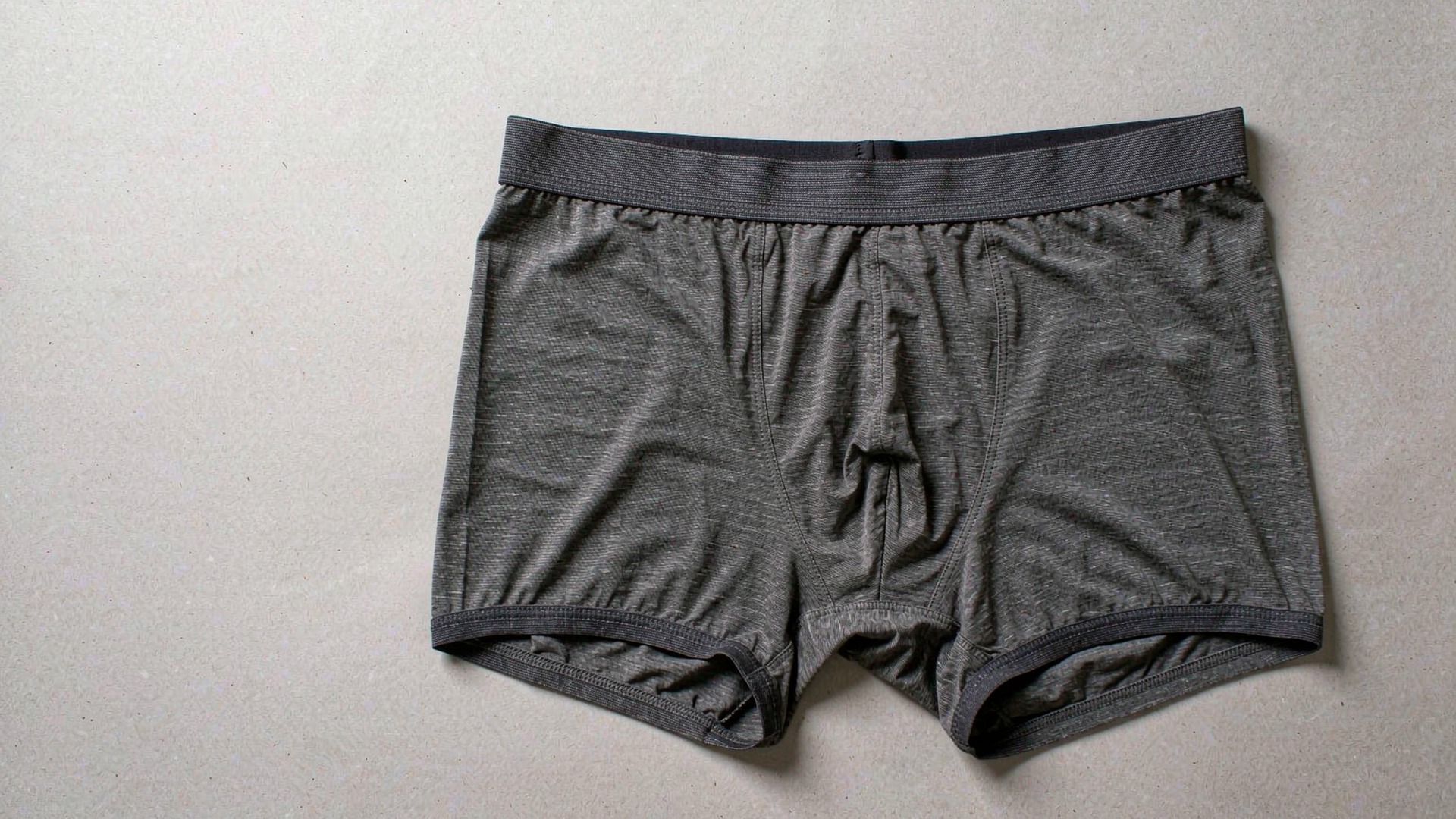
Since 8 July 2026 a US importer has to file CPSC certificate data electronically at the moment of entry, not keep a PDF on file. That change reaches men’s underwear only through one narrow gate: whether the garment is subject to a CPSC rule that requires a certificate. For adult cotton boxer briefs the answer usually turns on a single line of the flammability standard, and on a fabric weight most buyers never ask for. This guide walks the decision in the order a sourcing team actually meets it, and lists the documents a men’s underwear supplier has to produce before the first entry.
Direct answer: Not automatically. From 8 July 2026 CPSC certificate data must be filed electronically at entry, but the adult men’s boxer briefs we handle in cotton or cotton-blend jersey usually do not reach that step: 16 CFR 1610.1(d) exempts plain-surface fabric of 2.6 oz/yd² (about 88 g/m²) or more from testing, and CPSC’s 2016 policy means no GCC is enforced for that apparel. A reliable supplier documents the fabric; the importer files.
What actually changed on 8 July 2026?
The rule is the CPSC final rule on Certificates of Compliance, published at 90 FR 1843 on 8 January 2025. It did not invent a new obligation; it moved an existing one forward in time. Until then an importer could hold a general certificate of conformity (GCC) in a folder and produce it if CPSC asked. The final rule turns that into a data transmission at the border.
The dates in the rule are explicit:
- 8 July 2026 — effective date for all CPSC-regulated consumer products subject to the rule and required to be certified, imported or domestically made. This is the 18-month date fixed in section III.A of the preamble.
- 8 January 2027 — effective date for goods admitted to a foreign trade zone and later entered for consumption or warehousing. The rule gives this category 24 months.
- Either way, no value threshold — CPSC’s eFiling FAQ states that any product requiring certification must have an eFiled certificate “regardless of the value of the imported shipment”, and that there is no Section 321 (de minimis) exemption from eFiling. A 40-piece air shipment of samples is not outside the rule because it is small.
Two mechanics matter for a sourcing desk. First, the certificate data travels through CBP’s Automated Commercial Environment in one of two shapes: a Full PGA Message Set, where the importer transmits every data element at entry, or a Reference PGA Message Set, where the importer loads the elements into CPSC’s Product Registry before filing and sends only a unique reference identifier at entry. Second, and more important for who does the work: under 16 CFR 1110.7, for a product made outside the United States only the importer certifies. That is a different document set from the one covered in our underwear export documents checklist, which is about what leaves the factory, not what enters the customs territory. The production site does not certify. A brand that buys FOB and resells to a US distributor is not the certifier unless it is also the importer of record. That is why the same boxer brief order can need nothing at all in one channel and a filed message set in another.
Which men’s underwear orders need a certificate, and which do not?
Three conditions have to hold at once. The rule’s definition of a finished product in 16 CFR 1110.3 requires that the item is imported for consumption or warehousing or distributed in commerce, that it is subject to a consumer product safety rule or a similar rule, ban, standard or regulation enforced by CPSC, and that it is packaged, sold or held for sale to or for use by consumers. A pallet of boxer briefs in polybags for a retail launch meets all three only if the second condition is met.
For apparel, the second condition is created by 16 CFR part 1610, the standard for the flammability of clothing textiles. Its scope in 1610.1(b) covers “clothing and textiles intended to be used for clothing”, and underwear is clothing worn on the body. None of the four exceptions in 1610.1(c) applies: they are limited to hats that do not cover the neck, face or shoulders, gloves of 14 inches or less that are not part of another garment, footwear without hosiery, and interlining fabrics sold as a layer.
So the standard applies. The question then becomes whether the garment is exempt from testing, which is a different thing from being outside the standard. 1610.1(d) exempts two families of fabric: plain surface fabrics regardless of fibre content weighing 2.6 ounces per square yard or more, and all fabrics, plain or raised-fibre, regardless of weight, made entirely from acrylic, modacrylic, nylon, olefin, polyester or wool, or entirely from a combination of those fibres. The exemption removes the test, not the standard. That distinction is what produced the next paragraph of policy history, and it is the paragraph most buyers have never read.
In 2016 CPSC published a statement of enforcement policy at 81 FR 12587, effective 25 March 2016. It records that garments made from 1610.1(d) fabrics are “exempt from testing but not excepted from the standard as a whole”, that they are therefore still “subject to” a rule, and that manufacturers and importers of those garments had been required to issue a GCC. The Commission then exercised discretion: it will not pursue compliance or enforcement action for failure to certify adult wearing apparel that is exempt from testing under 1610.1(d). The policy is narrow and explicit about its limits. It covers certificate violations only, the garments must still meet every flammability requirement of the Flammable Fabrics Act, it does not extend to adult apparel that falls outside the 1610.1(d) exemptions, and CPSC reserved the right to withdraw it on 90 days’ notice.
That policy is what makes the eFiling question answerable. The final rule’s own text on disclaimers lists the cases where a Disclaimer PGA Message Set is not required, and the fourth is a product that “is subject to an enforcement discretion and no certificate is required”. The rule therefore contemplates exactly this situation: apparel that stays inside the standard, sits inside an enforcement discretion, and needs neither a certificate nor a disclaimer. As of this writing CPSC has not withdrawn the 2016 policy.
| Order | Certificate required? | What happens at entry |
|---|---|---|
| Adult men’s boxer briefs, cotton/spandex single jersey, plain surface, 180 g/m² | No — 1610.1(d)(1) exempts the fabric from testing, and the 2016 policy means CPSC will not enforce the GCC requirement for adult apparel; the obligation itself is not repealed | No certificate. Confirm the disclaimer treatment with the broker at the first entry |
| Adult boxer briefs, 100% polyester mesh body and polyester trims, any weight, raised back | No, provided every textile component is polyester — 1610.1(d)(2) covers fabric made entirely from the listed fibres at any weight and on any surface, and one non-polyester trim breaks it | No certificate. Confirm the disclaimer treatment with the broker at the first entry |
| Adult boxer briefs with a brushed cotton inner waistband or a fleece-lined pouch | Likely yes — the garment is no longer made “entirely from” exempt fabrics | GCC required and eFiled, or a documented test report first |
| Adult briefs, lightweight cotton/modal jersey at 85 g/m², plain surface | Yes — 85 g/m² is 2.51 oz/yd², below the 2.6 threshold, and the fibre is not on the (d)(2) list | GCC required and eFiled after testing |
| Boys’ briefs, any fabric, any weight | Yes — a children’s product needs a CPC under 15 U.S.C. 2063(a)(2), based on testing at a CPSC-accepted laboratory | CPC data eFiled; no enforcement discretion applies |
How do you check a boxer brief against the 1610.1(d) exemption?
Do it fabric by fabric, not order by order, and do it in grams per square metre, because that is the unit the mill quotes. One ounce per square yard is 33.9057 grams per square metre, so the 2.6 oz/yd² threshold is 88.2 g/m². The jersey we buy for mens boxer briefs typically runs 150 to 200 g/m², which is 4.4 to 5.9 oz/yd², while lightweight performance meshes and jerseys fall below the line. Based on our own order records, not a published statistic. That is why the exemption is the normal case for jersey rather than the exception — but three traps catch buyers who check only the headline number.
Note: the figure above is not published by a regulator. It reflects what we see across supplier quotations and should be verified against your own test reports before you commit it to a specification.
The first trap is the surface. 1610.1(d)(1) says “plain surface”. A brushed, peached, sanded or fleece-back knit is a raised-fibre surface, so route one is closed regardless of weight. A 240 g/m² brushed cotton interlock is heavy and still not covered by (d)(1). If it is 100% cotton it is also not covered by (d)(2), because cotton is not on that list. That garment needs a test.
The second trap is the word “entirely”. The exemption in 1610.1(d) is written for “products made entirely from one or more of these fabrics”. A boxer brief assembled from an exempt shell and a non-exempt brushed gusset or brushed inner waistband is, on the text, not a product made entirely from exempt fabrics. The 2016 policy is just as strict: it applies only to apparel that fits the specific testing exemptions, and it says so twice. On a mixed-fabric garment the written record has to name every textile component, because the exemption is judged on the garment, not on the shell.
The third trap is the waistband and trims. Elastane waistband elastic, heat-transfer labels and sewing thread are components rather than apparel fabrics, and 16 CFR 1110.19 deals with component-part certificates separately, as voluntary instruments. That provision governs certificates, not the reach of the 1610.1(d) exemption. Until CPSC says otherwise, treat any non-exempt textile component as breaking the “entirely from” condition and document it: ask the mill to state, in writing, the weight, the surface finish and the fibre content of every textile component in the garment.
| Fabric as specified | oz/yd² | Route | Result |
|---|---|---|---|
| Cotton/spandex single jersey, 180 g/m², plain surface | 5.31 | (d)(1) | Exempt from testing |
| Cotton/modal jersey, 140 g/m², plain surface | 4.13 | (d)(1) | Exempt from testing |
| Cotton jersey, 85 g/m², plain surface | 2.51 | Neither | Below threshold; test required |
| Polyester mesh, 100% polyester, 110 g/m², raised back | 3.24 | (d)(2) | Exempt regardless of weight and surface |
| Polyester/elastane mesh, 110 g/m², raised back | 3.24 | Neither | Elastane is not on the (d)(2) fibre list, so the fabric is not made entirely from listed fibres; test required |
| Brushed cotton interlock, 240 g/m² | 7.08 | Neither | Raised surface and cotton; test required |
| Cotton/nylon 90/10 jersey, 120 g/m², plain surface | 3.54 | (d)(1) | Exempt; a blend does not defeat (d)(1) |
| Cotton/elastane 92/8, 75 g/m², plain surface | 2.21 | Neither | Light and not all-synthetic; test required |
When a test is needed, 16 CFR 1610 classifies the result rather than passing or failing it. A plain-surface fabric that burns for 3.5 seconds or more in the specified test is Class 1. A raised-fibre fabric reaches Class 1 only when it burns for more than 7.0 seconds, or when a rapid surface flash does not ignite or fuse the base fabric; when the base fabric does burn and the burn time falls between 4.0 and 7.0 seconds inclusive, the fabric is Class 2. Class 3 is the class that cannot be used in clothing at all. For adult general-use apparel the test does not have to be run by a CPSC-accepted third-party laboratory — that requirement attaches to children’s products — but the report still has to exist if the exemption does not apply, because the certificate has to cite a test date and place.
What has to be in the certificate, and who owns each element?
The content requirements sit in 16 CFR 1110.11(a), the electronic filing duty in 1110.13, and the statutory floor in 15 U.S.C. 2063(g)(1). In practice each item is held by a different party, which is why a certificate assembled in the last week before sailing is usually wrong somewhere.
| Certificate content item | Who actually holds it | What a Chinese supplier can supply |
|---|---|---|
| Identification of the product covered | Importer, from the style and SKU structure | Style code, colour codes, size range, and a stable SKU convention |
| Citation to each applicable rule, listed separately | Importer or its compliance adviser | The test report’s citation to 16 CFR 1610, if a test was run |
| Identity of the certifying importer, with full street address, email and telephone, 1110.11(a)(3) | Importer only | Nothing. The production site cannot certify an import |
| Contact details of the individual keeping test records, 1110.11(a)(4) | Importer | A named contact at the production site, if the importer delegates recordkeeping |
| Date and place of manufacture, month and year at minimum, with the producing party’s name and contact details | Production site | The producing party’s name, street address, city, province, country, email and telephone for the actual site |
| Date and place of testing, with the testing party’s contact details | Testing laboratory | Report number, test date, laboratory name, street address, city, country, email address and telephone number |
| Identity of any third-party laboratory on whose testing the certificate depends, 15 U.S.C. 2063(g)(1) | Laboratory | Only where a third-party test was actually used; not applicable to adult apparel tested in house |
| Attestation of compliance, 1110.11(a)(7) | Importer | No separate document: the attestation is captured in the Product Registry or as a message-set data element |
Two practical notes. The certificate must be in English under 16 CFR 1110.9, which means the French or German test report a European mill sends is not itself the certificate. And the attestation is satisfied differently in the two filing shapes: a Reference Message Set carries it through the Product Registry account, while a Full Message Set carries it as a data element. A supplier who offers to “send the certificate” is usually offering the manufacture date, the place of manufacture and the test report, and calling that the whole file.
What does a briefs order need that a boxer briefs order does not?
Structurally, nothing: the rule is about the fabric, not the silhouette. The difference is in where the lighter weights sit. A classic men’s brief uses less cloth and, in the briefs we handle, is usually developed in 120 to 150 g/m² jersey, which converts to 3.5 to 4.4 oz/yd² and clears the threshold comfortably. Based on our own order records, not a published statistic. The risk appears when a brief is developed in a performance mesh or a light cotton/viscose blend below 88 g/m², or when the gusset is a different, brushed fabric. A boxer brief has more surface to work with and is heavier in practice, so the exemption question is asked less often — which is exactly why it gets asked late, on the style that needs it. If you are specifying a custom OEM boxer brief programme, the weight and surface belong in the boxer briefs specification from the first tech pack, not in a compliance email six months later.
Briefs also concentrate the second trap. The gusset is a separate fabric and is often the only brushed or the only light fabric in the garment. If the shell is exempt and the gusset is not, the garment is not made entirely from exempt fabrics. Ask for the gusset specification separately, with weight and surface finish, and keep it in the same file as the shell. On a 3,600-piece children’s order the same question is answered differently, because a children’s product needs a CPC and a CPSC-accepted laboratory regardless of fabric.
What should the supplier hand over, and by when?
The sequence below is the one we run on men’s adult underwear orders, starting from the fabric approval stage rather than from the shipping document stage. Based on our own order records, not a published statistic. It is a schedule, not a regulatory deadline: the regulatory deadline is the entry filing itself, which falls on the importer. It also assumes the supplier has already cleared the checks in how to choose a reliable underwear supplier, because a party that cannot name its fabric weights cannot support a certificate.
- At fabric approval — a technical sheet per fabric, stating composition, weight in g/m², knit structure and surface finish (plain, brushed, peached, fleece back). Without the surface finish the exemption cannot be judged.
- At fabric approval, second item — a named list of every textile component in the garment: shell, gusset, waistband textile, any raised trim. Each one carries its own weight and surface.
- At PP sample approval — a signed exemption statement if every fabric qualifies under 1610.1(d), naming the subparagraph relied on. This is the document that lets an importer answer a broker’s question in one email.
- If any fabric does not qualify — a 16 CFR 1610 test report from an ISO/IEC 17025 laboratory, with the class result, before bulk fabric is cut.
- Before ETD — the data pack for the manufacture and test elements: the producing party’s name, street address, city, province, country, email address and telephone number, the month and year of production, the test date and place, and the laboratory’s name, street address, city, country, email address and telephone number where a third-party test was used.
- At ETD — the commercial invoice carrying the same style codes used in the product-identification element, so the entry data and the shipping documents do not drift apart.
The sequence has no regulatory force of its own. The only regulatory deadline is the entry filing, and that deadline belongs to the importer.
What happens if the entry is filed without the data?
The exposure is not a single fine at the dock; it is a chain. A missing or incomplete message set degrades the entry’s risk score, which raises the probability of examination and hold, and a held container of 2,000 boxer briefs costs demurrage and a missed delivery window long before any penalty is assessed. On the penalty side, knowing violations of the certification requirement fall under section 20 of the Consumer Product Safety Act, 15 U.S.C. 2069, where the statutory maximum is 100,000 US dollars per violation, adjusted annually for inflation, with a separate cap for a related series of violations.
Two things not to assume. Do not assume the de minimis route insulates a shipment: CPSC’s FAQ is explicit that any product requiring certification needs an eFiled certificate regardless of shipment value, and that Section 321 shipments have no exemption from eFiling. And do not assume a supplier’s social or chemical certification substitutes for any of this. An amfori BSCI audit and an OEKO-TEX STANDARD 100 certificate held by our partner factories answer questions about labour and about restricted substances; neither is a CPSC certificate, and neither cites 16 CFR 1610. The chemical side of that file is set out in the REACH, GB 18401 and CPSIA comparison, and the two files are read by different agencies.
What should you check before the next purchase order?
- Ask for the fabric weight in g/m² and convert it yourself: multiply by 0.0295 to get oz/yd², and compare against 2.6.
- Ask for the surface finish in writing. “Plain” and “brushed” are different regulatory categories, not marketing words.
- List every textile component, including the gusset and any raised waistband lining, and test the garment against the “entirely from” wording.
- If any fabric fails both routes, book the 16 CFR 1610 test before bulk cutting, not after.
- Confirm who is the importer of record on the actual shipment, because that party is the only certifier for goods made outside the United States.
- Check whether the HTS line is flagged for CPSC in ACE, and ask the broker which message set shape it will file.
- Keep the exemption statement and the test report in the same file as the entry, so a later information request can be answered from one folder.
References
- 16 CFR Part 1110, Certificates of Compliance — source note 90 FR 1843 (8 January 2025); §1110.3 definition of finished product; §1110.7 who certifies imports; §1110.9 English-language requirement; §1110.11(a)(1)–(7) certificate content.
- CPSC, Certificates of Compliance, final rule, 90 FR 1843 (8 January 2025), FR Doc. 2024-30826 — DATES paragraph (8 July 2026 and 8 January 2027); section III.A effective date rationale (18 and 24 months); section III.F Disclaimer PGA Message Set carve-out for products subject to an enforcement discretion.
- CPSC, eFiling Frequently Asked Questions — no Section 321 exemption from eFiling; certificate required regardless of shipment value.
- CPSC, Statement of Policy on Enforcement Discretion Regarding General Conformity Certificates for Adult Wearing Apparel Exempt From Testing, 81 FR 12587 (10 March 2016), effective 25 March 2016 — text of the discretion, its limits, and the 90-day withdrawal clause.
- 16 CFR Part 1610, Standard for the Flammability of Clothing Textiles — §1610.1(b) scope; §1610.1(c) specific exceptions; §1610.1(d)(1) and (d)(2) testing exemptions.
- 15 U.S.C. 2063, Consumer Product Safety Act section 14 — (a)(1) general certificate of conformity; (a)(2) children’s product certificate; (g) electronic filing of certificate data.
- 15 U.S.C. 2069, Civil penalties — section 20 of the CPSA; per-violation maximum and the cap for a related series of violations.
- CPSC, eFiling programme page — Product Registry, Full and Reference PGA Message Set routes, importer and broker guidance.
- OEKO-TEX, STANDARD 100 — scope of the restricted-substance certification held by our partner factories, which is not a CPSC certificate.
· Xiamen Unitex Trade Co., Ltd. — OEM & ODM underwear sourcing partner