
A beach short is the least forgiving surface in a print programme. The same artwork that looks correct on a cotton jersey leaves the factory as four different products depending on how it is applied: a sublimated all-over that has no surface at all, a pigment print with a film you can feel, a rotary screen with a fixed repeat that decides where the design can and cannot land, and a digital print whose colour is only as stable as the fabric it was calibrated on. Then the garment goes into chlorinated water, salt water, sun and sand, and the differences that were invisible in a strike-off become the reason a reorder does not happen.
This page is the production side of printing on beach shorts, board shorts and swim shorts: which process belongs on which fibre, what each one does to the hand and the stretch, how a repeat and a registration tolerance are written down, and the fastness tests that belong on the purchase order before bulk. The fibre decision itself sits in the quick-dry fabric guide, the category split in beach shorts versus board shorts versus swim trunks, logo-specific placement in the custom logo guide, print defects in the inspection checklist, and the restricted-substance frame in the compliance guide. The category starting point is the beach shorts OEM page.
Xiamen Unitex Trade Co., Ltd. has traded since 2009 and was incorporated in Xiamen in 2013; we work as a sourcing and trading company, and the purchase order is issued in our name. The shells are woven and printed by partner factories — manufacturers audited under amfori BSCI and certified to OEKO-TEX® STANDARD 100 — and the same partners cut and sew the garment. The split matters on a printed style because printing is the stage most often subcontracted twice: the garment maker sends the roll to a print house, the print house sends it to a sublimation calender, and the colour standard ends up living in an email. One party answerable for the print is what makes the tests in this page mean anything.
Why does a print behave differently on a beach short than on a cotton tee?
Two things change at once: the fibre and the exposure. A cotton tee is printed on cellulose, which takes reactive dye into the fibre through a chemical bond, and it is washed in a machine at home. A beach short is usually polyester taslan, polyester peach, or nylon with elastane, and in use it meets pool water at a few milligrams per litre of free chlorine, ultraviolet light at the intensity of an Australian summer, salt, and abrasion against sand while wet. The chlorine test is run at the standard’s 50 or 100 mg/l condition rather than at the concentration a pool actually holds, because the test compresses a season of swimming into one laboratory cycle. Each of those exposures attacks a different part of a printed surface.
Fibre decides which dye family is even available. Cellulose — cotton, viscose, lyocell — takes reactive dye, which needs an alkali and steam to fix. Polyamide, which is what nylon is, takes acid dye. Polyester takes disperse dye, and only disperse dye, because the polymer is hydrophobic and has no reactive sites; the dye has to be forced inside the fibre as a gas or in a pressurised bath. Wool and silk take acid dye too. Anything else goes on as pigment held by a binder film, which is the only family that works on every fibre and the only one that is genuinely a coating.
Exposure then decides how that dye family behaves. Chlorine is an oxidising agent and it attacks the chromophore — the part of the molecule that produces colour — so a print does not wear off in a pool, it loses its colour from the inside. Ultraviolet light breaks the same bonds more slowly. Sand and wet abrasion attack the binder film of a pigment print from the outside, which is why a pigment print on a dark ground goes chalky at the edges while a sublimated print on the same garment simply becomes lighter everywhere. Stretch attacks the film mechanically: a cured plastisol that will not extend as far as the shell it sits on has no choice but to crack.
Sublimation, digital and rotary screen: what does each process actually do?
Three families cover almost every beach short in production, and they are not interchangeable in either direction: a design that needs a 900 mm repeat cannot be run on a fixed rotary screen, and a design that needs 14 spot colours is not a digital job at volume.
Sublimation is a transfer process. The design is printed onto paper with disperse ink, the paper is laid against the fabric, and at roughly 180 to 200 °C the dye turns to gas, penetrates the polyester and re-solidifies inside the fibre. Nothing is added to the surface, so the hand is unchanged, the fabric still breathes, and there is no film to crack. The constraints are absolute: polyester at 65% or more, otherwise the dye has nowhere to go and the print looks washed out from the first pull; and no white. Sublimation cannot print white, because white is the absence of dye — a white detail on a coloured ground is the unprinted fabric showing through, which is why sublimated designs are built around the ground colour.
Digital direct-to-fabric prints ink straight onto the roll with no screen and no repeat limit. What the ink is depends on the fibre: reactive ink for cellulose, which then needs an alkali pre-treatment, steaming at around 100 to 105 °C and a wash-off; acid ink for nylon, which needs steam and washing too; disperse ink for polyester, which needs heat to fix; and pigment ink for anything, which needs a binder and a cure at around 150 °C but no washing. The wash-off step is the cost that buyers forget: a reactive print is not finished when it leaves the printer, and the water and energy in that step are part of the lead time.
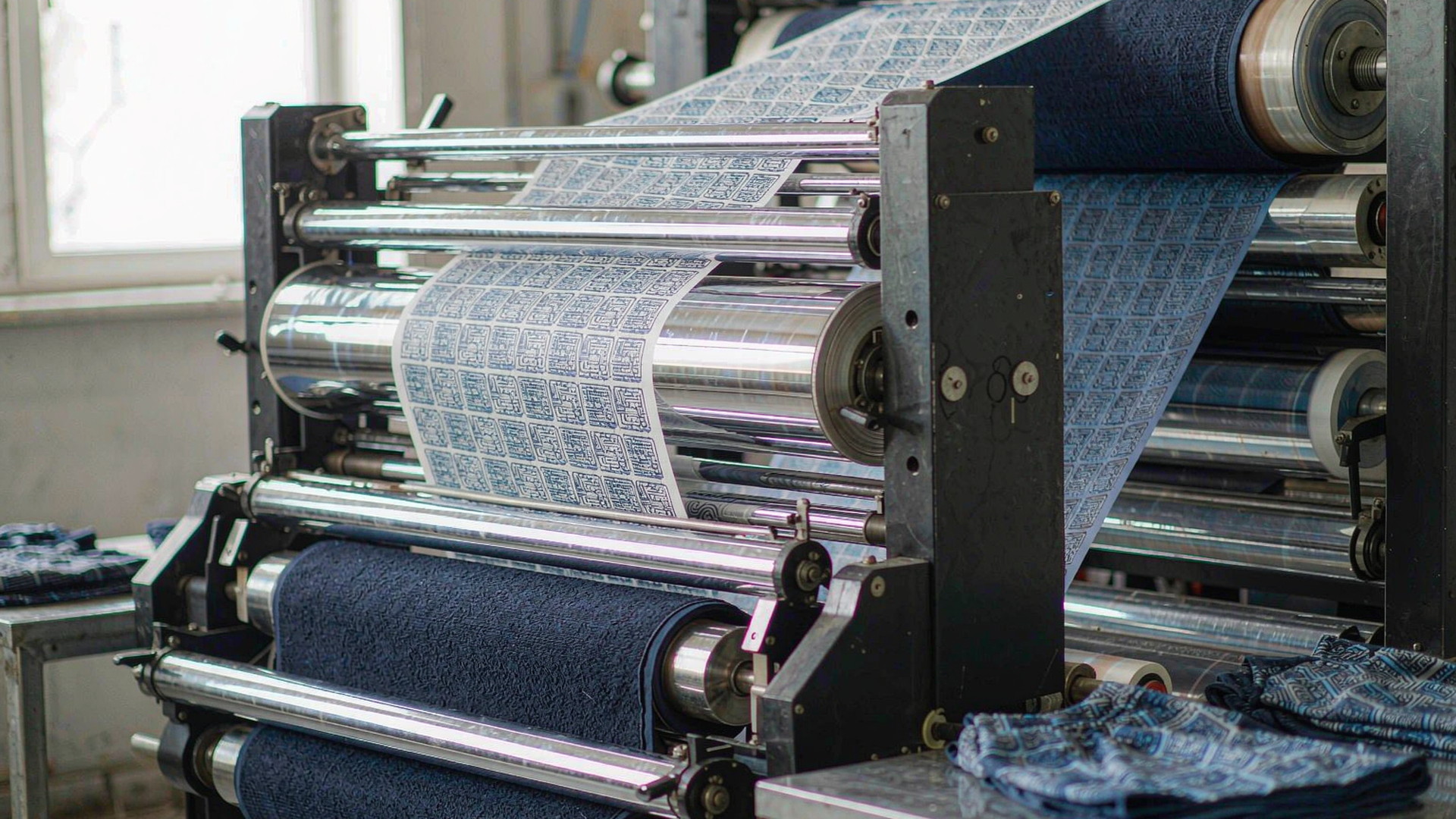
Rotary screen is the volume process. Each colour is a separate cylindrical screen, the paste is pushed through the mesh, and the fabric runs continuously. It is fast, it holds a spot colour accurately, and it is cheap per metre once the screens are amortised — but the repeat is fixed by the circumference of the screen, commonly 640 mm or 820 mm, so a design either fits the repeat or is engineered to it. Registration between colours is typically held to about ±0.5 mm on a well-set machine, and that tolerance does not improve as colours are added; it accumulates.
| Process | What carries the colour | Fibre it needs | Added weight and hand | How it fails in use | Where it belongs |
|---|---|---|---|---|---|
| Sublimation, paper transfer | Disperse dye vapour, fixed inside the fibre at 180 – 200 °C | Polyester at 65% or more; weak on nylon; no cotton | None — no film, no change of hand | Colour loss from chlorine and UV; ghosting where paper lifts; dye migration onto pale panels in storage | Photographic all-over and placement on polyester shells |
| Digital, reactive ink | Reactive dye bonded to cellulose, fixed by alkali and steam | Cotton, viscose, lyocell | None after wash-off | Colour loss with hard water and repeated washing; poor penetration on tight weaves | Cotton poplin beach shorts, small runs, many colours |
| Digital, acid ink | Acid dye bonded to polyamide, steamed and washed | Nylon, silk, wool | None after wash-off | Bleeding at the edges on nylon-elastane; shade shift between rolls | Nylon shells with fine line work |
| Digital, pigment ink | Binder film cured at about 150 °C | Any fibre, including blends | 5 – 20 g/m² locally; a perceptible film | Wet crocking on dark grounds; hand stiffens; edge wear from sand | Sampling, short runs, blends, white detail on dark |
| Rotary screen | Print paste through a mesh, one screen per colour | Any fibre, with the right paste system | 40 – 150 g/m² depending on coverage | Registration drift as colours accumulate; banding at the repeat joint | Volume spot colour, repeats, engineered placement |
| Flat screen | Print paste through a flat mesh | Any fibre | Heavier deposit than rotary | Slower; pressure marks on textured shells | Large panels, low volume, thick deposits |
| Silicone and high-density | Silicone cured onto the surface | Any fibre, best on stretch | 250 – 400 g/m²; raised and rubbery | Edge lift where the panel is stretched during pressing | Bold marks on swim shells, waistband detail |
| Foil and metallic | Adhesive plus a transferred metallic film | Any fibre | Thin film, high gloss | Cracks at the first stretch; not chlorine-stable | Fashion accents, not performance swimwear |
| Added weight is measured on the printed area, not on the garment average; a 12% coverage print can triple the local add-on while the garment weight barely moves. Figures are production ranges, not guarantees. | |||||
Which print survives chlorine, sun and washing?
None of them survives indefinitely, so the useful question is which failure the buyer is prepared to accept and at what point. The answer is written as a test method and a grade, and the grade is the brand’s decision, not the laboratory’s: ISO 105-A02 supplies the grey scale for change in colour and ISO 105-A03 the scale for staining, both running from 1 to 5 in half steps, and a typical swim programme writes 4 for change in colour and 3 – 4 for staining. A report that says “passed” without naming the scale and the grade has told you nothing you can put on a purchase order.
Chlorine is the test that separates a beach short from a beach towel. ISO 105-E03:2010 offers three concentrations of active chlorine — 20 mg/l, 50 mg/l and 100 mg/l — and the choice is the specification. Swimwear is normally tested at 50 mg/l or 100 mg/l; the 20 mg/l condition is intended for accessories such as beach robes and towels. A swim short tested at 20 mg/l and reported as chlorine-fast has been tested to the accessory condition, not to either of the two conditions the standard assigns to swimwear, and the gap shows up in the consumer’s hands rather than in the laboratory.
Light is the second exposure that beachwear cannot avoid. ISO 105-B02 uses a xenon arc lamp filtered to approximate D65 daylight, and the result is read against the blue wool references on a scale of 1 to 8. A print that reads 4 has changed visibly after a modest exposure; a print that reads 6 has barely moved. For a garment sold into Australia or the Gulf, light fastness is not a nice-to-have, because the same UV that fades the print also degrades the elastane underneath it.
Rubbing is the third, and the one most often skipped. ISO 105-X12 runs a crockmeter over the print, dry and wet, and reports the staining of an adjacent white cloth. Wet rubbing is the harder test and the one that catches pigment prints: a white base layer under a dark ground, which is how white detail is produced with pigment ink, is exactly the construction that transfers colour onto a wet beach towel. Dry rubbing catches the other end of the same problem, a print that has not fully cured.
| Test | What it catches | Condition to specify | Where it fails first |
|---|---|---|---|
| ISO 105-E03 | Oxidation of the dye by active chlorine | 50 mg/l or 100 mg/l for swimwear; 20 mg/l only for accessories | Light grounds, pigment reds and blues |
| ISO 105-C06 | Dye wash-off and binder failure | Method letter plus the single (S) or multiple (M) option | White base prints on dark grounds |
| ISO 105-X12 | Surface transfer of colour | Dry and wet reported separately | Pigment white base on navy |
| ISO 105-B02 | Photodegradation of the chromophore | Xenon arc, result as a blue wool grade | Sublimated cyan and red |
| ISO 105-A02 | How the result is graded, not the result itself | Grey scale, 1 to 5 in half steps | Any report that omits the grade |
| ISO 105-J03 | Colour difference against the approved standard | ΔE CMC, tolerance written by the buyer | Second and third bulk lots |
| ISO 6330 with ISO 5077 | Shrinkage after printing and washing | Named wash and dry cycle, three cycles | Panel prints, where shrinkage moves the register |
| The standards define the method and the scale. The pass grade is written by the buyer into the purchase order — that separation is what a supplier can evidence and what an adjective cannot. | |||
How do you print a design across sizes and seams without drift?
There are three ways to put a print on a beach short and they fail in different places. Panel printing prints the fabric before cutting, so the design flows across the roll and the seam is wherever the pattern falls; matching at the side seam then becomes a cutting instruction rather than a printing one. Cut-piece printing prints panels after cutting but before sewing, which allows an engineered placement — a motif centred on the leg, a border that follows the hem — as long as the panels are laid as a pair and the two sides are printed in the same pass. Garment or placement printing prints after sewing, which is the only route for a mark that must sit in the same place on every size, and it needs a pallet or board per size.
That last point is where quotes diverge. A placement print on five sizes needs five pallets and five setups, so the setup cost does not scale with quantity the way a roll print does. A buyer comparing two quotations for the same artwork is often comparing one supplier who priced five pallets with one who priced one and intended to stretch it across the size range; the second quote is cheaper and the print drifts by several millimetres between the small and the large.
Repeat is the second constraint. Rotary and flat screens come in fixed circumferences — 640 mm and 820 mm are the common ones, with larger flats available — so a design sized at 700 mm either loses 60 mm of its repeat or is re-engineered. Digital printing has no repeat limit at all, which is why a photographic placement that crosses a full leg is usually a digital job even when the volume would otherwise justify screens.
Seam matching is the third. For an all-over or a stripe, the working tolerance at a side seam and at the centre front is about 3 mm, and it is checked on the sewn garment rather than on the printed roll, because the seam allowance and the sewing tension move the pattern as much as the printer does. Write the tolerance into the tech pack and inspect against it; a 6 mm mismatch on a stripe is visible from a metre away and reads as a cheap garment regardless of what the fabric cost. The size chart and fit guide covers the measurement set that the same tech pack needs.
What changes when the print covers the whole short?
An all-over print is a different product from a placement print, even when the artwork is the same. Four things change.
First, the marker. A design with a directional repeat cannot be nested as tightly as a plain fabric, so fabric consumption rises; a large repeat wastes more at the cut than a small one. That is a cost the buyer pays in metres, not in print time, and it is the reason an all-over quote can exceed a placement quote for the same garment by a margin that has nothing to do with ink.
Second, the surface. A sublimated all-over adds nothing, so the fabric’s own performance — its drying time, its air permeability, its stretch — is untouched. A pigment all-over adds a film across the whole garment, typically 5 to 20 g/m² depending on coverage, which stiffens the hand, reduces air permeability and makes wet crocking a whole-garment risk rather than a local one.
Third, ultraviolet transmission. A dense, opaque print reduces the UV passing through the printed area, so the printed panel can measure a higher UPF than the same fabric unprinted; but the claim is made on the finished garment as tested, and EN 13758-1 measures the fabric, not the seams, the stretch or the wet state. A white or pale print does very little, and a garment that is stretched and wet transmits more UV than the same garment dry. Design the print for the look and test the garment for the claim.
Fourth, migration. On a polyester garment with pale panels next to a dark printed panel, disperse dye can move in storage or in a hot container and tint the pale area. The control is a migration-resistant dye set specified at the print stage, plus a storage test: a sample folded print-to-white at 40 °C for 72 hours is a cheap way to find out before the container does.
Which requirements belong on the purchase order?
Printing is the stage where a technically correct garment can still fail a restricted-substance test, because the ink, the paste and the binder are chemistry added after the fabric was already approved. Three limits do most of the work. Azo colourants are restricted under REACH Annex XVII entry 43 at 30 mg/kg on textile articles, so the dye supplier’s declaration matters as much as the finished-garment test. Formaldehyde is limited by OEKO-TEX® STANDARD 100 at 75 mg/kg for products in direct skin contact, which is the class a beach short belongs to, and at 16 mg/kg for baby articles. Phthalates are the reason a plastisol print is specified as phthalate-free rather than merely “low phthalate”: the restricted phthalates under REACH Annex XVII are limited in plasticised material, and a plasticiser is exactly what makes plastisol a paste.
Flammability is the fourth and it is usually handled wrongly on prints. 16 CFR 1610 is a fabric standard, and where the fabric is not exempt the test specimen has to represent the garment as sold — which means the printed fabric, not the greige roll. Two exemptions in 16 CFR 1610.1 decide whether a test is needed at all: a plain-surface fabric at 2.6 oz/yd² or heavier is exempt under (d)(1), and a fabric made entirely of acrylic, modacrylic, nylon, olefin, polyester or wool is exempt under (d)(2) at any weight, whether plain or raised. Both exemptions remove the test, not the standard: (d)(2) never reaches cotton, while (d)(1) still exempts a plain-surface cotton or cotton-blend print at 2.6 oz/yd² or heavier, so only a lighter or a raised-surface cotton print has to be tested as printed. Where a test is due, a heavy plastisol print changes how a lightweight polyester shell burns, in either direction depending on coverage, so a report issued on unprinted fabric does not answer the question the regulation asks. For a children’s programme the same principle applies to the lead limit on surface coatings under 16 CFR 1303, because a print is a surface coating.
Then the mechanical requirements, which are written as numbers: the ISO 105-C06 letter and cycle count, the ISO 105-E03 concentration, the ISO 105-X12 dry and wet grades, the ISO 105-B02 blue wool grade, the ΔE tolerance against the retained standard — 2.0 in ΔE CMC is the working default and a buyer can tighten it — the seam-match tolerance of 3 mm, and the shrinkage limit after three ISO 6330 cycles, where 3% or under in length and width is the usual starting figure. Inspection then runs to AQL under ISO 2859-1 against a defect list that names print defects separately — registration, banding, ghosting, crocking, pin-holes and colour variation between panels — which is what the inspection checklist sets out.
What does a custom beach shorts supplier in China need from you before a strike-off?
A strike-off is only meaningful if it is made on the production fabric with the production ink, and that requires the buyer to send six things. The artwork, as vector or at 300 dpi, with the design already placed on a technical drawing of the short. The repeat or the placement, dimensioned in millimetres. The colour reference, as Pantone solid coated for a spot colour and Pantone TCX for a dye or a sublimation, because an RGB value is a screen instruction and not a dye recipe. The fabric, named by construction and weight, since the same ink on a 110 g/m² peach and a 190 g/m² taslan reads as two different colours. The size range, because a placement print needs a pallet per size. And the destination market, because that decides which test list and which labelling set apply.
With those six, a custom beach shorts supplier in China can produce a strike-off that answers a real question: not “can you print this” but “does this print hold its colour on this fabric after the tests we agreed”. A supplier who will print on a stock polyester without asking for the fabric has answered the first question only. Sampling for a printed style runs 12 to 18 days with the strike-off inside that window, counted from artwork approval; a pre-production sample takes 5 to 7 days from the approved strike-off; and bulk runs 45 to 60 days from the approved pre-production sample and the deposit, or 30 to 40 days for a repeat.
How do you compare OEM beach shorts supplier in China options on print?
Ask the same six questions of every candidate and the differences stop being about adjectives.
- Is the printing in-house or subcontracted, and if subcontracted, to how many print houses? One answer is a control; three answers are three colour standards.
- Is there an ICC profile per fabric, and can it be produced? A digital printer who cannot show a profile is matching by eye, and eye-matching does not survive a second lot.
- Will the strike-off be run on the production fabric with the production ink, and will a retained standard be kept for the reorder?
- Which laboratory issues the fastness reports, and are the method letter, the concentration and the grade printed on them?
- Who owns the screens, the plates and the separated artwork, and where are they stored between seasons?
- How is colour continuity handled on a repeat — same ink lot, same screens, or a fresh match to the retained standard with a ΔE figure?
An OEM beach shorts supplier in China who holds the screens and the retained standard between seasons is selling continuity, which is the part of printing that a first order cannot reveal. A supplier who reprints from a fresh match every time is selling a cheaper first order and an inconsistent second one. Neither answer is dishonest; they are different products, and the purchase order should say which one is being bought.
What separates the best beach shorts supplier in China on print work?
The phrase is a search term, so the only defensible answer is a checklist a buyer can run in one meeting rather than a claim. On printing, five things separate a supplier who controls the process from one who passes it along. The supplier asks for the fibre and the fabric weight before quoting a method. The supplier names the process that the design will actually run on, and says so when the artwork cannot run that way. The supplier writes the test conditions into the quotation instead of answering them after a complaint. The supplier can show a migration test on a pale-ground garment, not only a fastness report. And the supplier treats the print as part of the specification, priced as its own line, so it can be compared and so it can be changed without renegotiating the garment.
Anything less specific than that is marketing. A reliable supplier answers with a method, a concentration and a grade; an intermediary answers with a promise about quality that nobody in the chain has been asked to measure.
What does a private label beach shorts programme need on the print side?
A label programme moves the branding from the garment to the packaging, and the print has to agree with it. The label set is a brand label, a care label to 16 CFR 423 or ISO 3758, fibre content to 16 CFR 303 or Regulation (EU) 1007/2011, country of origin, size, a hangtag carrying a GS1 GTIN, and a polybag with the recycling mark. If the print carries a colour that the label or the hangtag is matched to, that colour is the same ΔE problem as the print itself, and it is cheaper to approve all of it against one retained standard than to match a hangtag to a garment after the fact.
Two labelling interactions are worth designing for rather than fixing. A care label printed on the same fabric as the shell will fade with the print, and the care information has to stay legible for the useful life of the garment — so either the label is a woven or a printed tape with its own fastness requirement, or it is not printed at all. And a print that crosses the side seam changes the seam’s appearance after washing if the print’s shrinkage differs from the shell’s, which is why the ISO 6330 cycle belongs in the same specification as the print, not in a separate quality document.
For buyers running a children’s range, the tracking label required under CPSIA section 103 is permanent and separate from any print, and the testing is arranged to whatever the buyer specifies; the reports come from an accepted laboratory and the certificate is issued by the importing party.
Where to go next
The print sits between the fabric and the seam, so the next decision is usually one of these. The quick-dry fabric guide covers taslan, peach, rPET and cotton poplin with the gsm bands that decide whether sublimation is available at all; beach shorts versus board shorts versus swim trunks sets out which construction needs chlorine testing; the custom logo guide covers decoration placement, embroidery and the artwork set; the inspection checklist turns print defects into an AQL list; the compliance guide covers OEKO-TEX classes, REACH entries and UPF claims; and the beach shorts OEM page is the starting point for a programme brief. Adjacent programmes run through the same partner network and the same audit structure, for example custom men’s underwear OEM.
If you have artwork, a fabric reference and a target quantity, send them together. We will come back with the process the design can actually run on and the test list that goes with it before a price, because on a printed beach short the process is the specification.
· Xiamen Unitex Trade Co., Ltd. — OEM & ODM underwear sourcing partner