
A logo that looks right on a strike-off and looks tired on the shop floor eight weeks later is not a printing problem. It is a specification problem: the decoration method was chosen from the artwork before anyone wrote down the fibre, the exposure and the test that would settle the argument. Beach shorts are the hardest place to skip that step, because one garment is asked to survive chlorinated water, salt water, sun, abrasion against sand and a 40 °C wash cycle, and each of those attacks a different part of a decorated surface.
This page is the decision path we use for logos on beach shorts, board shorts and swim shorts: which method fits which fibre, why a print cracks while a sublimated mark fades away, what has to be in the artwork file, and the test list that belongs on the purchase order before bulk. Fabric behaviour sits in the quick-dry fabric guide; the category split is in beach shorts versus board shorts versus swim trunks; the defect side is in the beach shorts inspection checklist; the compliance frame is in the beach shorts compliance guide; and the category starting point is the beach shorts OEM page.
Xiamen Unitex Trade Co., Ltd. is a sourcing and trading company, in the trade since 2009 and incorporated in Xiamen in 2013. We are the supplier named on the purchase order, and the garments are cut, sewn and decorated by partner factories — the manufacturers audited under amfori BSCI and certified to OEKO-TEX® STANDARD 100. That structure matters here because decoration is where responsibility is easiest to lose: the buyer approves a logo, the printer approves a screen, and nobody owns the test report. Naming the party that signs the purchase order is the first control, not a formality.
Which logo method survives a beach short?
Five methods cover almost every beach short logo, and the choice is made by fibre chemistry rather than by taste. Sublimation needs polyester, because only polyester takes disperse dye into the fibre. Screen print and silicone transfer sit on top of whatever the surface is, so they work on nylon, polyester and blends, provided the ink’s elongation matches the fabric’s. Embroidery threads through the cloth, so it works on stable wovens and fights anything with elastane. Woven labels and jacquard elastic avoid the question by building the mark into a component instead of onto a surface.
| Method | What it bonds to | What it adds | How it fails in use | Where it belongs |
|---|---|---|---|---|
| Sublimation | Polyester, 65% or more. Not cotton; weak on nylon | Nothing on the surface: the dye sits inside the fibre, hand unchanged | Colour leaves; the mark becomes a ghost after chlorine and sun | All-over and placement prints on polyester shells |
| Screen print, plastisol | Nylon, polyester, blends, with a cured film | 80 – 150 g/m² locally; a visible film that softens after washing | Cracks along the edge when the fabric extends further than the ink; peels off a water-repellent finish | Chest, leg and back placement on woven shells |
| Screen print, water-based | Cotton-rich and polyester | Thin matte film, almost no hand | Low colour yield on dark nylon without a base layer, which means two passes | Large flat areas where hand matters |
| Silicone transfer | Nylon, polyester, elastane blends | 250 – 400 g/m²; raised, rubbery, opaque | Edge lifts if the panel is stretched during pressing; blocks airflow over mesh | Bold marks on stretch swim shells, panels next to the waistband |
| Heat-transfer film | Polyester, nylon; not on a fresh water-repellent finish | Thin film with a sharp edge and a slight gloss | Edge lift after repeated chlorine; a gloss ring if the press runs too hot | Names and numbers, small runs, short-life fashion |
| Embroidery | Stable wovens from about 120 g/m²; fights elastane | Raised thread, well under 1 g per 60 mm mark | Puckers on stretch; needle holes open on coated shells; fills in below 5 mm cap height | Leg hem, back pocket, heavier taslan shorts |
| Woven label, sewn | Any shell | Edges stand proud of the surface | Scratches if the tape edge is cut rather than folded | Centre back, side seam, waistband |
| Jacquard-woven elastic | None — it is the elastic | Nothing; the mark is yarn | Limited by the weaving repeat and by the yarn colours available | Waistband, when the elastic is already custom |
| Metal engraving | Hardware: aglets, eyelets, cord ends | Nothing on fabric | Plating wears through to base metal in chlorinated water | Drawcord ends, eyelets, cord locks |
| Add-on weights are typical values for a 60 mm mark, not figures from a standard. Bonding and failure follow fibre chemistry and cure temperature; cure windows are process data, and the ink supplier’s technical data sheet governs over a table. The remaining numbers on this page are trade ranges and process data, not specification limits; where a standard number appears, the standard governs. | ||||
Two rules make the table usable. First, the shell and the waistband are usually different materials, so one range can need two processes for one logo: a sublimated mark on the leg shell and a jacquard or printed mark on the elastic. Second, a method that is correct on a flat panel can be wrong at a seam, because a print pressed across a step thins the film exactly where the garment flexes most.
Why does a printed logo crack while a sublimated one disappears?
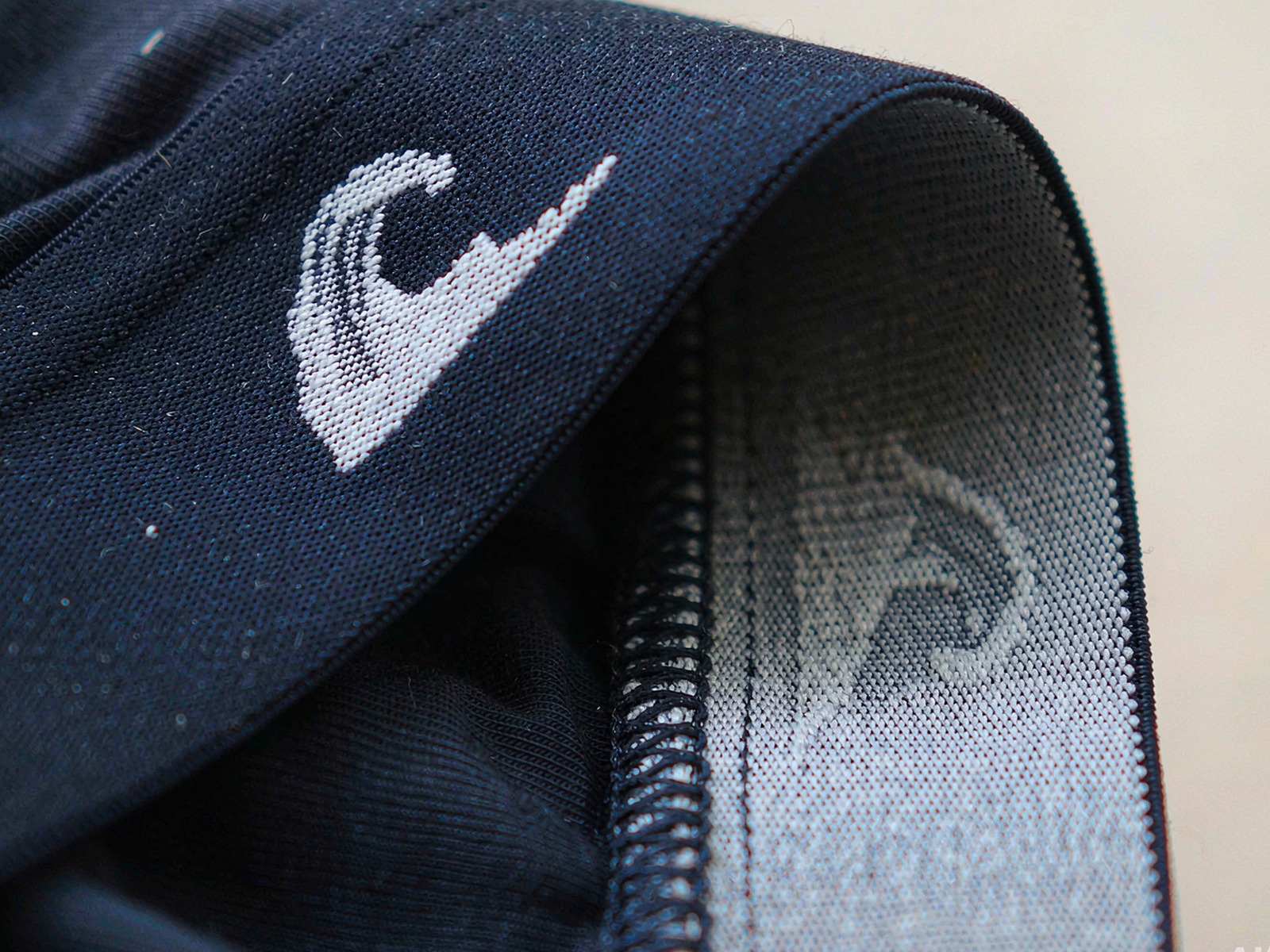
They are two different structures, and they fail in opposite directions. In sublimation the printed paper is pressed at roughly 180 – 200 °C, the disperse dye turns to gas, diffuses into the polyester and is trapped there when the fibre cools. Nothing is added to the surface, so there is no film to crack; the failure is colour loss, and it usually shows as a pale ghost of the original mark by the time the garment has seen a season of chlorine and sun. A screen print leaves a cured film 20 – 60 µm thick sitting on the weave. That film has its own elongation, and when the fabric extends further than the film can follow, the film gives.
The numbers explain most complaints. A four-way stretch swim shell can extend 80 – 120% across the hip. A fully cured plastisol film may stretch 150 – 200% before it breaks, which sounds like enough — but a film cured at 140 °C instead of 150 – 160 °C looks identical on the sample and fails at the first real extension. That is why the cure temperature belongs in the decoration specification and not only in the printer’s head.
Sublimation also cannot be carried across colourways without thinking. Disperse dye has low affinity for polyamide, so the same artwork printed on a nylon shell looks strong out of the press and washes grey within a few cycles; nylon is dyed with acid dyes at yarn stage, or decorated with a print film. A quotation that says the logo will be done “the same way on both colourways” is telling you that one of the two is going to be wrong in month two.
Elastane sets the temperature ceiling. Above roughly 175 – 180 °C elastane loses strength and yellows, so a calendar running at 195 °C over a shell with 18% elastane is a fabric problem before it is a print problem. On those shells the order is: print film or silicone, not sublimation; and if sublimation is unavoidable, the elastane has to be in a panel the press never touches.
Can you embroider a swim short, and where does it fail?
Every stitch is a needle perforation. On a tight woven taslan the fibres close around the thread and the holes disappear; on a laminated or coated shell the holes stay open, and the film starts to delaminate along the stitch line. The first question to ask about any embroidered swim short is therefore not how the front looks but what the reverse side looks like after two washes.
Geometry has hard minimums. A letter needs 5 mm of cap height, a satin column needs 1.2 mm of width, and two colours need 0.4 mm of gap between them, otherwise the fills merge into a blob. Those are digitising limits used across the trade rather than values from a standard — ISO 4915 governs stitch type, not minimum letter size — but a digitised file that ignores them will not sew. Below those numbers the artwork is not embroiderable and should become a woven label. On four-way stretch, embroidery needs a water-soluble stabiliser of 25 – 40 µm and a low-density underlay, and the film has to be washed out afterwards; leave it in and the panel stiffens and shows a ring after the second wash.
Placement carries the rest of the risk. Keep embroidery 15 mm clear of the waistband tunnel edge and off every bartack: a stitch line running across an elastic tunnel locks the stretch, and the wearer feels it at the waist within an hour. Weight is rarely the issue — a 60 mm mark at about 4,000 stitches adds well under a gram of 40s thread — the stiffness is. Where a seam is involved, the construction follows ISO 4915: a type 301 lockstitch for the seam and 304 zigzag at an edge tack. The embroidered mark itself is built from running, satin and fill stitches, which ISO 4915 does not classify.
Where embroidery wins is on heavier woven shells: taslan and ripstop from about 120 g/m² up, at the leg hem or on a back pocket, in markets where embroidery is read as a quality signal rather than as decoration. Where it loses is on mesh linings, coated shells, and anything that has to stretch.
How should a logo be tested before bulk?
Four attacks matter, and each one needs its own specimen: laundering, chlorinated water, light, and abrasion. They are separate tests because they destroy colour by different mechanisms, and a mark that passes one can fail the next. The table is the list we put in front of a buyer when the logo is approved.
| Test | Standard | Condition that matters | What a failure looks like | Who sets the pass level |
|---|---|---|---|---|
| Colour change after laundering | ISO 105-C06 | The letter: S is close to one home wash, M approximates up to five washes at 70 °C or below | Fading, bleeding into a white panel | Brand writes the grade; typically 4 |
| Chlorinated water | ISO 105-E03 | 50 mg/l and 100 mg/l are the swimwear conditions; 20 mg/l describes accessories such as beach robes and towels | Fading, yellowing, a hard hand | Brand writes the grade |
| Sea water | ISO 105-E02 | Immersion, then drying, without rinsing | Fading confined to the immersed area | Brand writes the grade |
| Perspiration | ISO 105-E04 | Acid and alkaline solutions, both required | Fading, staining of the adjacent panel | Brand writes the grade |
| Rubbing | ISO 105-X12 | Dry and wet crock, separately | Ink transferring to a towel or a white panel | Brand; 4 dry and 3 wet is common |
| Light | ISO 105-B02 | Xenon arc, with the exposure that matches the market’s UV claim | A fade line on the sun-facing panel | Brand writes the grade |
| Stretch-recovery of the decorated panel | In-house protocol | 10 cycles to the fabric’s declared extension, then 3 washes to ISO 6330 | Cracks, edge lift, gloss | Buyer and supplier agree in writing |
| Lead in the surface coating (children’s) | 16 CFR 1303 | 90 ppm limit in the coating; a printed logo is a surface coating | Non-compliant print on a kids’ short | US law |
| Phthalates (children’s, brand-required) | Buyer’s restricted-substance list; 16 CFR 1307 covers toys and child care articles, not apparel | 0.1% for the eight restricted phthalates, where the brand adopts that limit | Plasticiser in the plastisol | The brand, not US law |
| Pass levels are not in the standards. The ISO methods define the specimen, the medium and the grey scale used to grade — ISO 105-A02 for colour change and ISO 105-A03 for staining — and the brand writes the grade into the purchase order. A report that names neither the method letter nor the grade cannot be compared with another report. | ||||
The sequence matters as much as the list. Test the strike-off, not the bulk: a strike-off printed from the approved screen on the production fabric is the only specimen whose result predicts anything. Re-test after any change of ink, thread, tape, or mill, because a new ink lot with the same name can sit outside the colour tolerance. And test the assembled garment where the print crosses a seam, since a mark that passes on a flat swatch can fail on a step.
The chlorine condition is where reports most often go wrong. ISO 105-E03:2010 specifies three concentrations: 50 mg/l and 100 mg/l are intended for swimwear, and 20 mg/l is intended for accessories such as beach robes and towels. A swim short tested at 20 mg/l has been tested at two-fifths to one-fifth of the intended severity, and the report will still look clean. If the garment is sold for pool use, write the higher condition into the purchase order and say which one you want.
What artwork does a beach short logo need?
Most decoration disputes start with a file that cannot be produced, and the fix costs a day rather than a season if it is caught before sampling. The list below is what we ask for before a strike-off is booked on a beach short programme.
- Vector artwork — AI, EPS or PDF — with all fonts converted to outlines. A 300 dpi raster file is accepted only when the design is a photograph.
- A colour reference that matches the process: Pantone solid coated for screen print and silicone, Pantone TCX for dye and sublimation. An RGB file is not a colour reference.
- One file per placement, named by style, colourway and position, with the finished size in millimetres on the drawing.
- Minimum line weight — trade minimums rather than standard values — of 0.3 mm for screen print, 1.0 mm for sublimation on a textured taslan, and a 1.2 mm satin column for embroidery.
- White on dark nylon needs an opaque base layer, so the mark gains 40 – 80 µm and reads as a slightly raised patch. That is a physical consequence of covering a dark ground, not a printer’s preference.
- Gradients band on a textured weave; either keep them out or accept a visible step on the finished garment.
Colour acceptance is a separate sentence in the purchase order. We measure against the approved standard on the production substrate, with a tolerance of ΔE 2.0 or under as normal commercial practice — the tolerance is a buyer’s decision and belongs in writing, because the same ΔE number looks different on a matte taslan and on a glossy coated shell.
What belongs in a private label beach shorts branding set?
Branding is a set of components, not a single label, and the legal hooks differ for each one. The table is the set we assemble when a buyer brings a house brand to a beach short programme; the last two rows are the ones buyers most often forget.
| Component | Where it goes | What it must state | Rule or standard |
|---|---|---|---|
| Brand label | Centre back neck or inside waistband | Brand name, size, or the size on a separate tab | Buyer’s trademark; no legal wording required |
| Care label | Inside side seam, permanently attached | Wash, bleach, dry, iron and dryclean instructions | 16 CFR 423 in the US; ISO 3758 symbols elsewhere |
| Fibre content | With the care label | Percentages by fibre, in descending order | 16 CFR 303 in the US; Reg (EU) 1007/2011 |
| Country of origin | Label or hangtag, legible at the point of sale | Made in the country of manufacture | 19 CFR 134 in the US; EU customs marking rules |
| Size label | Waistband or care label | Size and the size system used | Buyer’s grade rule |
| Hangtag | Attached with a Swiftach or a string | Brand story, price area, barcode | GS1 GTIN allocation |
| Polybag | Outer packaging | Recycling mark, warnings, responsible person | PPWR (EU) 2025/40; GPSR (EU) 2023/988 |
| Children’s tracking label | Permanent, on the garment itself | Producer, production date and batch, location | CPSIA section 103 |
| Care labels must stay legible for the useful life of the product, so the label is tested with the garment rather than on its own. A tape that survives 20 washes on a garment whose print fails at five is a complaint, not a labelling win. | |||
Tape specification is the quiet failure point. A soft-edge woven or laser-cut tape folded to 15 – 20 mm and attached with a type 301 stitch stays flat; a tape with a cut edge scratches the waist and comes back as a return even when every other measurement is correct. For a programme where the elastic is already custom, a jacquard mark removes the label entirely and removes the scratch with it.
The component that carries the most risk is the care label, because it is a statement about performance. If the label says the short can be machine washed at 40 °C, the decoration has to survive that instruction, and the only way to know is to test the print through the same cycle. That single link — care claim, decoration test, purchase order — is what separates a label set that survives a season from one that generates claims.
A custom beach shorts supplier in China should be able to put three things on the table before the bulk order is confirmed: the strike-off on the production fabric, the screen or plate that will run it, and the wash and chlorine report for that exact print. Anything less is a promise about a process nobody has seen. Beyond the logo, the label set, the polybag artwork and the GTIN are all printed items that need their own approval cycle, and each one adds a proof round.
An OEM beach shorts supplier in China normally holds the artwork, the screens and the colour standard between seasons, which is what makes a reorder a repeat of a documented process rather than a new development. Ask where those items are stored, who owns them, and what happens to them if the relationship ends: the answer is a reasonable proxy for how the supplier treats everything else that belongs to you.
What separates the best beach shorts supplier in China on logo work?
The phrase is a search term, so the only useful answer is a list of things a buyer can check in one meeting rather than a claim. On decoration, six questions do most of the work.
- Does the supplier ask for the fibre composition before quoting a method? A quote that starts with the artwork and never mentions polyamide or elastane is a quote for a picture, not for a garment.
- Will they show the strike-off on the production fabric, or only a digital mock-up? A mock-up cannot show ink build-up on a textured weave.
- Which test report will they produce, from which laboratory, and with which method letter and grade? “Passed washing” is not an answer.
- Who owns the screens, plates and artwork files, and where are they stored between orders?
- How is colour continuity handled on a reorder — same ink lot, same screen, or a fresh match against a retained standard?
- Is decoration quoted as its own line, so the add-on can be compared between suppliers instead of hidden inside a garment price?
None of these are expensive to ask for, and all of them are hard to retrofit after the first bulk shipment. A reliable beach shorts supplier in China answers them with documents; a trading intermediary answers them with adjectives.
Where to go next
The logo is one decision inside a larger specification. The quick-dry fabric guide covers gsm, taslan versus peach finish and recycled polyester, which is what decides whether sublimation is available at all; beach shorts versus board shorts versus swim trunks sets out where the three categories diverge; the inspection checklist turns decoration defects into an AQL list to inspect against; the size chart and fit guide covers the measurement set; and the beach shorts OEM page is the category starting point for a programme brief.
· Xiamen Unitex Trade Co., Ltd. — OEM & ODM underwear sourcing partner