
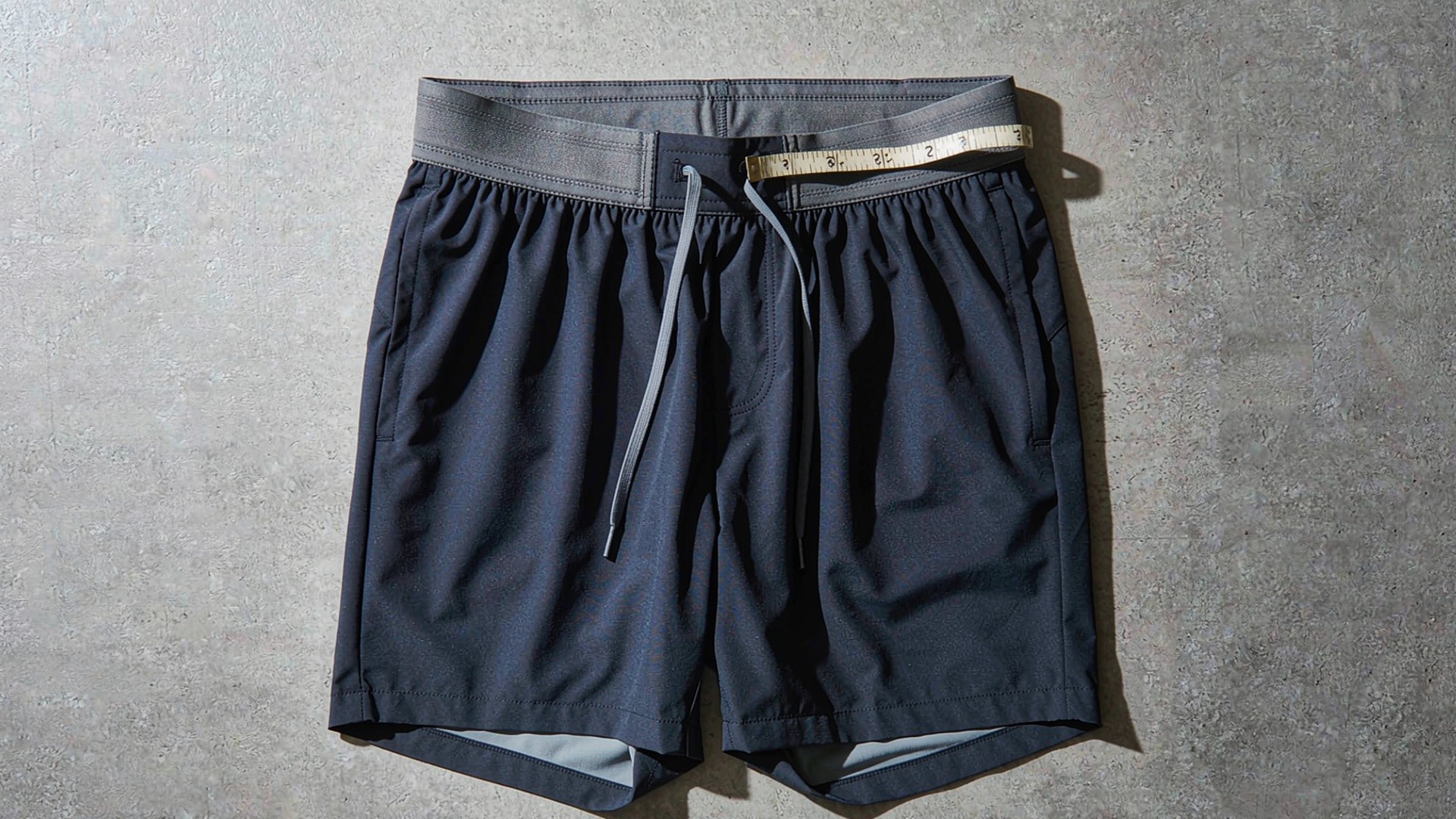
A beach short can pass a flat measurement check and still come back as a complaint. The three numbers a buyer usually signs off — waist, hip and inseam — do not describe what happens when 3 cm of elastane is stretched around a body that has just eaten lunch. The garment measures correctly on the table and rides up on the beach. Most of the size disputes we handle are not cutting errors; they are specification errors, where a size chart that states body measurements and a spec sheet that states garment measurements get signed on the same page as if they were the same thing.
This page is the measurement set we use for beach shorts, board shorts and swim shorts: the points, how each one is taken, the tolerances, and the two documents that have to exist before a size set is approved. Fabric behaviour sits in the quick-dry fabric guide, the category split in beach shorts versus board shorts versus swim trunks, the defect side in the beach shorts inspection checklist, and the category overview on the beach shorts OEM page.
Xiamen Unitex Trade Co., Ltd. is a sourcing and trading company, in the trade since 2009 and incorporated in Xiamen in 2013. We are the supplier named on the purchase order and the party that signs off the size set. The garments are cut and sewn by partner factories — the manufacturers audited under amfori BSCI and certified to OEKO-TEX Standard 100. That distinction matters here because a size dispute is settled by a measuring tape and a sealed sample, and the person holding both has to be named.
What inseam and outseam should a beach short actually have?
Two numbers describe the leg, and buyers quote one while factories cut the other. Inseam runs from the crotch seam to the hem along the inside of the leg. Outseam runs from the top edge of the waistband to the hem along the side. On a pair of trousers the two move together predictably. On a beach short they do not, because the rise is short and the waistband sits anywhere the design wants it to sit. Two shorts with the same 18 cm inseam can differ by 4 cm in outseam if one is cut with a 23 cm front rise and the other with a 27 cm rise.
That is why a spec sheet has to say which number is controlled. If the print or the side panel is placed relative to the hem, the outseam is the controlling dimension and the rise absorbs the difference. If the customer is matching a garment they already sell, the inseam is controlling and the rise follows the body. Writing “7 inch short” into a tech pack without saying which of the two it refers to leaves the factory free to choose, and the factory will choose the one that uses less fabric.
| Family | Inseam | Outseam | Front rise | What the number is for |
|---|---|---|---|---|
| Swim trunk | 10 – 15 cm (4 – 6 in) | 32 – 38 cm | 22 – 25 cm | Pool and short swim; leg stays clear of the knee |
| Beach short | 15 – 20 cm (6 – 8 in) | 40 – 47 cm | 23 – 27 cm | Walking, resort wear, the mainstream retail length |
| Board short | 20 – 28 cm (8 – 11 in) | 48 – 56 cm | 24 – 29 cm | Surf; covers the knee on a shorter wearer |
| Long beach short | 23 – 25 cm | 50 – 53 cm | 25 – 28 cm | Markets that read “knee length” as a selling point |
| Ranges are industry practice for adult men’s size M, not values from a standard. They shift with body size, so the grade rule and the size set govern, and the tech pack governs over both. A 3,000-piece order should never be cut from a table alone. | ||||
The practical consequence for a print programme: if the artwork is placed 4 cm above the hem and the rise is then changed by 2 cm, the print still sits 4 cm above the hem but lands 2 cm lower on the body. Print placement has to be tied to one datum — the hem is the safer one — and the tech pack has to name it. We have re-cut panels for exactly this reason on programmes where the placement note said “mid-thigh” and nothing else.
How is a beach short waist measured — flat, stretched, or on the body?
All three are legitimate and they answer different questions. The flat measurement is taken across the top edge of the waistband, garment closed, no tension, and it describes the garment. The extended measurement pulls the waistband to the extended figure written in the tech pack, and it describes whether the short will go over the hip. The body measurement is the wearer’s waist girth taken at the landmark defined in ISO 8559-1, and it describes the person. A retail size chart that says “waist 76 – 86 cm” is quoting the third. A factory spec sheet that says “waist 39 cm” is quoting the first, as a half-measure. Mixing them is the single most common cause of a size argument that neither side can win.
On a full-elastic waist the extended number is not a detail. On a size M that measures 39 cm flat — 78 cm around — the same waist extends to about 43 cm flat, or 86 cm around. That 10 percent move is what lets one size cover a 76 to 86 cm band of bodies, and the tape behind it is cut at roughly 1:2.2 to the finished waist, so the elastic is doing the work rather than the seam. If the ratio is not written down, the factory will set it by feel, and two production runs of the same style will fit differently. The ratio also drives the recovery requirement covered further down this page, because an elastic cut closer to its limit loses recovery faster.
Which measurement points belong on a beach short spec sheet?
Nine points cover the garment, and each one needs a written method, not just a number. A measurement without a method is an opinion: “hip 52 cm” means one thing measured 9 cm below the waistband seam and another measured at the widest point of the seat.
| Point | How it is taken | Tolerance | Failure it catches |
|---|---|---|---|
| Waist relaxed | Across the top edge, garment closed, flat, no tension | ± 1.0 cm | Cutting or elastic-length error |
| Waist extended | Pulled to the extended figure in the tech pack, held 5 s, read once | ± 1.5 cm | Elastic too short, tunnel too tight |
| Hip | Flat across, at the point named in the tech pack; we use 10 cm below the waistband on an 18 cm inseam | ± 1.0 cm | Pattern block error, side seam drift |
| Front rise | Crotch seam to top edge of waistband, front | ± 0.5 cm | Wearer feels the short sitting low or high |
| Back rise | Crotch seam to top edge of waistband, back | ± 0.5 cm | Gaping at the back waist |
| Inseam | Crotch seam to hem, inside leg, following the seam | ± 0.5 cm | Length claim on the hangtag |
| Outseam | Top edge of waistband to hem, along the side | ± 0.5 cm | Print or panel placement drift |
| Thigh | Flat across the leg, 2.5 cm below the crotch seam | ± 0.5 cm | Leg too tight to sit down in |
| Leg opening | Flat across the hem, garment closed | ± 0.5 cm | Hem flare, uneven hem after washing |
| Tolerances are industry practice for woven polyester and poly-cotton shells. Knitted swim shorts need wider bands, and a buyer’s own tolerance table overrides this one. The point of the table is that every point carries a number before production, not that these numbers are universal. | |||
Two of these points are worth arguing about at the sampling stage rather than at inspection. Back rise controls whether the waistband gaps when the wearer crouches, and it is the point most often copied from a trouser block without adjustment. Thigh controls whether the short can be worn sitting down, which is what beachwear is for. Both are cheap to change on a pattern and expensive to change on 3,000 pieces.
What does ISO 8559-1 fix, and what does it leave to the brand?
ISO 8559-1:2017 defines the anthropometric measurement set and the landmarks used to take it. It is the answer to “what does waist girth mean, and where is it measured” — the basis for any size chart that expects two people in two countries to measure the same body and get the same number. It does not contain garment measurements, and it does not tell anyone what ease to add.
ISO 8559-2:2025, the second edition published in September 2025, replaced the 2017 edition and assigns primary and secondary dimensions by garment type. For trousers and shorts the primary dimension is waist girth, with height and inside leg as the secondary dimensions. That is a useful discipline: it says a short is sized by the waist, and the length is a separate statement, not a size. The standard is explicit that size designation is based on body measurements rather than garment measurements, and that the allowance between the two is left to the designer.
EN 13402-3:2017 does the same job for the European market and adds intervals. In its example tables for adult men, waist girth steps in 4 cm and height in 8 cm, and the label shows the range around the design value — a waist designation of 84 cm covers 82 to 86 cm — rather than the single number the garment was drafted on. That convention is worth copying even outside Europe, because a range is something a consumer can check against a tape measure, and “size L” is not.
The gap between the two standards is where fit disputes live. The standards describe the body. The brand decides the ease. A beach short with a 39 cm flat waist will sit on a 76 cm body and still go over an 86 cm one, and neither number appears on the label. Somebody has to write down which body range the size is intended for, and that somebody is the buyer, not the factory.
Which size chart should a buyer sign off — body or garment?
Both, and as two separate documents. The body chart faces the consumer and follows ISO 8559-1 landmarks so it can be compared with a tape measure. The garment spec faces the factory and carries the nine points above with tolerances. A third document, the grade rule, says how the spec changes from size to size. Without it, every size is a separate pattern and the size set stops being a set.
Our house grade for a full-elastic adult beach short is 5 cm at the waist and 5 cm at the hip per size, inseam constant, outseam up 0.5 cm. That is a house rule and it is written down so a buyer can reject it before cutting rather than after. Markets that use EN 13402-3 conventions will often ask for 4 cm waist steps instead, and the answer is that the grade rule follows the market, not the factory’s habit. What cannot happen is a size set where the waist steps 5 cm, the hip steps 4 cm, and nobody notices until the fitting.
One document is not enough for a buyer sourcing across languages. “L” means a 102 cm chest in one market and a 40 inch waist in another. A size set that carries waist girth in centimetres and the corresponding body range travels; a set that carries letters does not. This is also the practical argument for a men’s underwear buyer to keep the same measurement vocabulary across categories, because the same retail group will apply one size chart policy to both.
How much does a beach short move after three washes?
Shrinkage is measured, not estimated. ISO 6330:2021 specifies the domestic washing and drying procedures, and ISO 5077:2007 specifies how the dimensional change is measured and reported. The pair matters: a shrinkage figure quoted without the wash procedure and the drying method is not a specification, because tumble drying moves a cotton short further than line drying does. Our default is 40 °C normal on a type A front-loading machine, line dry, three cycles, with the same garment measured before and after and conditioned between measurements.
What the numbers usually look like is more useful than a single tolerance. A polyester or taslan shell holds within about 2 percent over three cycles. A cotton poplin beach short moves up to 3 percent in length, and a viscose blend can reach 4 percent. These are industry practice figures from our own programmes, not values printed in a standard, and the point is not the exact number — it is that the allowance has to be cut in before the fabric is cut. Adding 2 cm to the pattern is free. Discovering the loss at inspection costs a lot or a re-cut.
The care label then has to match the market. ISO 3758:2023 is the symbol system used in the EU and most export markets. The United States is different: the FTC Care Labeling Rule requires care instructions on a permanently attached label that stays legible for the useful life of the garment, and the US accepts ASTM D5489 symbols rather than the ISO set. A short labelled with ISO symbols alone and shipped to the US has a labelling problem even if the garment is perfect.
Where do waistbands and drawstrings fail the fit test?
The waistband fails in one direction: it stops coming back. Elastic loses recovery with heat, chlorine and time under tension, and a tape specified too close to its extension limit loses it faster. The test we run is simple enough for a buyer to repeat in their own office: mark 20 cm of waistband, stretch it to 1.5 times that length, hold for 30 minutes, release, and measure after 60 seconds. Growth above 5 percent means the short will gape at the back within a season. Three cycles of that test, with a recovery floor of 90 percent, is the acceptance we write into the spec.
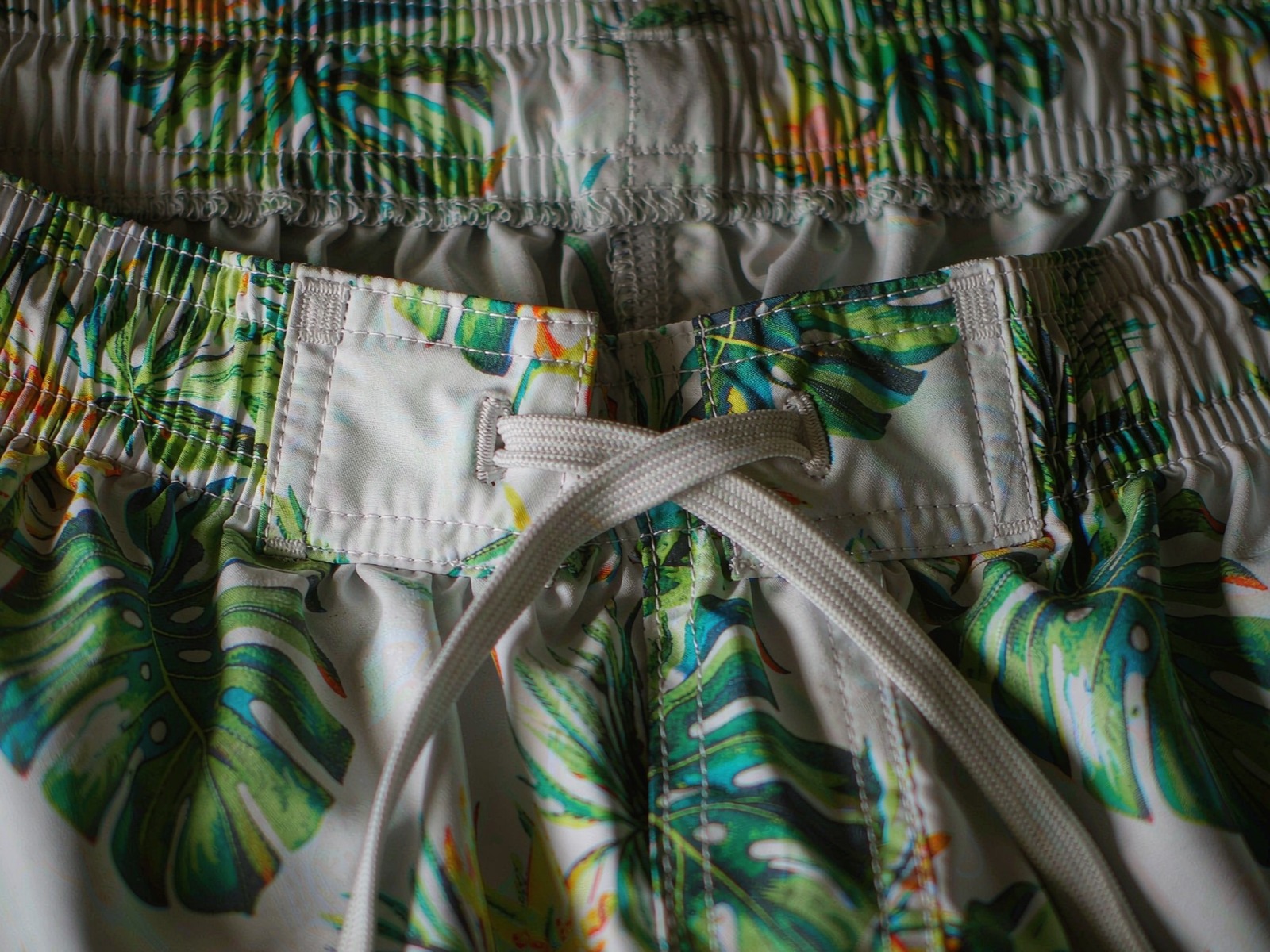
The drawstring fails in three ways, all of them specified rather than sewn. First, the cord pulls out of the waistband in the wash, because it was not caught at the back waist. Second, the eyelet tears, because there is no bartack either side of the exit. Third, the free ends are long enough to catch on something, which is a snag risk on a beach and a compliance issue on a child’s garment. Our standard adult build is 1.2 cm flat woven tape, centre-front exit, four bartacks, and 25 to 30 cm of free end each side, with the cord sewn through at the centre back.
Children’s shorts are not a scaled-down version of this. EN 14682:2014 governs cords and drawstrings on children’s clothing, and the limits are set by age band and body area rather than by waist size, so a boys’ short inherits a different cord specification from the men’s style it was derived from. The boys’ beach shorts OEM guide works through that case, including the testing a buyer should request.
Is the best beach shorts supplier in China the one with the lowest quote?
Rarely, and the reason is structural rather than moral. A quote that omits grading, shrink allowance and inspection is cheaper because those steps are being done by someone else later — usually the buyer, at the point where the goods are already on the water. Since there is no way to compare quotes without comparing what is inside them, the useful question is not who is cheapest but who can answer eight specific questions before the order.
Those eight, in the order we would ask them: can you show a graded size set rather than one sample size; do you measure against a sealed pre-production sample and record the numbers; does your spec sheet name the method for every point; do you provide a shrinkage report per fabric lot; is print placement tied to a named datum; do you run 3,000 pcs per style per colour with the size ratio we need; does the partner factory hold amfori BSCI and OEKO-TEX Standard 100; and will you hand over the tolerance table before the order rather than after the first complaint. A supplier who can answer all eight has a system. A supplier who answers four has a sample room.
How do you write size and fit into an order that can be enforced?
The order document carries six things: the measurement method for each point, the tolerance per point class, the grade rule, the size ratio per carton, the sealed sample reference, and the inspection plan. The inspection plan is where ISO 2859-1 does its work — the 2026 third edition replaced the 1999 edition and keeps the same architecture of code letters, acceptance numbers and switching rules. A 3,000-piece lot of one style in one colour draws 125 pieces at general inspection level II for AQL 2.5, and eight major defects reject it. Size and fit defects belong in the major column, because a short that measures outside tolerance is not saleable at full price.
This is also where a custom beach shorts supplier in China is separated from a trading desk that only relays messages. A custom programme means your print placement, your waistband colour, your label pack and your size grade, all four documented, and all four checked on the pre-production sample rather than on the bulk.
An OEM beach shorts supplier in China should be able to show the tech pack it was given, the sealed sample it returned, and the measured numbers that tie the two together — those three documents are the difference between an OEM programme and a purchase of stock. The label pack itself is a specification: a private-label programme needs your hangtag, your woven label, your size pip and your polybag artwork approved before the labels are ordered, because a label reprint after the goods are packed is the most avoidable delay in the whole timeline.
Timing, because it constrains everything above: sampling takes 12 to 18 days, the pre-production sample 5 to 7 days after approval, the first bulk order 45 to 60 days, and a repeat 30 to 40 days. A size set with nine points and five sizes cannot be compressed into the last week before the cut. If the size chart is still being negotiated when the fabric is booked, the schedule is already gone.
Where to go next
The measurement set only works with the fabric behaviour behind it. The quick-dry fabric guide covers gsm, taslan versus peach finish and recycled polyester; beach shorts versus board shorts versus swim trunks sets out where the three categories diverge; the inspection checklist turns these tolerances into a defect list; and the beach shorts OEM page is the category starting point. Buyers who need the compliance side — OEKO-TEX classes, REACH, UPF and chlorine — should start with the beach shorts compliance guide.
· Xiamen Unitex Trade Co., Ltd. — OEM & ODM underwear sourcing partner