
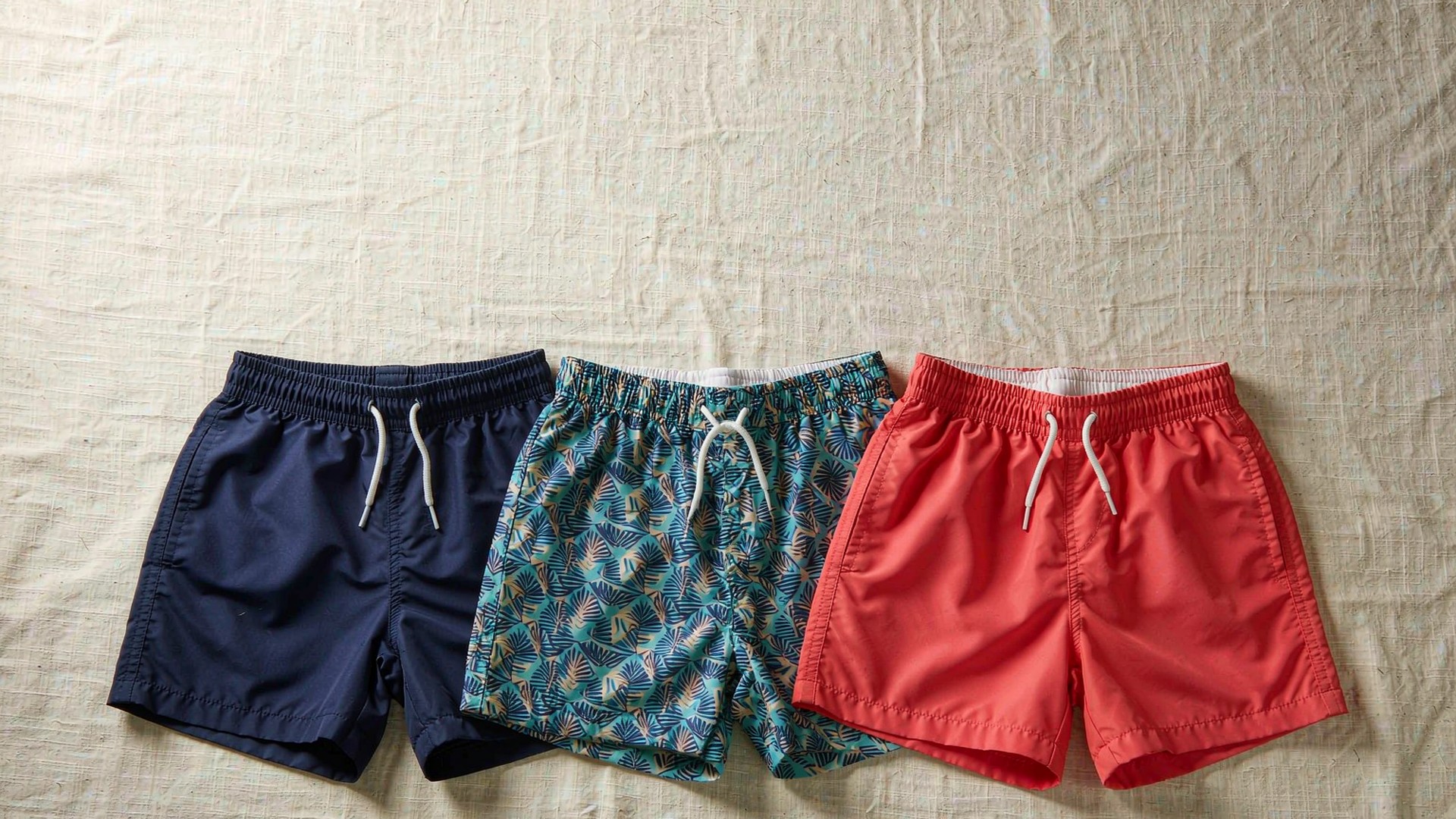
Boys’ beach shorts are not a smaller version of the men’s style with a different label. The rule set changes at the wearer’s age: a garment for a six-year-old is a children’s product, and in the United States that single classification pulls in third-party testing, a Children’s Product Certificate, a permanent tracking label, and a flammability file that has to name the exact route the shell takes. None of that follows the same short in a men’s size.
Most of the confusion sits in one place. The fabric that makes a good boys’ beach short — a 100% polyester or nylon taslan around 100–120 g/m² — is exempt from flammability testing under 16 CFR 1610, and buyers routinely read that exemption as “no flammability rule applies”. It does not mean that. This page separates the two, then works through the tests, the certificate, the sizing block and the cord rules that decide whether a kids’ order clears a customs filing and a retail audit.
Related reading sits in the quick-dry fabric guide for substrate selection, the beach shorts compliance guide for OEKO-TEX classes and REACH, the inspection checklist for the AQL plan that follows testing, and the beach shorts OEM page for the category overview.
Xiamen Unitex Trade Co., Ltd. is a sourcing and trading company, in the trade since 2009 and incorporated in Xiamen in 2013. We are the supplier named on the purchase order. The garments are cut and sewn by partner factories — the manufacturers that hold the social audit (amfori BSCI) and the product certification (OEKO-TEX Standard 100). That split between the trading role and the manufacturing role matters most on a children’s order, where the file has to name who tested what, at which site, for which importer.
What has to be tested on a boys’ beach short, and who signs the certificate?
The test list is short; the paperwork around it is not. On a US-bound boys’ beach short the applicable federal rules are 16 CFR 1610 for flammability of wearing apparel, total lead content at 100 ppm in the substrate under 15 U.S.C. 1278a, and the CPSIA tracking label under section 103 of the Act. Wearing apparel is named on CPSC’s list of rules that require third-party testing and a Children’s Product Certificate, so 1610 is not optional paperwork on a kids’ garment — it is one of the citations that has to appear on the certificate, whether or not a burn test was ever run on the fabric.
The certificate itself is where most sourcing conversations go wrong. A CPC is issued by the US importer or the domestic manufacturer, not by the overseas factory. What the factory supplies is the input: a test report from a CPSC-accepted laboratory naming the rule, the sample, the colourway and the date. A boys’ beach short shipped from Xiamen therefore arrives with a report, and the importer turns that report into a certificate. A supplier who offers to “provide the CPC” is describing the arrangement loosely at best, and a buyer who accepts that answer has usually discovered the gap at the port rather than at sampling.
Testing on request is the position we work from. We do not claim CPSIA certification and we do not hold a certificate that covers a buyer’s garment; we commission the tests the buyer nominates, at the laboratory the buyer nominates, and we schedule them so the report is in hand before the bulk cut rather than after it. An OEM beach shorts supplier in China that will not separate those roles is asking the buyer to carry a risk that sits on the importer’s side of the border, and the garment itself comes from partner factories whose part in the file is to hold the fabric and trim records the laboratory will ask for.
Does 16 CFR 1610 apply to a polyester boys’ beach short?
Yes — the standard applies to all wearing apparel, and the exemption is narrower than it sounds. Section 1610.1(d) exempts two classes of fabric from the requirement to test in support of a guaranty:
- (d)(1) plain surface fabrics, regardless of fibre content, weighing 2.6 oz/yd² or more, which is 88 g/m²;
- (d)(2) all fabrics, plain or raised surface, regardless of weight, made entirely from acrylic, modacrylic, nylon, olefin, polyester or wool, or any combination of those fibres.
Two words do the work. “Entirely” means a 65/35 polyester-cotton blend takes nothing from (d)(2); “plain surface” means a cotton flannel takes nothing from (d)(1) however heavy it is. A 100% polyester taslan at 115 g/m² clears (d)(2) on fibre alone, a polyester-cotton poplin at 120 g/m² clears (d)(1) on weight alone, and a polyester-cotton at 80 g/m² clears neither and has to be tested. That is the whole decision, and it belongs in the tech pack, because the route attaches to the fabric rather than to the style — change the shell and the route changes with it.
The exemption is from testing, not from the standard, and not from the guaranty behind it. A fabric that is exempt still has to perform to 1610 if it is tested, and the firm issuing the guaranty still carries the obligation. For a fabric that is tested, Class 1 normal flammability means an average flame spread time of 3.5 seconds or more on a plain surface, or 7.0 seconds or more on a raised surface, or no base burn at all. A sublimated shell has no raised surface, so 3.5 seconds is the figure that matters.
| Shell fabric | Weight | Surface | Route | What the file needs |
|---|---|---|---|---|
| 100% polyester taslan | 105–120 g/m² | Plain | Exempt, 1610.1(d)(2) | Fibre content evidence from the mill; no burn test |
| 100% nylon taslan | 100–115 g/m² | Plain | Exempt, 1610.1(d)(2) | Same route as polyester; nylon is on the fibre list |
| Polyester-cotton 65/35 | 110–130 g/m² | Plain | Exempt, 1610.1(d)(1) | Weight evidence at or above 88 g/m² |
| Polyester-cotton 65/35 | 75–85 g/m² | Plain | Neither route — test | Burn test report, Class 1 at 3.5 s or more |
| Cotton flannel | Any | Raised | Neither route — test | Burn test report, Class 1 at 7.0 s or more |
| Polyester fleece | 200–240 g/m² | Raised | Exempt, 1610.1(d)(2) | Fibre content evidence; raised surface is allowed |
| Exemption from testing under 16 CFR 1610.1(d) does not withdraw the standard. Weight conversion: 2.6 oz/yd² × 33.906 = 88 g/m², so 88 g/m² is the threshold to write into the tech pack. | ||||
One further route matters when the print is not a dye. Sublimation drives disperse dye into the fibre, so there is no applied layer and no coating question. A plastisol or screen print leaves an ink film, and a film on a children’s garment can bring the 90 ppm lead limit for paint and similar surface coatings under 16 CFR 1303 into the file, on top of the 100 ppm substrate limit. The two limits are different numbers because they measure different things, and a report that quotes one while the print is the other is not answering the question that was asked.
Best beach shorts supplier in China — what does a kids’ programme check first?
The question is typed as a search, so it deserves an answer a buyer can verify rather than a ranking. Six items separate a supplier who can run a children’s programme from one who can run an adult programme and hopes the difference does not surface.
- The report names the rule and the sample. “Passed flammability” is not a citation. The document should quote 16 CFR 1610, the shell and print actually used, and the date of the test.
- The laboratory is CPSC-accepted. For a US children’s order the accreditation scope has to cover 1610; a report from a laboratory outside that scope does not support a certificate.
- The tracking label artwork exists before bulk. Importer or private-labeler name, production location and date, and a batch or run number — permanent, legible, on the garment and on the packaging to the extent practicable.
- The OEKO-TEX class matches the size range. Class 1 covers articles for babies and toddlers up to three years; a 4–14 range sits in Class 2 for direct skin contact, and one 2–3 year size in the same order pulls the style into Class 1.
- Quantity is quoted per style and per colour. A programme that prices 30,000 pieces as one line is not quoting the same thing as one that prices 3,000 per colourway.
- Someone signs for the drawcord. Cord length, attachment and free ends are a design decision, not a trim detail, and they are the most common finding on a kids’ short.
Against those six, the checkable facts about us are these: in the trade since 2009, incorporated in Xiamen in 2013, 600,000 pcs monthly capacity across partner factories that hold amfori BSCI and OEKO-TEX Standard 100, and a quotation written at 3,000 pcs per style per colour. A reliable supplier is judged on those documents rather than on the adjectives in a profile, and whether that makes a particular supplier the right one for a given programme is the buyer’s call.
What changes in sizing when the wearer is six, not thirty-six?
Three things: the measurement points, the growth allowance, and the tolerance the chart can afford. ISO 8559-1 defines the body measurement points, ISO 8559-2 sets out the primary and secondary dimensions a garment size is built from, and EN 13402-3 designates children’s sizes by height in centimetres — which is why a European kids’ order arrives as 104, 116, 128, 140, 152 and not as S, M, L.
The consequence on a beach short is that the inseam shrinks faster than the waist grows. A men’s medium runs a 20–22 cm inseam; carried unchanged onto a 128 cm boy that length reaches the knee, so our kids’ block runs 12 cm at 104, 16 cm at 128 and 21 cm at 164, and the leg opening widens to keep the short clear of the thigh in movement. The waistband carries more adjustment than an adult style — a 3 cm elastic with a drawcord rather than a fixed waist — and the drawcord is functional rather than decorative, which is exactly why the cord rules below bind.
Tolerances move the other way. Plus or minus 1.0 cm is a 2 cm band — about 2.5% of an 80 cm men’s medium waist and nearly 4% of the 52 cm waist on the 104 size — so a chart that carries adult tolerances across the range will pass garments that do not fit. Our kids’ block runs ±1.0 cm on waist and hip and ±0.5 cm on inseam and outseam, measured flat after 24 hours relaxation, on the points named in the tech pack rather than on points the inspector chooses on the day.
| Height band (cm) | Waist relaxed | Hip | Inseam | Leg opening |
|---|---|---|---|---|
| 104 | 52 cm | 60 cm | 12 cm | 42 cm |
| 116 | 55 cm | 64 cm | 14 cm | 44 cm |
| 128 | 58 cm | 69 cm | 16 cm | 47 cm |
| 140 | 62 cm | 74 cm | 18 cm | 50 cm |
| 152 | 66 cm | 80 cm | 20 cm | 53 cm |
| 164 | 70 cm | 86 cm | 21 cm | 55 cm |
| These are our block figures for a mid-rise elastic short, confirmed against the signed measurement chart at PPS — not values published by a standard. ISO 8559-1 fixes the measurement points and EN 13402-3 fixes the height bands; the numbers in between are a commercial agreement. | ||||
Which cord and drawstring rules apply to a boys’ beach short?
In the EU, EN 14682:2014 is the reference. It covers cords and drawstrings on children’s clothing up to 14 years and works by body zone and age band rather than by garment type, which is why the same cord is compliant on a jacket and not on a short. Two requirements land on a beach short: functional cords in the waist area must not have free ends longer than 14 cm, and no cord may hang below the hem of the garment. The head and neck zones are stricter still — for children up to seven years, functional cords are not permitted there at all — which matters if the style carries a hood, a contrast collar or a neck tie.
In the US there is no equivalent garment standard for lower-body drawstrings: ASTM F1816 addresses drawstrings on children’s upper outerwear, so a waist cord on a short falls outside it. The practical answer is to design to EN 14682 for every market. It is the more demanding reference, and a design that passes it does not need a second version for Europe. For sizes 2T and under, detachable hardware at the cord exit is also assessed under the small parts rule at 16 CFR 1501.
On the line that means a sewn-through channel rather than an open casing, a bartack at each cord exit so the cord cannot pull through, no metal aglets on the youngest sizes, and a cord length written into the tech pack as a finished measurement rather than as “standard”. These are cheap decisions at sampling and expensive ones at the port.
How do you fit the testing window into a 45–60 day bulk?
Testing is not a step that runs alongside production; it gates the cut. The sequence that works puts the shell, the print and the trim in front of the laboratory at PPS stage, so the report describes the goods that will be made rather than the goods that were proposed. Development sampling runs 12–18 days, PPS 5–7 days once the fabric is approved, and bulk 45–60 days on a first order and 30–40 days on a repeat. A third-party turnaround of one to two weeks on a three-panel submission is typical rather than published, so it belongs in the plan as a buffer rather than as a hope.
| Test | Method | Sample | When it runs |
|---|---|---|---|
| Flammability | 16 CFR 1610, or the documented exemption route | Full garment, each shell and print | PPS, before the bulk cut |
| Colour fastness to chlorinated water | ISO 105-E03 at 20, 50 and 100 mg/l | Shell and print, per colourway | PPS |
| Colour fastness to washing | ISO 105-C06 | Per colourway | PPS |
| Colour fastness to rubbing | ISO 105-X12, dry and wet | Printed panels | PPS, after the final press |
| Dimensional change | ISO 6330, method set by the care label to ISO 3758 | Per shell | PPS |
| Total lead content | 15 U.S.C. 1278a, 100 ppm in the substrate | Shell, print and trim | Before bulk, US orders |
| UPF claim | EN 13758-1 for the fabric, AATCC 183 for the US, AS/NZS 4399 for AU and NZ | Per shell, unwashed and after washing | Only where a UPF claim is made |
| Small parts | 16 CFR 1501 | Hardware at the cord exits, sizes 2T and under | At sample approval |
| Each test on this list is run when the claim or the destination market requires it. Flammability is the one that is never skipped on a US children’s order, even where the shell is exempt from testing, because the route has to be documented rather than assumed. | |||
Two habits keep the calendar honest. The first is testing the fabric that will actually be used: a lab report on a mill’s stock article means nothing if the bulk shell comes from a different lot with a different weight. The second is separating the report date from the shipment date in the plan, because a certificate filed against a report that has not arrived yet is the most common reason a container sits.
What does a private label programme need beyond the garment?
On a private label beach shorts programme the garment is the easy part; the identification is where a retail audit stops a shipment. A complete set carries your hang tag, your woven main label, a care label whose symbols follow ISO 3758, your barcode on the tag or the polybag, a polybag that meets the packaging rules of the destination market, and the tracking label described above. On an EU order the GPSR block — responsible person name and address inside the Union — has to be on the product or its packaging, since Regulation (EU) 2023/988 has applied from 13 December 2024.
A custom beach shorts supplier in China is therefore being asked for more than a print: your artwork applied to the shell, your woven and care labels sewn in the positions the tech pack names, your polybag and barcode, and a sample set that shows all of it on the garment rather than in a folder. We run that as a single approval round at PPS, because approving a label separately from the garment it is sewn into is how a wrong care label reaches a container. Fibre content on the woven label follows Regulation (EU) No 1007/2011, and the stitch types called out in the tech pack follow ISO 4915.
What should a buyer confirm before approving a boys’ beach short?
Five items, all of them one page of paperwork each. The shell and its weight, because that decides the flammability route. The print method, because dye in the fibre and an ink film are treated differently. The full size range, because one 2–3 year size moves the OEKO-TEX class. The cord specification, because EN 14682 is a design constraint and not a finishing check. And who issues the certificate, because on a US order that party is the importer and never the factory.
Boys’ beach shorts are a documentation problem before they are a sewing problem. Get those five in writing at PPS and the inspection that follows is a formality; leave one of them to email and it becomes a hold. The commercial frame is quoted once and does not move with the size range: 3,000 pcs per style per colour, development sampling 12–18 days, PPS 5–7 days, bulk 45–60 days on a first order and 30–40 days on a repeat, 30% on order confirmation with 70% against a copy of the B/L, FOB Xiamen, quotation valid 30 days, inspection to AQL under ISO 2859-1 on the defect list agreed at PPS.
Boys’ styles sit on the beach shorts OEM page beside the adult range; the cut differences against board shorts and swim trunks are set out in beach shorts versus board shorts versus swim trunks, and the measurement discipline here runs the same way through our men’s underwear OEM programmes, where the audit position is identical.
References
Sources used for the standards, test methods and regulations cited in this article.
- eCFR — 16 CFR Part 1610, Standard for the Flammability of Clothing Textiles, including 1610.1(d)
- CPSC — rules requiring third-party testing and a Children’s Product Certificate (wearing apparel, 16 CFR part 1610)
- CPSC — testing and certification, and the CPSC-accepted laboratory requirement
- CPSC — tracking label business guidance, CPSIA section 103
- CPSC — Children’s Product Certificate business guidance
- CEN-CENELEC — EN 14682:2014, safety of children’s clothing, cords and drawstrings
- ISO Online Browsing Platform — ISO 8559-1, ISO 8559-2, ISO 105-E03, ISO 105-C06, ISO 105-X12, ISO 6330, ISO 3758, ISO 2859-1, ISO 4915
- ISO 105-E03:2010 — colour fastness to chlorinated water, at 20, 50 and 100 mg/l
- OEKO-TEX STANDARD 100 — product classes and limit values for skin-contact articles
- amfori BSCI — the social audit held by the partner factories
- EUR-Lex — Regulation (EU) 2023/988 on general product safety
- EUR-Lex — Regulation (EU) No 1007/2011 on textile fibre names
- ECHA — substances restricted under REACH Annex XVII
- AATCC — AATCC 183, transmittance of ultraviolet radiation through fabrics
- FTC — fibre content and care labelling under the Textile and Wool Acts
· Xiamen Unitex Trade Co., Ltd. — OEM & ODM underwear sourcing partner