
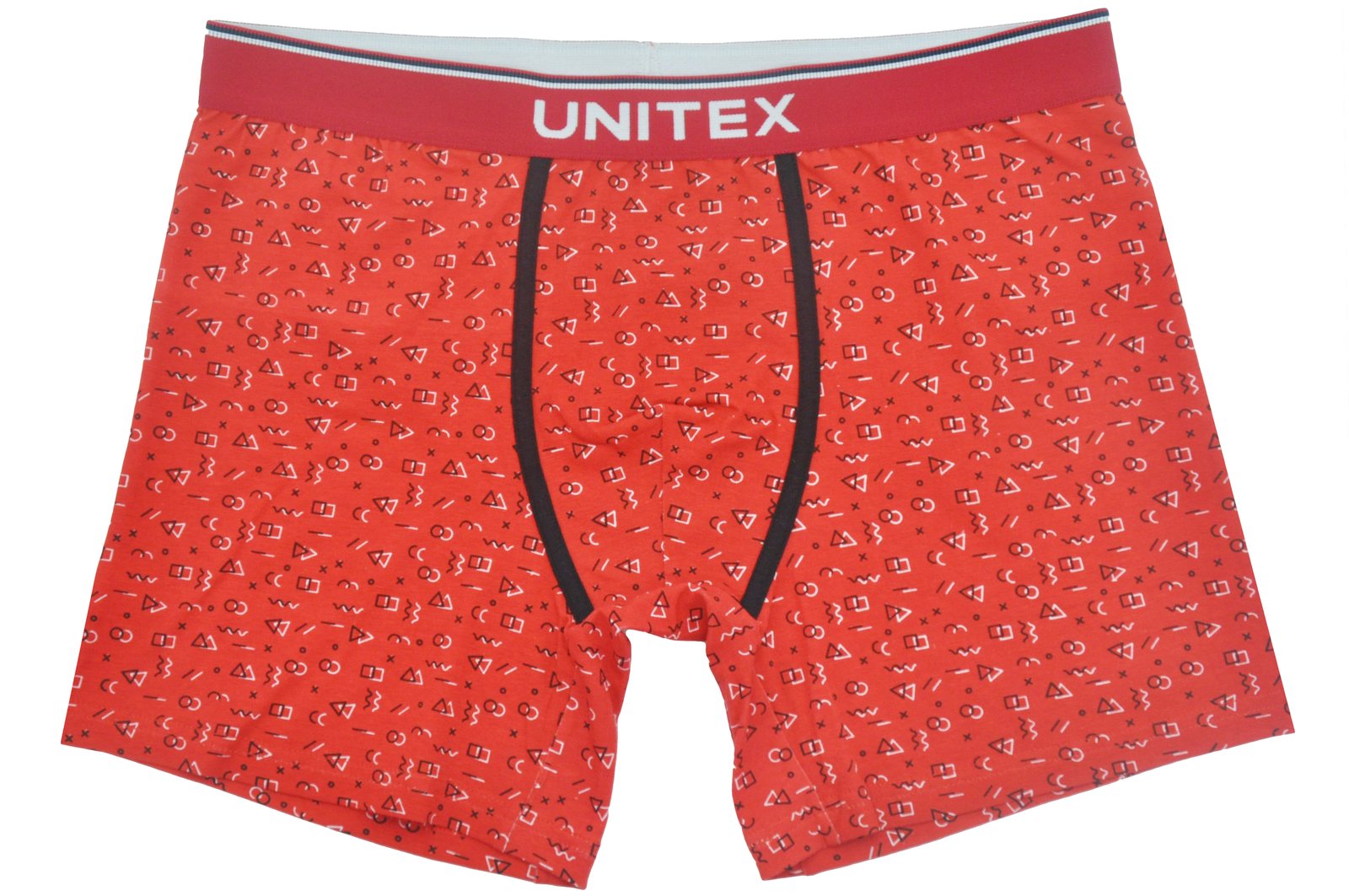
Almost every underwear fabric in the market is knitted, not woven, and the word “weaving” survives in the trade because buyers and suppliers both use it loosely. The distinction matters before a price is discussed: a knitted fabric is built from interlocking loops and stretches by construction, while a woven fabric is built from two sets of straight yarns that cross and do not stretch. Once the construction route is fixed, the machine, the gauge, the fabric weight and the seam type follow from it.
Three knitting routes supply underwear fabrics: circular knitting for tubular fabric, flat knitting for panels and whole-garment pieces, and warp knitting for dimensionally stable linings and compression panels. What each one decides is set out below, with the machine gauge, the fabric weight band and the inspection points a buyer can actually check.
1. Circular knitting: the tubular route most underwear comes from
A circular machine knits a tube, so the fabric arrives as a sock-like roll rather than a flat width. That is why the construction is behind so many side-seam-free bodies: a single tube becomes the body of a brief or a boxer with seams only at the crotch and the waist. It is also the fastest and cheapest of the three routes per kilogram, which is the reason it dominates volume programmes.
Gauge is the number a buyer meets first. It is written as GG — needles per inch of cylinder — and it sets the relationship between yarn count and fabric weight. A coarse gauge knits a heavier, more robust fabric from a thicker yarn; a fine gauge knits a lighter, smoother fabric from a finer yarn. The partner mills we work with run the range from 18GG to 40GG, and the gauge is quoted alongside the yarn count, never on its own.
| Route | Gauge notation | Fabric it produces | Typical underwear use |
|---|---|---|---|
| Circular, single jersey | GG, needles per inch of cylinder | One face of loops, the lightest and most stretchable structure | Briefs, boxer briefs, camisoles, linings |
| Circular, rib | GG | Alternating knit and purl wales, elastic across the width | Waistbands, cuffs, body panels where recovery matters |
| Circular, interlock | GG | Two interlocked faces, stable and smooth on both sides | Bodies that must not curl, thicker winter weights |
| Flat knitting | GG, needles per bed | Panels knitted to shape, or a whole garment | Seamless briefs and boxers, shaped panels |
| Warp knitting | E, needles per inch (a different scale from GG) | Stable, low-stretch, fine surface | Linings and compression panels where stability beats stretch |
A woven route exists too, and it is worth knowing where it belongs: a boys’ woven boxer is cut from poplin or flannel rather than knitted, and the woven boys’ boxer page sets out what that changes in pattern and inspection. Within the knitted routes, two practical consequences follow. A tubular fabric cannot be flat-printed in the usual way without slitting it open, so an all-over print programme is a different supply route from a plain tubular programme. And a tube has a width but no selvedge, so the finished garment measurement is controlled by the machine diameter rather than by a cut width.
2. Flat knitting: where “seamless” actually comes from
Flat knitting builds panels in garment shape, or on a whole-garment machine builds the piece in one pass. This is the route behind seamless underwear in the strict sense: a knitted tube with integrally knitted leg openings or a shaped body, so the garment has no side seam to sew. It is slower than circular knitting and the machine cost per piece is higher, which is why seamless sits at a different price point rather than replacing the sewn brief.
The distinction that matters commercially is between seamless knitting and bonded construction. Seamless means the fabric is knitted as one piece with no side seam. Laser-cut and bonded means a flat fabric is cut and joined with adhesive, with no sewing. The two are often marketed with the same words and they are not the same product, so a specification should name which one it is buying.
3. Warp knitting: the stable route, and why its gauge looks different
Warp knitting feeds many yarns at once along the length of the fabric, which produces a structure that holds its shape rather than stretching with the body. That is exactly what a lining or a compression panel needs, and it is why the route exists in underwear at all. Its gauge is written with E, not GG, because the needle count is measured on a different bed; mixing the two notations in one tech pack is a reliable way to receive the wrong fabric.
4. Yarn, gauge and weight: the three numbers that travel together
A fabric weight on its own says very little. The same 160 g/m² can come from a fine gauge with a fine yarn or a coarser gauge with a thicker yarn, and the two behave differently in the wash. The numbers below are the ones to quote as a set, and the weight bands are typical commercial ranges for underwear knits rather than limits set by any standard.
| Parameter | How it is expressed | What it controls | Where it is verified |
|---|---|---|---|
| Yarn count | Ne, imperial count for cotton | Smoothness, strength, the finest gauge the yarn can survive | Yarn certificate, then the knitted sample |
| Yarn type | Carded or combed, ring or compact spun | Hairiness, pilling, surface smoothness | Yarn certificate, pilling test on the fabric |
| Gauge | GG for circular and flat, E for warp | The weight and the hand-feel for a given yarn | Machine specification, then the fabric |
| Fabric weight | g/m², measured to ISO 3801 | Coverage, opacity, drape, cost | Cut-and-weigh on the finished roll |
| Stitch density | Courses and wales per inch | Stability, shrinkage, print definition | Magnifier or pick glass at inspection |
| Elastane content | Percentage by weight | Recovery and growth, at the cost of stability | Composition test, then the wash trial |
The elastane figure is where most first specifications go wrong in one direction or the other. A high percentage buys recovery and pays for it with growth after wear, and a low percentage holds shape and pays for it with a tight waistband. The number has to come from a wear trial on the actual body type, not from a competitor’s label.
5. What the construction decides about shrinkage
A knitted cotton fabric relaxes after washing, and the relaxation is a property of the loop structure rather than a defect. The test method is fixed — ISO 6330 for the domestic washing procedure and ISO 5077 for the dimensional change measurement — while the pass threshold is commercial and belongs in the specification. A compacted, pre-shrunk knit starts from a lower figure than a plain knit because the relaxation has already been taken out at the mill, and that difference is visible in the price per kilogram.
Two rules keep this honest. Test the fabric as it will be washed by the end consumer, using the care label instruction rather than a convenient laboratory condition. And test the finished garment as well as the roll, because a waistband and a seam can add shrinkage that the fabric never showed on its own.
6. The defects this construction produces, and how to find them
Knitted fabric fails differently from woven fabric, and the failure modes are specific enough to be named in an inspection plan. The sampling plan and the AQL come from the purchase order, with ISO 2859-1 as the standard behind almost every garment AQL clause.
- Barre, or horizontal streaks. Caused by yarn count variation, a mixed yarn lot or a damaged needle. Visible under oblique light, which means it has to be checked on the roll, not on a folded garment.
- Needle lines and dropped stitches. A vertical line of distortion from one needle position, which becomes a hole after a few washes.
- Spirality, or torque. The garment twists after washing because of the twist direction in the yarn; it shows up as a side seam that moves to the front.
- Weight shortfall. A roll below the specified g/m² within the tolerance, which usually means a lighter yarn rather than a knitting error.
- Shade variation between rolls. A dye-lot problem rather than a knitting problem, and the reason a cutting plan needs roll numbers.
None of these is caught by measuring a folded garment on a table. They need the roll, oblique light and a wash trial, which is why the fabric inspection is worth doing before the cutting table rather than after the sewing line.
7. How we work on fabric development
Unitex is a sourcing and trading company based in Xiamen, working with partner factories across the Xiamen–Quanzhou–Jinjiang knitwear cluster rather than owning mills. The partner factories hold amfori BSCI and OEKO-TEX Standard 100 certification. What we do is convert a hand-feel brief into a construction: gauge, yarn count, weight, elastane percentage and the test plan that proves each one, then hold that construction stable across the order.
What we do not claim is a mill of our own, a gauge we do not have access to, or a test result we have not seen. A fabric brief that names a gauge and a weight but not a yarn count is a brief that will come back with three different samples, and the specification work exists to prevent exactly that.
8. Next step
If you are developing a knitted underwear fabric and want the construction fixed before sampling, send the hand-feel reference, the target weight and the destination market. We will return the gauge and yarn combination that reaches it, the test plan behind each number, and the fabric inspection points to write into the purchase order. For the sewing side of the same programme, the flatlock construction guide covers stitch type and seam verification, and the OEM product range shows what the constructions become in a finished garment.
· Xiamen Unitex Trade Co., Ltd. — OEM & ODM underwear sourcing partner