
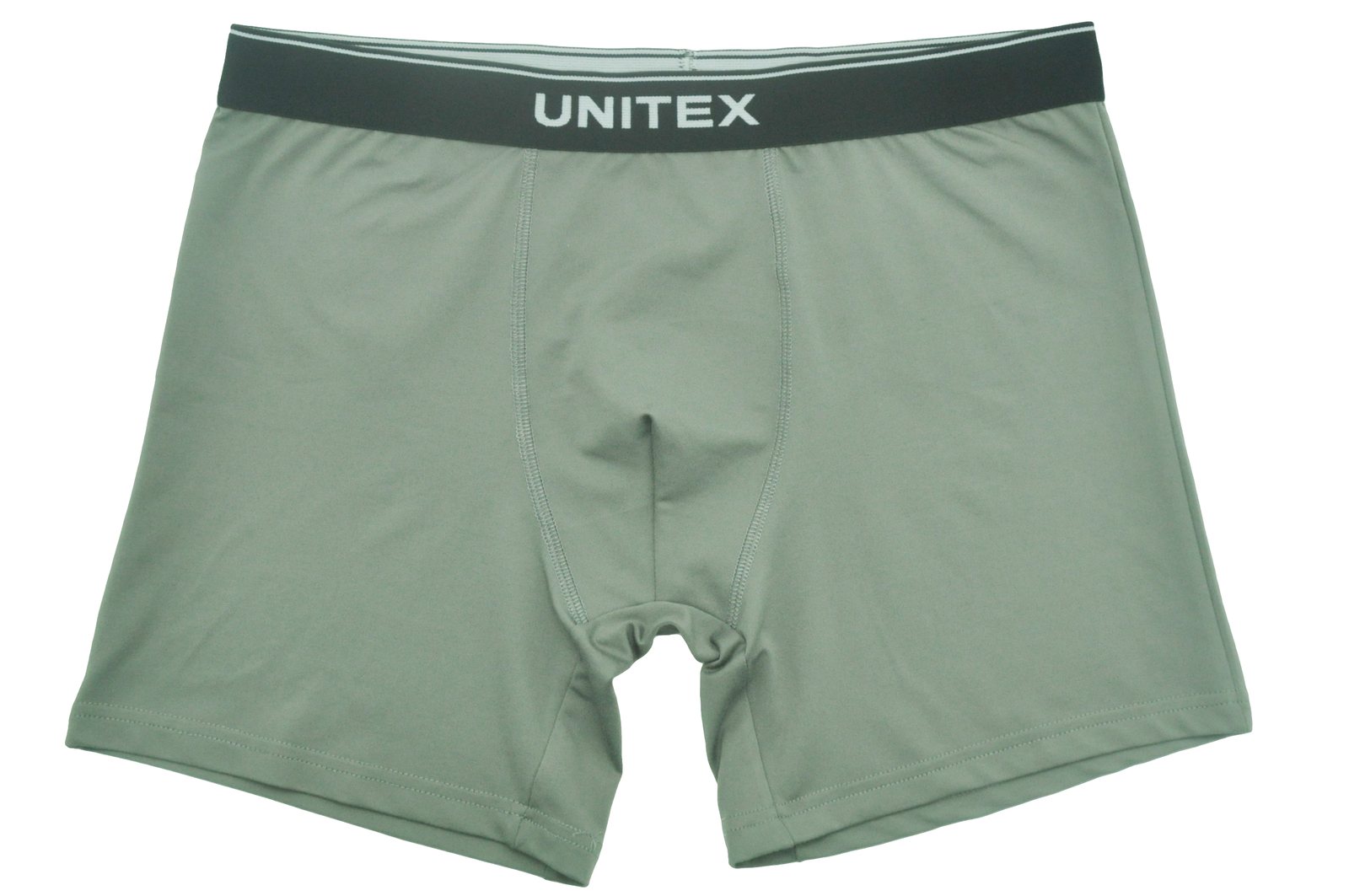
Quick answer. Custom kids’ underwear normally runs on a minimum of 3,600 pieces per style and colour. The gate is compliance rather than construction: children’s articles fall under OEKO-TEX Standard 100 Class I rather than the Class II used for adult lines, the age band decides which requirements apply, and the print and trims are part of the tested article.
1. What differs from an adult programme
The sewing is similar. Four things are not.
- Compliance class. Class I applies to articles with direct skin contact for babies and children, and a Class II certificate does not satisfy it. A supplier working mainly on adult lines may default to Class II without flagging the difference.
- Age band. Requirements tighten as the band drops, so the band has to be stated per style rather than at range level.
- Size grade. Children’s sizing follows body development rather than a scaled-down adult block, and proportions change quickly through childhood.
- Print and trims. A printed panel, a bow, a patch or a cord is part of the tested article, so the test scope has to cover them.
2. Compliance is the gate, not the finish
- OEKO-TEX Standard 100 Class I — direct skin contact for babies and children. Confirm the class explicitly rather than inheriting a Class II specification.
- CPSIA — governs children’s products entering the United States, with third-party testing where the applicable rules require it.
- EN 71-3 and EN 14682 — the European framework, covering migration of certain elements and cords or drawstrings. The second matters wherever a waistband carries a drawcord.
- Test scope. Print, dye and trims are part of the tested article; a report covering the base fabric alone does not support a claim about a printed garment.
Confirm the age band and the destination market together, before the sample is approved. A specification fixed at range level and applied across several bands usually ends up over-specified at one end and under-specified at the other.
3. Age bands and sizing
- Bands, not one range. Typical bands run 2–4, 4–6, 6–8, 8–10, 10–12 and 12–14, and each still needs more than one size.
- Grade within the band. A child can gain height without gaining waist, so a two-year band covers two body shapes at the same nominal size.
- Check the ends. The middle of a band is usually the sample size; the ends are where a shallow block shows.
- Allow for growth. A garment that fits exactly at the start of a band is outgrown before the band ends, which is a design decision rather than a fault.
4. The four specification decisions
- Construction. Flatlock or bonded seams, because the wearer cannot adjust the garment. A seam an adult would shift out of the way simply rubs for a child.
- Waistband. Soft, with recovery at low tension rather than a strong hold. A waistband that grips to stay up will mark the skin.
- Fabric and weight. Fibre, blend ratio and weight in g/m², chosen for the climate and the season rather than the price tier alone.
- Print, trim and gusset. Each listed and tested as its own item, since all three are part of the tested article.
5. MOQ, cost and lead time
- Minimum. Around 3,600 pieces per style and colour.
- Granularity pressure. Kids’ ranges often carry more colourways than adult ones, which makes the arithmetic the main constraint on a first order.
- Sampling. 7–10 days on a stock block, 12–18 days for full custom development.
- Bulk production. 45–60 days after pre-production sample approval, 30–40 days on a repeat.
- Additional window. The testing cycle sits on top of production rather than inside it, so it belongs in the schedule from the start.
6. Common errors in kids’ programmes
- Inheriting the adult class. The most common error and the most expensive to discover after testing.
- Scaling an adult pattern down. Produces a garment that matches the measurements on paper and sits wrong in wear.
- Listing the print but not the trims. Both are part of the tested article.
- Fixing the specification at range level. Requirements differ by age band, so one specification over-serves one end and under-serves the other.
- Leaving the testing window out of the schedule. It is the item that moves a launch date in this category more than production does.
- Ordering too wide too early. Depth in two or three styles tests a market better than six at shallow depth.
7. How to compare two quotations
- Same age band and same class. A quotation that assumes Class II is not comparable with one that prices Class I.
- Test scope stated. Whether the price includes testing the print and trims, or only the base fabric.
- Fabric and weight itemised. The same fibre at a different weight is a different garment.
- Seam construction stated. Flatlock or bonded is a cost line, not a description.
- Minimum basis, trade term and validity. Per style and colour, FOB and the port, plus how long the figure stands.
Specification at a glance
| Specification item | What to write | Why it decides the order |
|---|---|---|
| Age band | Toddler, kids or teen, stated in months and height | The band decides the safety requirement set |
| Skin-contact class | OEKO-TEX Standard 100 Class I for toddler sizes | Class II does not cover the youngest band |
| Waistband | Soft covered elastic, no exposed edge | Chafing is the return reason in this category |
| Construction | Flat seams and a printed rather than sewn label | Sewn labels are felt through the garment |
| Design limits | Cords, small parts and embellishment checked against the market rule | A drawcord can fail a whole shipment |
| Size grade | Height-based rather than age-based where the market expects it | Age labels do not predict fit in childrenswear |
Where the specification usually slips
| Item | What buyers often write | What it should say |
|---|---|---|
| Age | 4-6 years | Months, height and weight, with the band boundary stated |
| Safety | Oeko-Tex | Class I at the youngest size, named on the certificate |
| Label | Printed | Printed care and size label, not sewn |
| Trim | Small bow | No detachable parts; state the fixed alternative |
Related specifications
Related specifications: kids boxer shorts programme and school boxer shorts programme. For the commercial side of the same decision, see kids’ compliance bands and chemical limits for childrenswear.
· Xiamen Unitex Trade Co., Ltd. — OEM & ODM underwear sourcing partner