
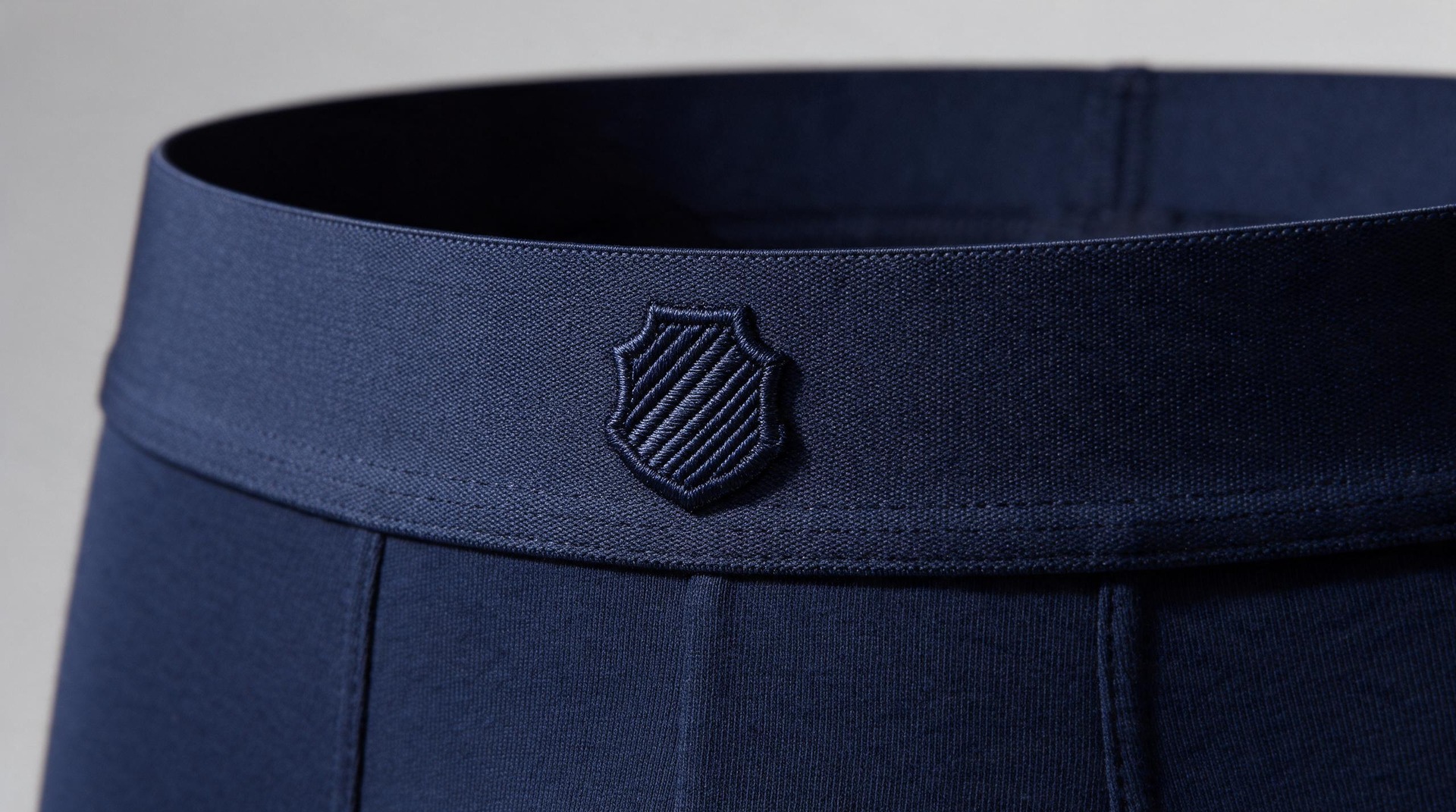
A boxer brief waistband is specified by four numbers, not by a photograph: the width of the elastic in millimetres, the elongation it works at, the recovery after washing, and how the band is fixed to the garment. With those four the brief can be quoted, sampled and inspected. Without them every delivery is judged by impression, and the complaint arrives when the garment is already on a shelf.
This guide sets out how each of the four is decided, what the standards actually cover, and what belongs on the approval sheet — including the tolerances Unitex Underwear works to on waistband orders. Figures drawn from our own practice are marked as such, because no official statistic exists for most of them.
The three constructions, and why they are not interchangeable
Almost every argument about a men’s boxer brief waistband ends in one of three constructions. They are not variations on a theme: each attaches the band to the body differently, and each fails for a different reason.
| Construction | How it is fixed | What it buys | Where it fails | |—|—|—|—| | Woven jacquard with logo | Elastic woven on a needle loom, then sewn or bonded to the garment | Brand integrated into the band itself; clean read; does not wash off | The loom is set per design, so each pattern opens its own minimum and lead time | | Covered elastic (two-ply) | Elastic sits in a channel of the same fabric, closed with a topstitch | Soft hand, clean look, discreet or no branding | The channel twists if the width is not right; the topstitch marks the fabric if tension rises | | Bonded | Hot-melt tape or PUR dot on a laser-cut edge | Flat edge, no thread, very low profile under clothing | Narrow wash window: the adhesive softens with heat and the band lifts |
The practical decision is usually this. If the brand is meant to be read on the waistband, a jacquard band solves branding and structure in one piece. If the product competes on hand-feel and entry price, covered elastic is cheaper per unit and more forgiving of a colour change. Bonded belongs to a different discussion — the invisible edge — and carries a condition that is not negotiable: the care instruction declared on the label has to be compatible with the adhesive. A bonded waistband with a high-temperature tumble dry on the care label is a design contradiction, not a production problem.
In all three cases the waistband type is a specification decision. Changing it on a repeat forces a new sample, because it changes consumption, line time and behaviour after washing. In practice that is treated as a new style, with its own approval and its own record.
For the constructions behind the band, the seam that most often decides whether a waistband holds is the four-needle flatlock; the ISO 4915 class 600 designation is covered below.
Width is decided by size and use, not by aesthetics
Band width is the number most often improvised and the one the wearer notices first. A narrow band on a large size digs in. A wide band on a small size rides up when the wearer sits. The width has to spread the load over enough surface without invading the hip.
On our boxer brief orders, the bands that work are these.
| Style | Usual width (our practice) | What happens outside the range | |—|—|—| | Adult boxer briefs, S–XL | 32–35 mm | Below 30 mm the band rolls at the waist; above 38 mm it invades the hip on small sizes | | Larger sizes, XXL–4XL | 38–40 mm | A standard-size width forces the tension up and leaves a mark on the skin | | Men’s briefs | 25–28 mm | A boxer width on a brief looks out of proportion and raises cost without improving fit | | Bonded waistband | 28–32 mm | Above 32 mm the tape needs more heat to activate and the risk of lifting rises |
Two clarifications that prevent misreading. First, width is measured at rest, laid flat on a table — not on a body. A measurement taken on a form or on a fit model is not the same number and cannot be compared with a specification. Second, width is not chosen by size alone; it is chosen by the relationship between fabric weight and band force. A 200 gsm combed cotton boxer brief pulls harder than a 160 gsm one, and with the same band the feel changes even though the measurement is identical.
That is why a specification that names width but not fabric weight is incomplete: the two interact, and the buyer feels the combination rather than either number alone.
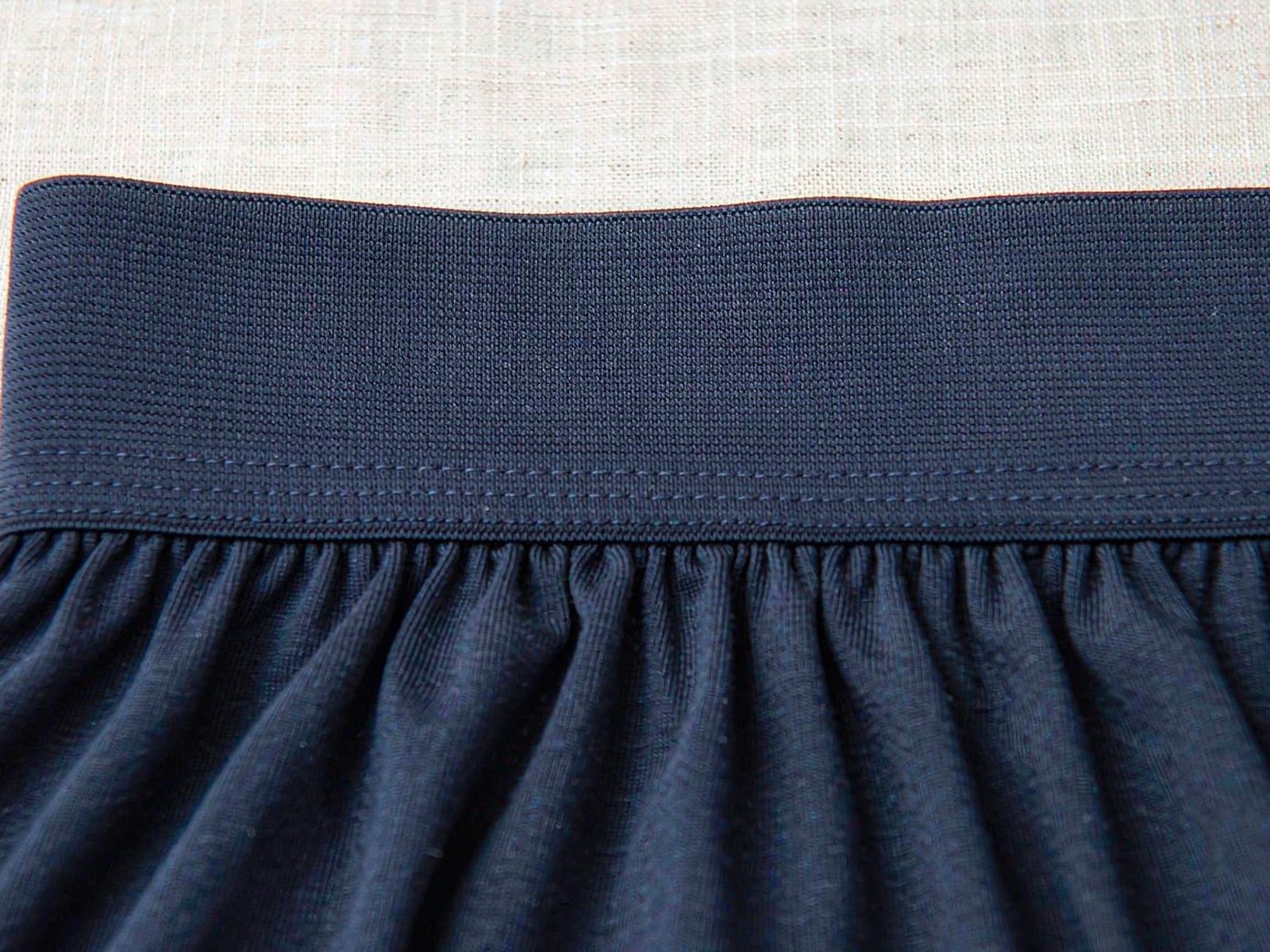
Elongation and recovery: the two tests that can actually be cited
This is where a conversation with a supplier separates from a conversation with a catalogue. Elongation and recovery are measured properties, not adjectives.
The normative point comes first. ISO 20932-1:2018, which covers elasticity of fabrics by strip specimens, expressly excludes narrow fabrics from its scope. A waistband is exactly that — a narrow band. The test that applies to the band is therefore ISO 20932-3:2018, which specifies methods for narrow fabrics and separates two uses: a method A oriented to product quality assurance, and a method B oriented to behaviour in use. Those are different questions: *does this band meet what was agreed*, and *does this band survive what the wearer will do to it*.
The vocabulary point comes second. An elongation of 100% means the band is taken to twice its resting length. It is not “very stretchy”; it is a figure, measured on a constant-rate-of-extension machine. If a technical sheet says “high-elasticity elastic” and does not say at what elongation it works, there is nothing to verify at reception.
The third point concerns strength. ISO 13934-1:2013 determines maximum force and elongation at maximum force on a strip specimen, on a constant-rate-of-extension machine, and provides for specimens conditioned in the standard atmosphere and specimens in the wet state. That second condition is the one that matters in underwear: a band that behaves well dry and loses strength wet is the one that fails at the third wash, not in the shop.
What goes on the sheet, then, is two values and one condition: working elongation, recovery after resting, and the state in which it was tested. Recovery is read at two horizons because they are not the same number — the figure at 30 minutes describes how the garment feels when worn, and the figure at 24 hours describes whether the band comes back or stays open.
Washing: the test that decides the reorder
A waistband is not judged on a freshly made counter-sample. It is judged after washing, because washing is what relaxes the elastic and reveals whether the adhesive or the thread holds.
ISO 6330:2021 is the reference, and its scope is wider than it is usually given credit for: it covers 16 washing procedures with the type A horizontal-axis front-loading reference machine, 12 procedures with the type B vertical-axis top-loading agitator machine, and 7 procedures with the type C vertical-axis pulsator machine. It adds six drying procedures — line, line drip, flat, flat drip, press flat and tumble — and states that a complete test is one wash plus one dry. So “washed to ISO 6330” says nothing unless the procedure and the drying are named.
That is where the most useful conversation with a supplier starts. The same elastic can pass with line drying and fail with tumble drying. If the care label for the destination market declares tumble drying, the order protocol has to include tumble drying — that is the condition the buyer will meet in use, and the one that turns an acceptable band into one that stays open.
Our approval protocol on waistband orders is three complete wash-and-dry cycles, with the band measured at rest before the first cycle, at 30 minutes after the last, and at 24 hours after the last, compared against the approved counter-sample. The tolerance is agreed in writing before production, not after seeing the result.
Two further references are worth naming because buyers meet them in test reports. AATCC TM135 covers dimensional changes after automatic home laundering and is the method most US retail programmes cite alongside ISO 6330; ASTM D2594 covers stretch and recovery of low-power stretch fabrics and is the test a US buyer is likelier to have in an existing protocol. Neither replaces ISO 20932-3 for a narrow band, but a report may arrive citing either, and the specification should say which one the acceptance is based on.
That protocol has a consequence that is usually forgotten: the care label stops being a formality. ISO 3758:2023 sets the graphic care symbol system and its use in labelling; in the United States the care instruction is governed by 16 CFR 423. If the band is bonded, the label cannot recommend high-temperature tumble drying. If the band is cotton with covered elastic, the limit is set by fabric shrinkage more than by the band.
Fixing the band to the garment: stitch class 607 versus bonding
With the band defined in width and elasticity, what remains is how it joins the body. On cotton boxer briefs the answer is almost always a coverstitch. On nylon or polyester with elastane there are two open routes.
ISO 4915:1991 classifies and designates stitch types. The family that matters here is class 600, coverstitches, within which designation 607 is the four-needle, six-thread configuration the market calls flatlock. The difference from bonding is not aesthetic: in a seam the load travels through threads, in a bond it travels through a layer of adhesive. That decides what fails first, and whether the garment can be repaired at all.
On our orders, stitch density at the waistband join runs 11–13 stitches per 3 cm. Below that, the band separates at the point of highest tension. Above it, the needle perforates the elastic and opens a failure path that does not show until the second wash.
What gets signed on the counter-sample
Approval of a waistband is not an email that says “ok”. It is a sheet with six measurements and a retained reference sample. Without the reference sample there is no discussion possible six months later, because the memory of a band is tactile and does not transmit in writing.
| Measurement | How it is taken | Why it is signed | |—|—|—| | Width at rest | Steel tape or calliper, band laid flat | The figure compared at every delivery | | Length at rest | Band closed, no tension, flat surface | Catches cutting differences between sizes of one style | | Working elongation | Constant-rate machine, strip specimen | The value declared on the sheet and verified to ISO 20932-3 | | Recovery at 30 minutes | Measured after resting, same room temperature | Describes the feel when worn | | Recovery at 24 hours | Measured the next day, same reference | Catches the band that stays open | | Measurement after three washes | ISO 6330 protocol with the drying the market will use | The one that decides the reorder |
The tolerances we sign on our orders are: width ±2 mm against the approved reference, recovery of at least 90% of that measurement after the three cycles, and working elongation with a maximum variation of 5 percentage points between the counter-sample and the first bulk lot.
To those six we add an appearance check that is not measured but photographed: that the channel does not twist, that the band does not wave at the seam, and that the logo sits centred relative to the side seam. The photograph is signed with the sample and the date.
One detail that prevents arguments: approval is per colour, not only per style. Two colours of the same elastic can come from different dye lots and recover differently. If the programme carries four colours, that is four approvals on the same sheet.
Production control: the four waistband defects
At final inspection the waistband attracts a disproportionate share of observations. These four recur, and each points at a different process.
- Waving or bagging at the join. Almost always uneven presser-foot tension or too high a sewing speed through the curve. It is confirmed by laying the band flat on a table: the wave does not disappear.
- Twisted channel. The inner elastic has rotated inside the channel. On a counter-sample it is a width problem; on bulk it is a seam that did not trap the elastic at the intended point.
- Logo off-centre or distorted. The jacquard pattern stretches during sewing. Measure the distance from logo to side seam at three points along the band.
- Lost recovery. The band stays open after resting. This is the defect that does not appear in inspection of new garments, and the one the wash protocol exists to catch.
The acceptance criterion is agreed before production and applied by sampling, and on our orders Unitex Underwear writes the defect list into the purchase order rather than leaving it to the final inspection. The framework is ISO 2859-1, the attribute sampling scheme the market knows as AQL. What matters is not the chosen number but that the report arrives with the level applied and the defect breakdown by type, not only a pass or fail conclusion.
Cost and minimum: what actually moves the waistband price
The waistband is not the most expensive line in a boxer brief, but it is the one most often changed without measuring the effect. These are the real levers.
- Width and elastane content. At equal design, more width and more elastane means more metres of tape and more cost per piece; the effect shows at volume, not on one unit.
- Loom per design. A jacquard band with its own logo requires setting the loom: the minimum opens per design and per colour combination, not per garment style.
- Dye lot. Every elastic colour is a lot. Four colours on a small programme cost more than four colours on a large one.
- Line time. Waistband joining is a learning-curve operation: the first hour of a run does not produce at the rate of the fifth.
- Rejection rate. A badly specified elastic is rejected late, when it is already sewn in. The cost of rejection includes the whole garment, not the band.
If the buyer is a wholesaler serving several chains, colour count weighs more than the price of the tape: every colour opens a dye lot and a loom setting, and that is the cost that never appears in a unit quotation.
Our minimum is 2,000 pieces per style and colour, and it applies here too. When a programme is small, the route is not a lower minimum but the salesman sample from 50 pieces, used to validate the band before committing to bulk.
What a 2,000-piece waistband programme actually involves
Specifications are abstract until they meet a quantity. This is the shape of a first order as we run it, so a buyer can see where the waistband decision lands in the timeline rather than only in the document.
- 2,000 pieces per style and colour is the MOQ we quote, and on a four-colour programme that is four sets of 2,000 — the colour count multiplies the order, not the style count.
- Counter-sample in 7–10 days, where fabric and elastic are in stock. The six measurements above are taken on that sample and signed.
- Bulk in 45–60 days from approval, counted from the signed counter-sample rather than from the purchase order. A waistband change made after that point restarts the clock.
- Salesman samples from 50 pieces per style and colour, which is the route to validate a band on a small programme instead of asking for a lower minimum.
- Four colour approvals on one sheet, because each elastic colour is a dye lot and recovery varies between them.
The sequencing point that catches buyers: the waistband decision has to be made before the counter-sample, not before bulk. Once the counter-sample is signed with a 33 mm band and a working elongation, changing either means a new sample and a new seven to ten days, which is usually the difference between making a delivery window and missing it.
Where buyers and suppliers disagree, and why the numbers settle it
Three arguments recur on waistband programmes, and all three dissolve once the specification carries numbers.
“It feels like it will stretch out.” A feeling is not a specification. Working elongation to ISO 20932-3 and recovery at 30 minutes and 24 hours turn the feeling into two figures that either match the reference or do not.
“The band is the same width as last time.” The same width on a heavier body fabric is a different garment. A 200 gsm boxer brief loads a 33 mm band more than a 160 gsm one does, and the band that was comfortable on the lighter style becomes tight on the heavier one without any measurement changing.
“It passed inspection.” Inspection of new garments cannot see lost recovery. The defect appears after washing, which is why the three-cycle protocol belongs in the order and not in the final inspection checklist. A garment that passes on the table and comes back from the customer is not a quality success; it is a specification gap.
Four mistakes that repeat on the first order
1. Specifying “high elasticity” instead of an elongation figure. There is nothing to test at reception, so the argument starts at the first delivery and cannot be settled.
2. Measuring width on a body or a form. The number differs from the flat measurement by several millimetres, and the specification becomes unenforceable.
3. Reusing a waistband width across sizes. The band that works at S–XL rolls at XXL, and the correction happens after cutting.
4. Approving one colour for a four-colour programme. Different dye lots recover differently; the colours that were never approved are the ones that come back.
What to put on the waistband specification
- Construction — woven jacquard, covered elastic or bonded, named explicitly.
- Width at rest in millimetres, with the measurement method stated (flat, at rest).
- Fabric weight of the body, since it changes the load the band carries.
- Working elongation, in percent, with the test standard (ISO 20932-3:2018).
- Recovery at 30 minutes and at 24 hours, as two separate values.
- The wash and dry procedure the band will be tested to (ISO 6330:2021, procedure named).
- Fixation method — stitch class 607 with density, or adhesive type.
- Tolerances — width, recovery and elongation variation, written before production.
- Colour approval per colour, not per style.
- Retained reference sample, signed and dated, held by both sides.
- Defect list and AQL level, with the report format required.
- Care label consistency — the declared care must be compatible with the band construction.
Why this matters for the order, not just the page
A waistband is the part of a boxer brief that is touched on every wear and the part that loses recovery first. It is also the part where a specification saves the most money, because a band rejected after sewing takes the whole garment with it.
Unitex Underwear works as an OEM and custom underwear sourcing and supply-chain partner from Xiamen: we fix the specification, develop the counter-sample, control quality by sampling and coordinate shipment, with production in audited partner factories. If you are specifying a waistband and want the four numbers settled before sampling, send the garment style, the fabric weight and the market, and we will quote against a written specification rather than a description.
References
- International Organization for Standardization, ISO 20932-3:2018 — Textiles: Determination of the elasticity of fabrics, Part 3: Narrow fabrics. https://www.iso.org/standard/69854.html
- International Organization for Standardization, ISO 20932-1:2018 — Textiles: Determination of the elasticity of fabrics, Part 1: Strip tests. https://www.iso.org/standard/69852.html
- International Organization for Standardization, ISO 13934-1:2013 — Textiles: Tensile properties of fabrics, Part 1: Determination of maximum force and elongation at maximum force using the strip method. https://www.iso.org/standard/60676.html
- International Organization for Standardization, ISO 6330:2021 — Textiles: Domestic washing and drying procedures for textile testing. https://www.iso.org/standard/76063.html
- International Organization for Standardization, ISO 3758:2023 — Textiles: Care labelling code using symbols. https://www.iso.org/standard/74405.html
- International Organization for Standardization, ISO 4915:1991 — Textiles: Stitch types, classification and terminology. https://www.iso.org/standard/10982.html
- International Organization for Standardization, ISO 2859-1 — Sampling procedures for inspection by attributes, Part 1: Sampling schemes indexed by acceptance quality limit. https://www.iso.org/standard/65307.html
- U.S. Code of Federal Regulations, 16 CFR Part 423 — Care labeling of textile wearing apparel and certain piece goods. https://www.ecfr.gov/current/title-16/chapter-I/subchapter-D/part-423
- OEKO-TEX, Standard 100 — Product certification, limit values and product classes. https://www.oeko-tex.com/en/our-standards/oeko-tex-standard-100
- International Organization for Standardization, ISO 5077:2007 — Textiles: Determination of dimensional change in washing and drying. https://www.iso.org/standard/41877.html
- AATCC, AATCC TM135 — Dimensional changes of fabrics after automatic home laundering. https://www.aatcc.org/
- ASTM International, ASTM D2594 — Standard Test Method for Stretch Properties of Fabrics Having Low Power Stretch. https://www.astm.org/d2594-04r20.html
· Xiamen Unitex Trade Co., Ltd. — OEM & ODM underwear sourcing partner