
Men’s Underwear OEM Guide: Boxer Briefs & Briefs Manufacturing (2026)
Men’s underwear is one of the most stable, highest-reorder categories in apparel — but it’s also where fit mistakes and cheap waistbands quietly kill brands. This guide covers the essentials of men’s underwear OEM: the styles that sell, the construction details that decide quality, MOQ and cost structure, and the specification mistakes to avoid on your first order.
Quick Answer
Boxer briefs and briefs are the two workhorse styles for men’s underwear OEM — start there before branching into trunks, boxers or jockstraps. The three things that decide quality are fabric (combed cotton 95/5 spandex at 160–200 gsm), a waistband with real recovery, and flat, durable stitching. A typical MOQ is 2,000 pcs per style/color.
1. THE STYLES THAT ACTUALLY SELL
Don’t launch with ten styles. The men’s market concentrates on a few proven silhouettes: • Boxer briefs: the modern default — the highest-volume style in the US and EU. Mid-length leg, supportive fit. • Briefs: the classic, still a core basic for a large buyer segment. • Trunks: a shorter-leg variation of boxer briefs, growing fast in younger markets. • Boxers (loose): lower volume but steady; more fabric, more size tolerance. • Jockstraps / athletic: niche but high-margin, often with a sport positioning. Start with two or three styles (boxer brief + brief + trunk) and enough size depth to test the market — a common first-order mistake is spreading a small budget across too many styles.2. THE THREE CONSTRUCTION DETAILS THAT DECIDE QUALITY
1. Waistband recovery. This is the number-one return driver. A waistband that stretches out after a month kills a brand. Spec a 95/5 cotton-spandex or a covered-elastic waistband and wash-test it before bulk. 2. Stitching density and flat seams. Cheap underwear uses single-needle seams that chafe. Spec flatlock or coverstitch on the seams and check stitches per inch (SPI) — higher SPI means smoother and stronger. 3. Fabric weight and hand-feel. 160–200 gsm combed cotton is the safe range for everyday basics. Below 160 gsm feels cheap; above 200 gsm gets heavy and warm.3. MOQ AND COST STRUCTURE
Men’s underwear MOQ typically runs 2,000 pcs per style per color for custom development — pcs at a per-piece premium. The cost structure breaks down roughly as: • Fabric (the largest single cost, driven by GSM and blend) • Elastic/waistband components • Stitching and labor • Trims, labels and packaging Sizing drives efficiency: men’s sizes cluster tighter than women’s, so a full size run (S–XXL) is more efficient per unit than a fragmented women’s range. That’s part of why men’s basics are a forgiving first category.4. THE SPECIFICATION MISTAKES TO AVOID
1. “Cotton” without a spec. Always state blend ratio and GSM. “Cotton” that turns out to be a polyester blend is the most common first-order surprise. 2. Skipping the fit sample. Men’s underwear fit is unforgiving — a 3-star fit rating on Amazon is hard to recover from. One or two rounds of fit samples is cheap insurance. 3. Ignoring the label. Composition and care labels are legal requirements in the EU and US, and fiber percentages must be accurate. 4. Ordering too wide too early. Ten styles at 200 pcs each is a worse bet than three styles at 700 pcs each. Depth beats breadth for a first order. 5. PACKAGING AND PRIVATE LABEL For private-label men’s underwear, packaging matters more than most new brands expect: • Hang tags and belly bands carry your brand — spec them early. • Polybags with your logo and size sticker are the standard retail format. • For Amazon FBA, carton labeling and barcode requirements are non-negotiable — confirm them before bulk. Plan packaging specs in the tech-pack stage, not after production — retrofitting packaging to a finished order adds cost and delay.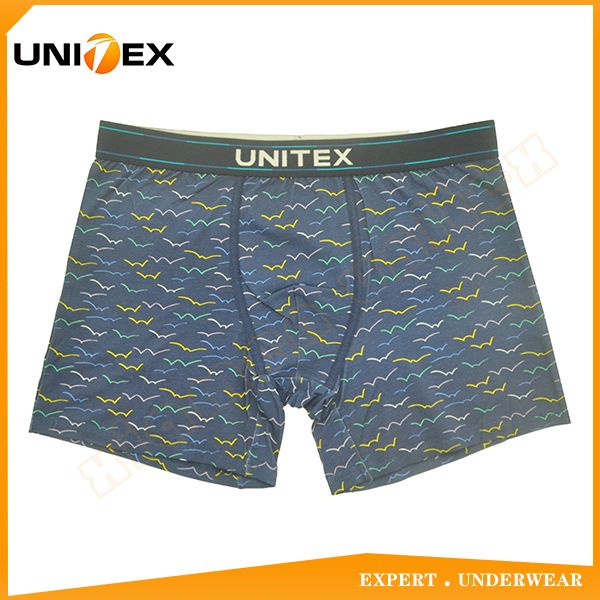
6. Fabric specification: what to state beyond “combed cotton”
“Combed cotton” names a yarn preparation, not a specification. Two suppliers can both quote combed cotton and deliver garments that feel and wear differently, because four other variables sit underneath the fibre name.
- Weight in g/m². 160–200 g/m² is the everyday-basics range. Below 160 the cloth feels thin; above 200 it gets heavy and warm. Fix the figure per style rather than per range.
- Blend ratio. 95/5 and 90/10 behave differently in wear. The elastane percentage is what gives the waistband and the leg opening their recovery, so state it to the percentage.
- Knit structure. Single jersey is the default for the body; rib is used where stretch is needed. The structure changes both the hand and the consumption per piece.
- Finishing route. Enzyme wash, silicone softener and bio-polishing all change how the cloth feels, and some are not durable. Ask which route was applied rather than assuming one.
- Certification. OEKO-TEX Standard 100 applies to the material for chemical safety; organic content claims need a fibre certification with a named holder and scope.
Write all five into the tech pack. Without the weight and the blend ratio, two quotations cannot be compared — they may describe different garments at the same fibre name.
7. Size grading and the fit sample
Men’s size runs cluster tighter than women’s, which is part of why men’s basics are a forgiving first category. The risk is not the middle size — it is the ends.
- Confirm the block per market. EU, US and UK runs are cut to different pattern blocks rather than being one chart relabelled. Confirm which one the quotation is based on.
- Check the ends, not the middle. The middle size is usually the one the sample was developed on, which is exactly where a shallow block hides. Fit complaints concentrate at the smallest and largest sizes.
- Plan for two rounds. Sample development typically runs 15–30 days per round and most programmes need one to two before the fit is right. The second round is normally where fit is settled rather than a repeat of the first.
- Consolidate your comments. The weeks lost in sampling are usually lost to scattered feedback rather than to sample making. One consolidated response per round keeps the round count predictable.
- Ask for a measurement sheet. A sample should arrive with its measurements and declared composition, not only photographs. That is what makes the approval a record rather than a recollection.
8. Lead time: the full timeline and where it slips
A first order to Europe or the US runs roughly as follows. The figures are planning ranges rather than promises, and the left-hand column is where the schedule usually breaks.
- Sampling: 15–30 days per round, one to two rounds for a new style.
- Fabric booking: 7–14 days, and it can run in parallel with size-set approval rather than after it.
- Bulk production: 45–60 days for a new style, 30–40 days on a repeat, starting from the approved pre-production sample.
- Inspection: 1–2 days, measured at AQL 2.5 for major defects.
- Sea freight: 30–35 days to Europe or the US east coast.
- Peak season: August to October adds 10–15 days to the production queue.
Two things decide whether the dates hold. The first is that the bulk clock starts at sample approval, not at the enquiry or the order — everything upstream sits between the two. The second is that the delivery window should be quoted as a range with a stated worst case, because a single date turns a normal queue variation into a dispute.
9. Quality control: the checkpoints that matter
A quality system is not a certificate on the wall; it is a set of checkpoints that produce records during production. These are the six worth confirming before the order is placed.
- Pre-production sample approval. The reference everything downstream is measured against — and the point from which the bulk clock runs.
- Fabric inspection before cutting. Catches shade and width variation before it becomes a garment rather than after.
- First-piece confirmation at the line. Verifies that the line is making the approved garment, not a version of it.
- In-line inspection during production. The stage buyers most often leave out, and the one that produces records describing the process rather than the shipment.
- Final inspection before packing. Commonly AQL 2.5 for major defects, with zero tolerance for critical ones, and it should cover the waistband recovery and the leg opening.
- Needle detection, every shipment. Metal detection runs as its own checkpoint, because the exposure is binary — a single missed fragment is the whole risk. It is a safety matter rather than a quality one, and it needs a record per shipment.
Ask for the inspection records from the last production run. Records produced during production tell you what the process was; a report generated for the shipment tells you what the goods are.
10. Payment, trade terms and the amendment rule
Three commercial items belong in the written order rather than in the conversation around it.
- Payment structure. The standard structure on a first order is a deposit on order confirmation with the balance against a copy of the bill of lading, either by T/T or under an L/C at sight. A request for full prepayment on a first order is a cash-flow signal rather than a negotiation position.
- Trade term. FOB Xiamen is the usual basis, and the quotation should state it along with the specification it prices and its validity date. A unit price without those three cannot be compared with another quotation.
- The amendment rule. Any material change — a fibre swap, a different trim, a component from a different sub-tier — should require a signed amendment and an updated specification. The reason is not distrust; it is that without a written record there is no way to establish later who approved what.
Name in the contract who has authority to approve a change, and extend the rule to sub-tier changes. A substitution agreed verbally by an intermediary is the most expensive kind of saving, because the cost is not the difference in the material but the accountability gap it opens.
FAQ Q: What’s the best fabric for men’s boxer briefs? Combed cotton 95/5 spandex at 160–200 gsm. The 5% spandex gives the waistband its recovery so it still fits after a year of washing. Q: What’s a typical MOQ for men’s underwear OEM? 2,000 pcs per style/color for custom development. Q: How long does men’s underwear production take? New styles typically 45–60 days after pre-production sample approval; repeat orders 30–40 days. Sample development usually 15–30 days. Q: Which styles should I launch first? Boxer briefs and briefs are the two workhorses; add trunks for younger markets. Start with two or three styles with size depth rather than many styles at shallow quantity. Q: Do I need a fit sample for men’s underwear? Yes. Men’s underwear fit is unforgiving, and a bad fit rating is hard to recover from. One or two fit-sample rounds is the cheapest insurance in the process. Bottom Line Men’s underwear is a forgiving first category — stable demand, efficient sizing, high reorder rate — as long as you get the waistband, the fit sample and the fabric spec right. If you’re sourcing boxer briefs and briefs with flexible trial MOQs, talk to Xiamen-based Unitex Trade. Related guides: Underwear Fabric Guide: Modal vs Cotton vs Bamboo · Low MOQ Underwear Manufacturing: Cost Economics Explained · Underwear Certifications ExplainedInsights: what decides the outcome of a first boxer-brief order
| Decision | Option A | Option B | When it wins |
|---|---|---|---|
| Fabric weight | 140–150 g/m² | 160–180 g/m² | A for hot climates and price-led packs; B for volume retail and private label |
| Composition | 100% cotton | 95/5 cotton/elastane | B when the wearer cares that the garment keeps its shape |
| Waistband | Plain elastic | Jacquard with your logo | B when the brand is the selling point |
| First order | 2,000 pcs of one style | 2,000 + 2,000 across two styles | B when the cash covers two minimums and you want assortment data before a season |
The cash-flow sum almost nobody runs before ordering
Multiply your target FOB price by the number of pieces. One style at 2,000 pcs ties up X. Two styles at 2,000 pcs each tie up 2X but double your assortment coverage. On a first order, breadth across two styles usually teaches you more than depth in one — but only if the cash covers both minimums.
Good sample vs. bad sample: five checks
- It arrives with a measurement sheet and a declared composition — not just photos.
- The colour matches the approved Pantone, or the deviation is documented in writing.
- The waistband still recovers after being stretched several times.
- The front rise does not pull when you sit down — test the middle size of your curve.
- The proposed labelling already covers fibre composition, care, size and importer for your market.
Where the seam is the deciding cost, the four-needle six-thread specification is set out in our 4-needle 6-thread boxer brief specification.
· Xiamen Unitex Trade Co., Ltd. — OEM & ODM underwear sourcing partner