
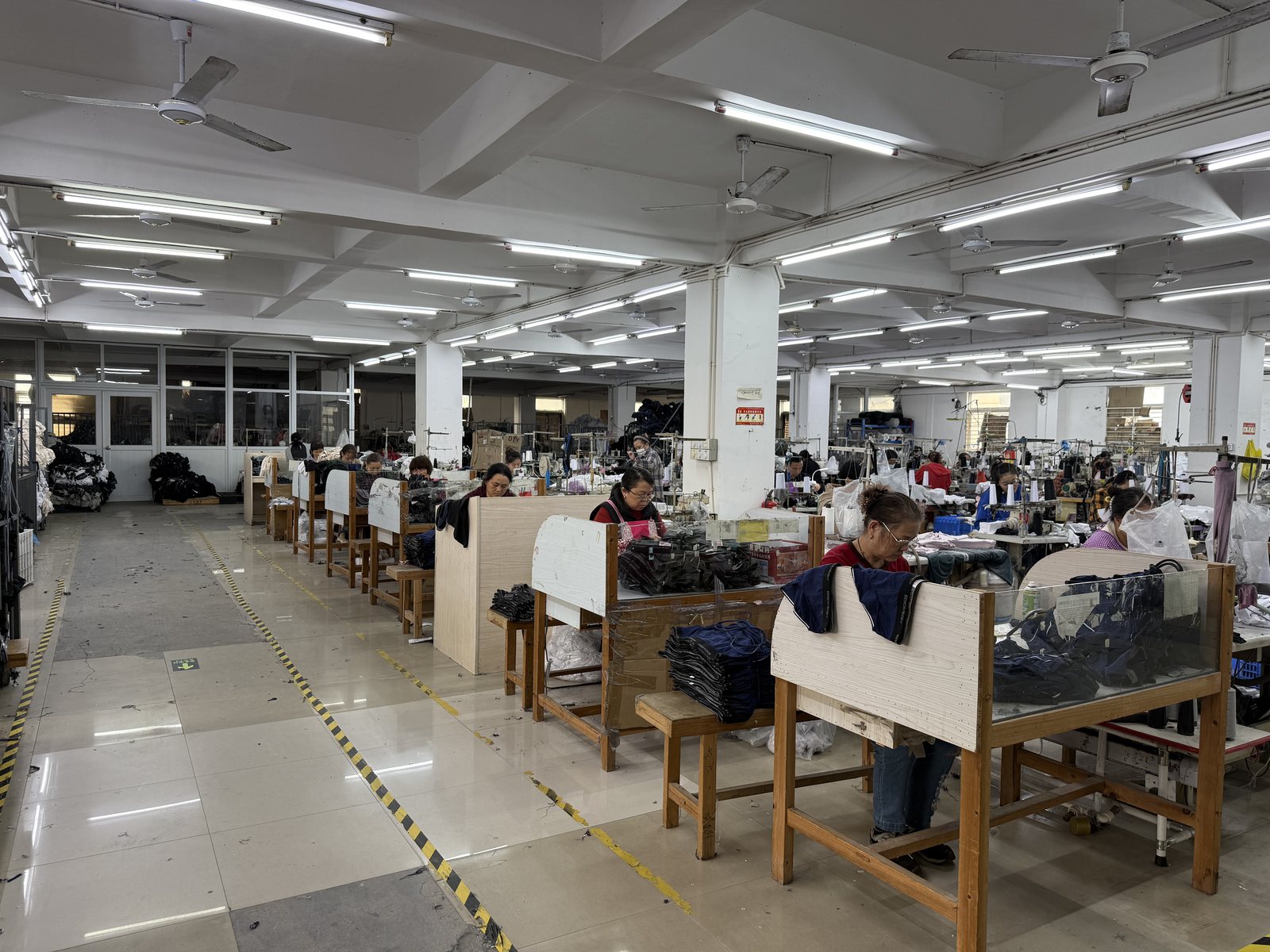
Unitex Underwear (Xiamen Unitex Trade Co., Ltd.) is an OEM and ODM underwear supplier and sourcing partner, in the trade since 2009 and incorporated in Xiamen in 2013, working through BSCI-audited and OEKO-TEX Standard 100-certified partner factories in Fujian and Guangdong.
What does “custom” actually cover in an underwear programme?
Customisation is not one thing. It runs from a logo applied to an existing block to an entirely new pattern with new fabric and trims, and each level adds a development stage, a sample round and a minimum quantity the level below does not have. Establish which level you are buying before the quote is built.
The three levels that matter commercially are these. A branded stock style takes an existing block and adds your waistband print, woven label, hangtag and polybag. A modified style changes elements of a block that already exists: leg opening, rise, gusset construction, elastic width, or the fabric weight. A new development starts from a pattern that does not exist yet, which means a pattern-maker, a fit round on real bodies, and a fabric that may need to be developed or sourced to your weight.
Each level changes what can go wrong. On a branded stock style, the risks are branding and packing. On a modified style, they are fit and tolerance. On a new development, they are the fabric itself, and a first bulk run in a new fabric is where most first orders fail.
What has to be in the specification before anyone quotes a price?
A quotation is only as firm as the specification behind it. If two suppliers quote the same style at different prices, the difference is usually the specification rather than the price list. Nine items cover most of it.
- Fabric composition and weight in g/m². A fibre name is not a specification. Combed cotton at 160 g/m² and at 200 g/m² are different products at different prices, and the range we work in runs from 150 to 220 g/m² across cotton, modal and bamboo blends.
- Fibre blend and any functional finish. Elastane percentage, mercerised or not, and any moisture-management treatment.
- Waistband construction and elastic width in centimetres. Knitted or woven, and the exact width, because this is the most negotiated line on a first sample. Two widths cover most requests: 4.5 cm and 6 cm.
- Rise, leg opening and gusset construction for the style you are buying.
- Size block and grading. EU, US and UK curves are graded from different blocks, so name the market rather than the letters.
- Packing format. Pieces per polybag, bag format, carton configuration, and whether the market buys in multipacks.
- Care and fibre labelling for the destination market.
- Test requirements the buyer will ask for, so testing sits in the plan rather than in the dispute.
- Target ship window, which fixes the sampling deadline by working backwards.
How do you tell a custom programme from a relabelled stock style?
Almost every supplier advertises customisation. The distinction that matters is whether anyone actually holds your pattern. Four questions settle it, and none of them depends on a factory visit.
First, ask who owns the block. If the answer is that it belongs to the supplier and is shared with other customers, you are buying a branded stock style rather than a programme. Second, ask to see the tech pack before sampling, not after. A specification written before the sample exists is the difference between development and guesswork. Third, ask what happens to the pattern if you move supplier; a block you cannot take with you is leverage you do not have. Fourth, ask whether the counter sample is made to your spec or pulled from the current catalogue.
On a genuine programme the counter sample arrives with the grading table and the fabric reference attached. On a relabelled style it arrives with a photograph and a price.
Which entity holds the certificates on a custom order?
Certificates attach to a material or a production site, not to the company arranging the order. A fibre or chemical-safety certificate names the mill or the finishing plant; a social audit names the site that was audited. A sourcing company can hold neither on behalf of someone else.
That is why the holder’s name belongs in the specification. Ask for three things: the name of the entity on the certificate, the scope it covers, and how to check the number at the issuing body. Chemical-safety certificates can be looked up in the issuing body’s own database. Social audits are checked with the audit programme rather than with the supplier’s website.
The partner sites that make our orders hold amfori BSCI (social audit) and OEKO-TEX Standard 100 (product chemical safety). The certificate covering the specific site running your order is shared at quotation stage, and we do not publish certificate numbers; the verification route is the issuing body’s own register. We hold no certification in our own name, and we claim none beyond the two programmes above.
How do the EU, US and UK size blocks change the order?
Size blocks are not the same chart relabelled. They are graded from different base patterns, and the difference becomes visible at the ends of the range, which is where returns concentrate. Confirm which block you are buying and approve it on a sample rather than on a chart.
Labelling and chemical rules also move with the market. In the European Union, fibre labelling and product requirements sit inside the textiles framework, and REACH governs chemical substances in articles. Those rules are the buyer’s responsibility to name, because they change what can be printed on a label and what a test report has to cover.
Ask for the grading table for the specific curve you sell, at the sizes you actually stock. A supplier who sends one size chart for three markets has not understood the question.
Two further sources are worth knowing before the specification is fixed. EU product rules for textiles are tightening under the circular economy framework, which moves traceability information from a nicety towards a requirement. On the other side of the Atlantic, US apparel import volumes are published by the Office of Textiles and Apparel, which is where a market-sizing figure can be checked rather than estimated.
Why does the packing format change the cost?
Packing is where a style decision turns into a cutting and labour cost. A multipack that matches how the market buys changes how garments are counted, how they are folded, and how the cutting plan is laid out, so it is not simply a bag choice made at the end of the order.
Specify the format rather than accepting a supplier’s default. Piece count per polybag, carton configuration and the retail-ready requirement all belong in the specification alongside fabric and fit. Leaving them to the default is how a programme ends up repacking in the destination market.
How small can a first order be, and what does it test?
A trial quantity is the honest test of whether a supplier plans production or fills a slot. Minimum order quantities differ by category: men’s and women’s underwear 2,000 pcs; kids’ 3,600 pcs per style per colour, sports bras 3,600 pcs, and pyjamas 600 sets.
Production starts at the standard minimum of 2,000 pcs per style and colour, so a first order is a full production run rather than a trial.
A 2,000-piece run costs more per unit than a repeat, because fabric, trims and setup are amortised over fewer pieces, and a salesman sample at 50 pcs per style and colour is the only smaller quantity we quote. That is what sits behind a low minimum quotation, and it is worth understanding before comparing two suppliers on minimum quantity alone.
Two sample types are often confused, and neither of them is a minimum order quantity. A development sample is the route to a quotation on a new style, quoted per style and refundable against the first bulk order. A salesman sample is a finished, saleable garment at 50 pcs per style per colour, paid in full before production starts.
Timing follows the same logic. Sampling runs 7–10 days on a stock block and 12–18 days for a full custom development. Bulk production runs 45–60 days after pre-production sample approval for a new style, and 30–40 days on a repeat. Before the bulk run, the approved sample is sealed and signed by both sides, and every QC check is read against that sealed piece.
What does a sourcing partner do that a single factory cannot?
A single production site sells you its own machine park: its gauge, its capacity ceiling, its fabric relationships and its audit status. A sourcing partner works the other way round, holding your specification and your delivery date and matching each order to a site whose lines fit that style, that quantity and that compliance requirement.
Four things change when a partner carries the order. Your order can move to another audited site if a line is full in peak season or an audit lapses, so one site’s problem does not become your delay. Inspection follows one written standard across every site that touches the order, rather than each site applying its own. Trial quantities can start lower than a single large factory will usually accept, because the order can be split across a block that suits it. And sampling, export documents and shipping sit with one counterpart instead of several.
The cost of that arrangement is the partner’s margin, and the risk is a partner who will not name its production sites, which leaves you without recourse. That is why the site name belongs on the paperwork. For scale, our partner network runs at around 600,000 pieces a month, across long-term partner factories rather than any facility of our own.
Bulk inspection follows AQL 2.5 under ISO 2859-1 (GB/T 2828.1-2012 in China), applied at the site making the order, and the reports are shared with the buyer.
Unitex Underwear is not a factory owner. Men’s underwear is our main line, with women’s and kids’ underwear alongside it, then pyjama sets and sports bras. Customisation covers jacquard-logo elastics, all-over printing, embroidery and retail-ready packaging, on top of fabric, fit and size-block changes.
Payment runs at 30% on order confirmation, with the balance against a copy of the bill of lading for sea freight, or before shipment for rail, air and courier, where no document of title exists. An L/C at sight is available for larger or first orders. Quotations are answered within 48 hours and hold for 30 days. A significant share of our business comes from repeat orders by long-term partners; references are available on request under NDA.
If a China trip is on your calendar, send the dates and we will build the factory visits around them.
Where can you check these facts yourself?
The company registration is public. Xiamen Unitex Trade Co., Ltd. is registered in Xiamen, Fujian, and the record can be pulled from China’s National Enterprise Credit Information Publicity System.
The external rules cited here can be checked at source. Chemical-safety certificates can be looked up with OEKO-TEX; social audits with amfori; the sampling standard used for inspection, ISO 2859-1, is published by the International Organization for Standardization, and its Chinese equivalent GB/T 2828.1-2012 by China’s national standards body; and the European rules on textile labelling and on chemical substances in articles are published by the European Commission.
Email [email protected] or message WhatsApp +86 186 5081 3853. Send the fabric composition and weight, the waistband construction, the size block and the packing format, plus your ship window, and MOQ, lead time and price come back within 48 hours; quotations hold for 30 days.
· Xiamen Unitex Trade Co., Ltd. — OEM & ODM underwear sourcing partner