
Buying fabric is a different transaction from buying garments, and the difference is not only commercial. When a buyer orders finished underwear, the supplier owns the fabric risk: the weight, the shade, the shrinkage and the yield are all problems the supplier absorbs. When the same buyer orders fabric, every one of those risks moves across the table. The roll arrives at a declared weight and width, and everything after that — marker efficiency, cutting loss, shrinkage allowance, shade matching across lots — belongs to the buyer.
This guide is about that transfer. It sets out what a knitted fabric specification has to fix, how the sampling sequence works, and where fabric supply disputes come from, with the specifications Unitex Underwear runs at partner mills as reference points. It is written for brands, importers and garment makers sourcing knitted fabric from China.
What changes when you buy fabric instead of garments
Four things move, and buyers who have only ordered garments usually notice them one at a time, at the worst possible moment.
Yield becomes your number. A garment price includes the fabric consumed. A fabric price does not include what you lose cutting it. A 5 cm shortfall in width, a weight at the bottom of the tolerance, a shade lot that has to be cut separately — all of these turn into metres you paid for and cannot use, and none of them show up on the invoice.
Shrinkage becomes your allowance. Fabric shrinks after washing; that is normal. When you buy garments, the supplier has already built the allowance into the pattern. When you buy fabric, you have to know the figure and add it yourself, or the finished garment comes back one size small.
Shade becomes your problem to manage. A mill dyes in lots. A garment order of 20,000 pieces, for example, is often cut from three or four lots. When you buy fabric, you receive those lots and have to decide how to lay them.
Testing becomes your decision. A fabric supplier can provide test reports, but the buyer decides which tests, at what acceptance level, and whether to test every lot or sample. Nobody will choose that for you.
None of this is a reason to avoid buying fabric. It is a reason to write the specification properly, because the specification is the only place these four risks can be allocated before the money moves.
Knitted fabric supply from Unitex Underwear: what we run
The range is knitted fabric for underwear and the garment categories that sit next to it: single jersey, 1×1 rib, interlock and jacquard rib, in cotton, modal, viscose, polyester and nylon, with or without elastane. Weight runs from about 125 gsm to 260 gsm, width from 135 cm to 180 cm.
The fabric supply matrix below is the practical shape of it. “Typical end use” is not a restriction on what the fabric can be used for; it is where each specification is normally bought.
| Structure | Composition range | Weight | Width | Elastane | Typical end use | |—|—|—|—|—|—| | Single jersey | Cotton, modal, viscose, polyester, nylon, and blends | 125–210 gsm | 148–173 cm | 0–16% | Briefs, boxer briefs, T-shirts, light loungewear | | 1×1 rib | Cotton, modal, nylon, blends | 200–220 gsm | 135–170 cm | 5–13% | Rib-bodied briefs, waistband panels, cuffs | | Interlock | Modal-cotton, nylon, polyester blends | 150–180 gsm | 155–165 cm | 5–25% | Opaque briefs, seamless and shaping, light outerwear | | Jacquard rib | Cotton-polyester, cotton-modal | 150–200 gsm | 160 cm | 0–10% | Fashion bodies, decorative waistbands | | French terry | Cotton, cotton-polyester | 210–260 gsm | 180 cm | 0–6% | Loungewear, sweatshirts, shorts | | Interlock loop | Viscose, cotton blends | 240–260 gsm | 175 cm | 4–6% | Loungewear, robes, heavier knit tops |
Two notes on reading that table. First, the weight bands are the ranges our partner mills routinely produce, not catalogue extremes; a fabric outside them can usually be developed, but it becomes a development project with its own timeline rather than a selection from the range. Second, structure and weight are coupled: a 150 gsm interlock is not a thin version of a 180 gsm interlock, it is a different fabric with different recovery.
Reference knitted fabrics for underwear and loungewear
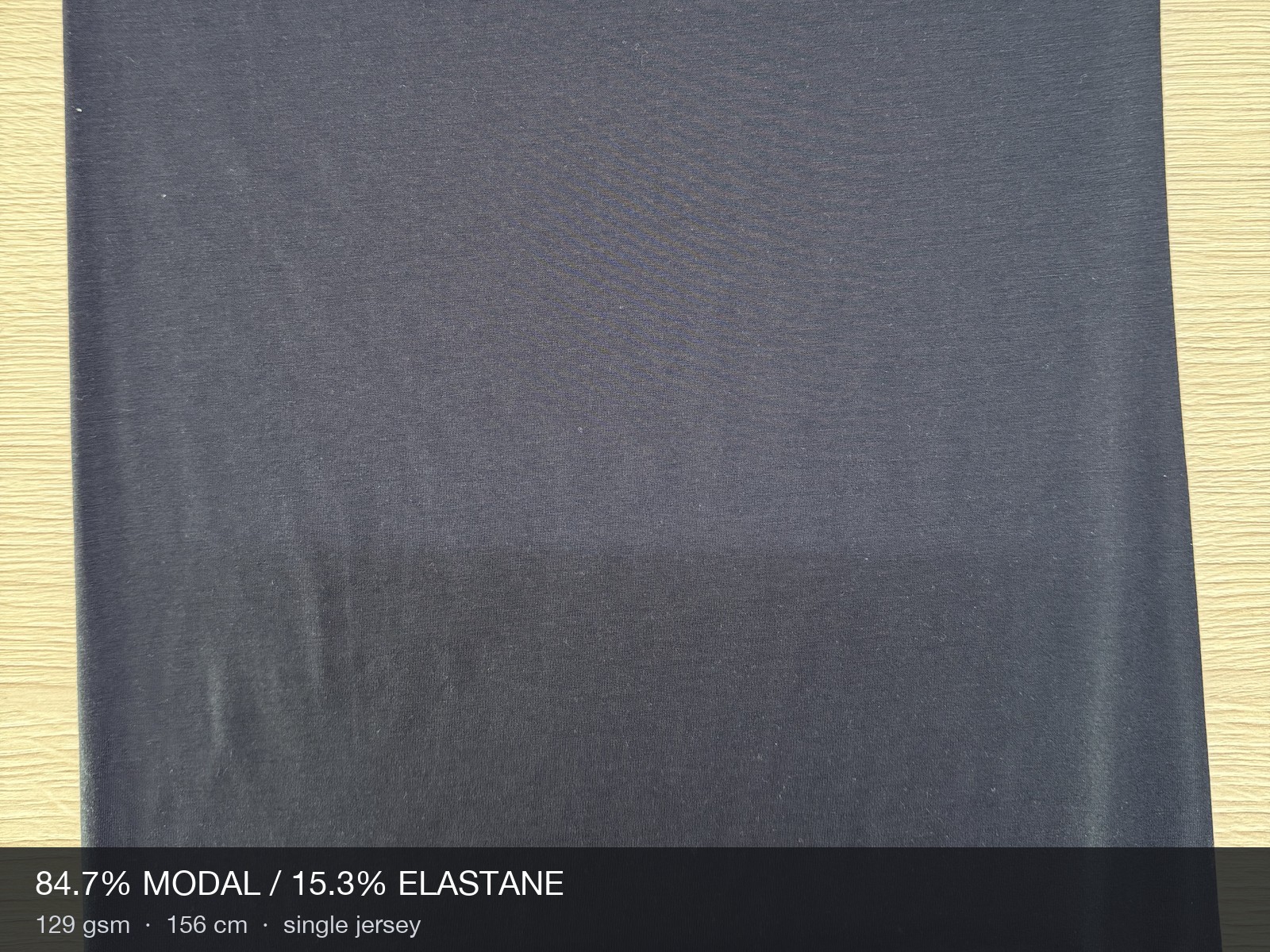
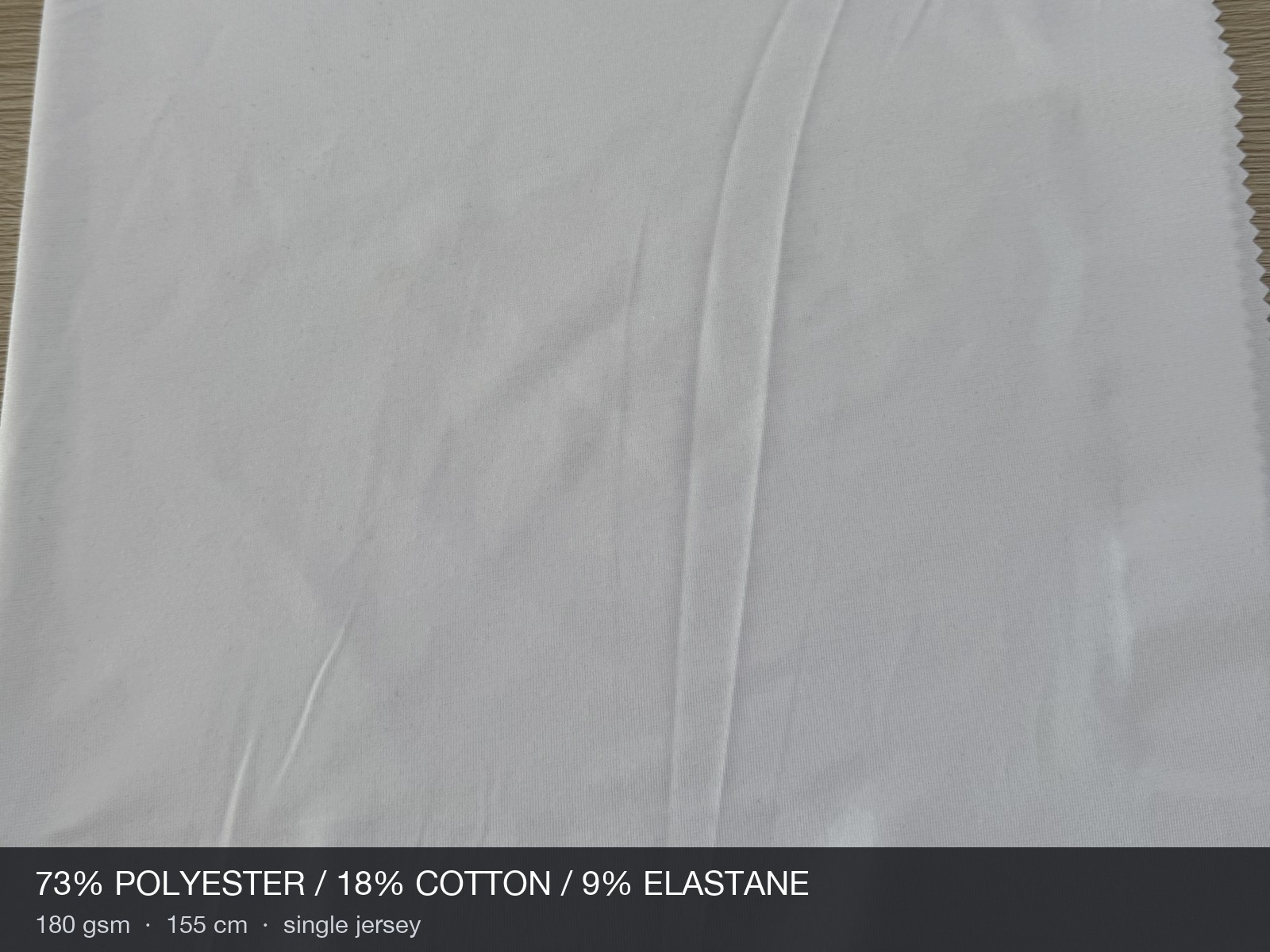
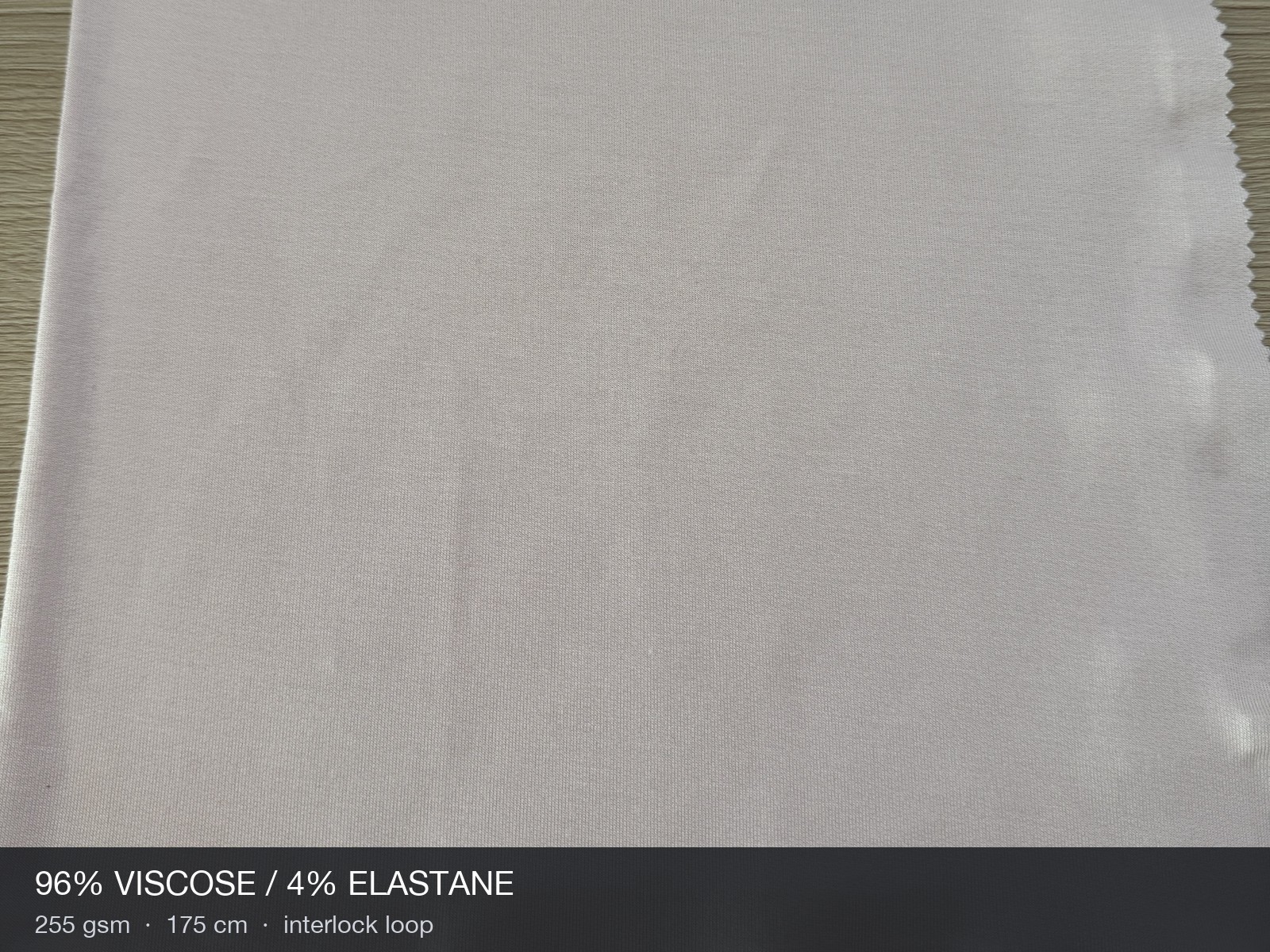
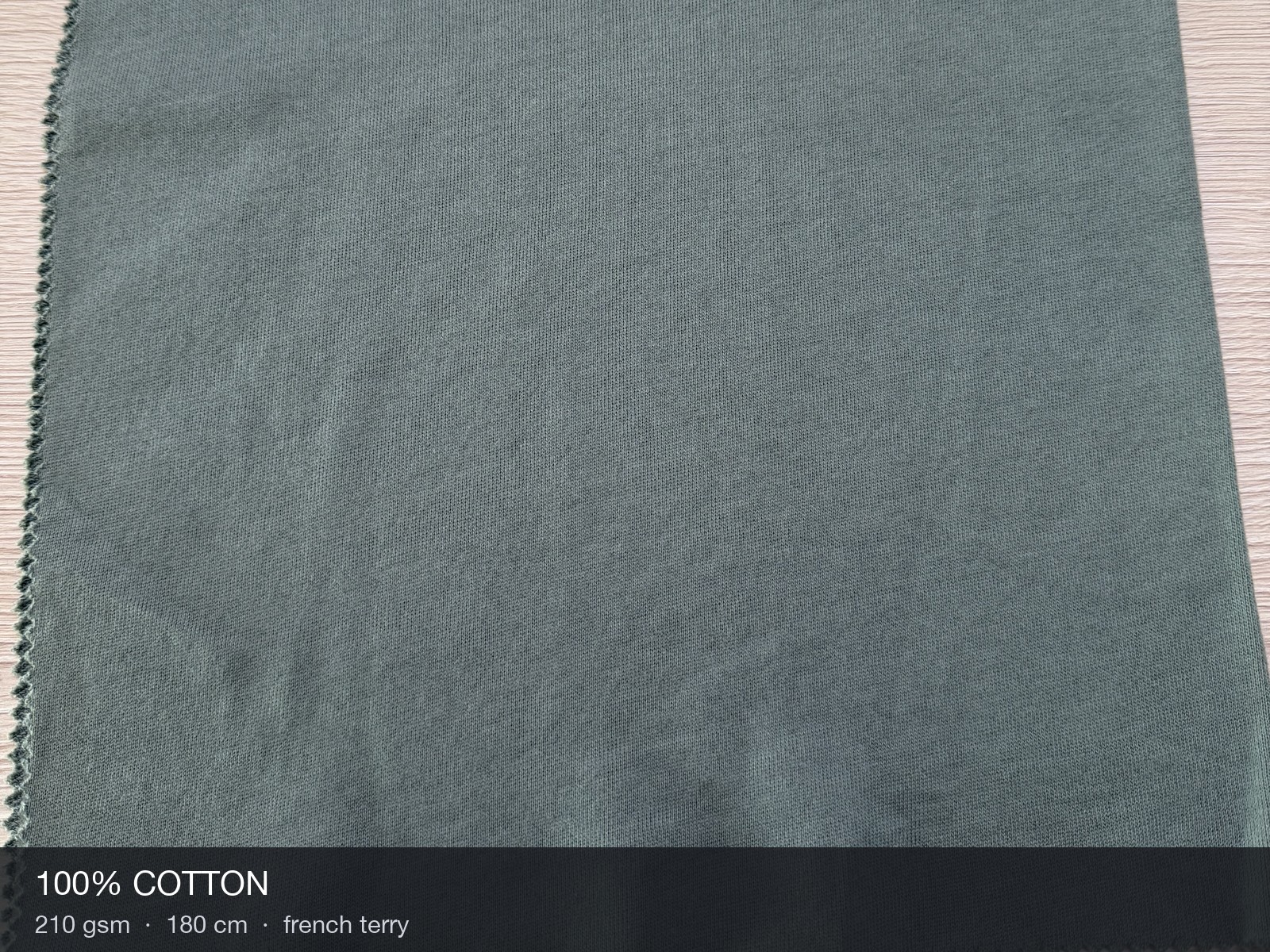
The fabrics below are production specifications from our supply, each labelled with composition, finished weight, width and structure. They are shown because a specification is easier to discuss when both sides are looking at the same object.
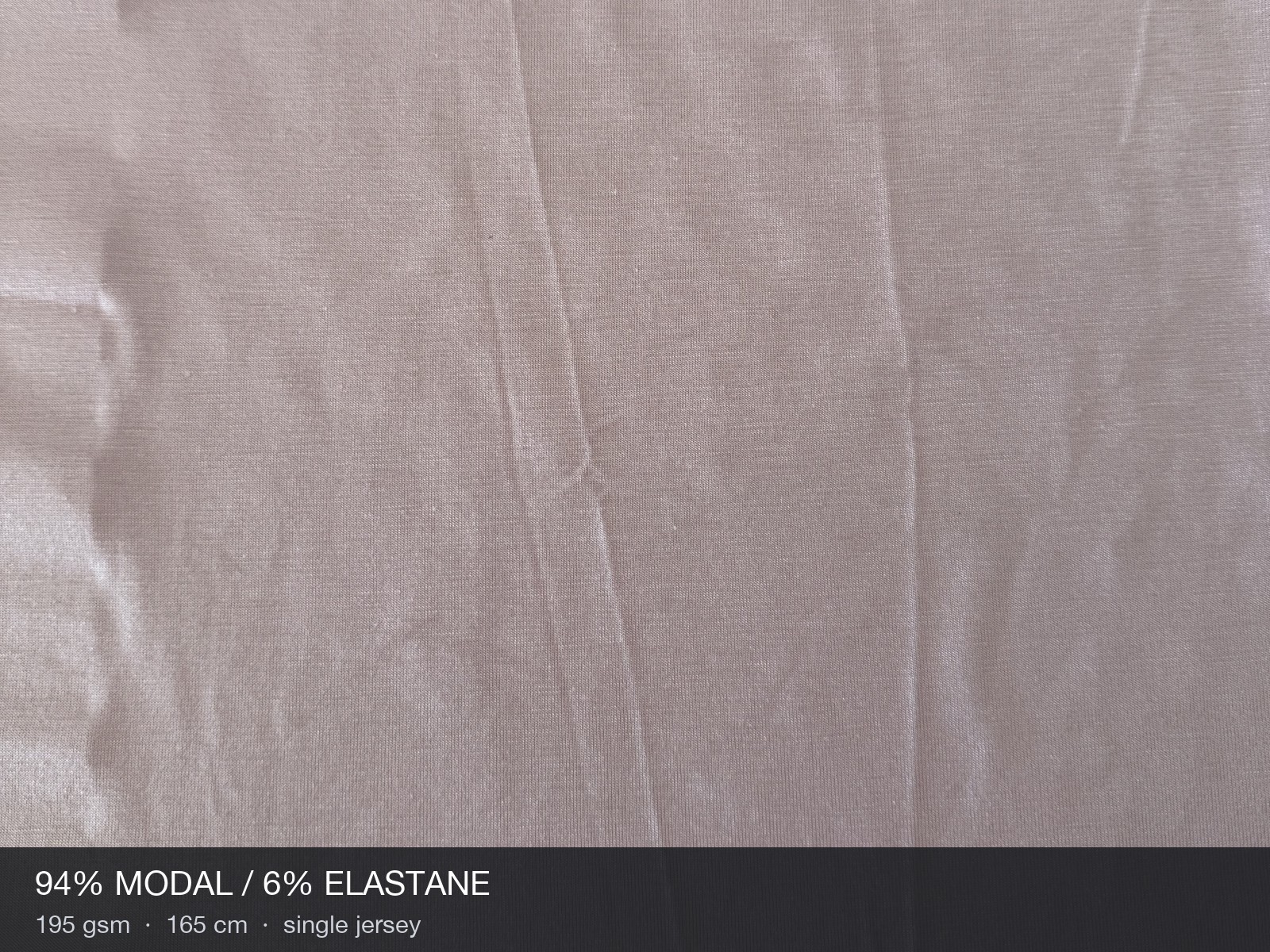
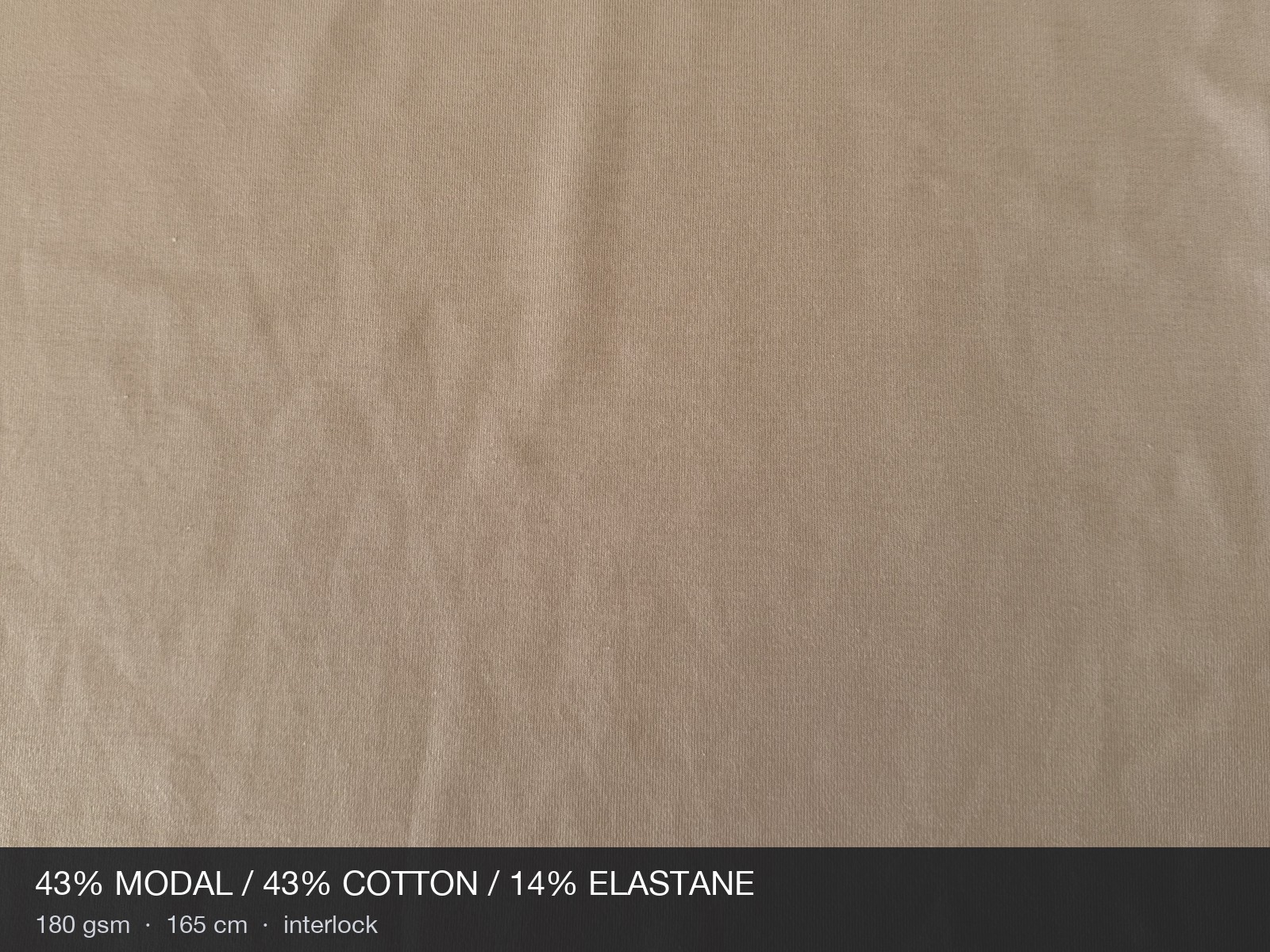
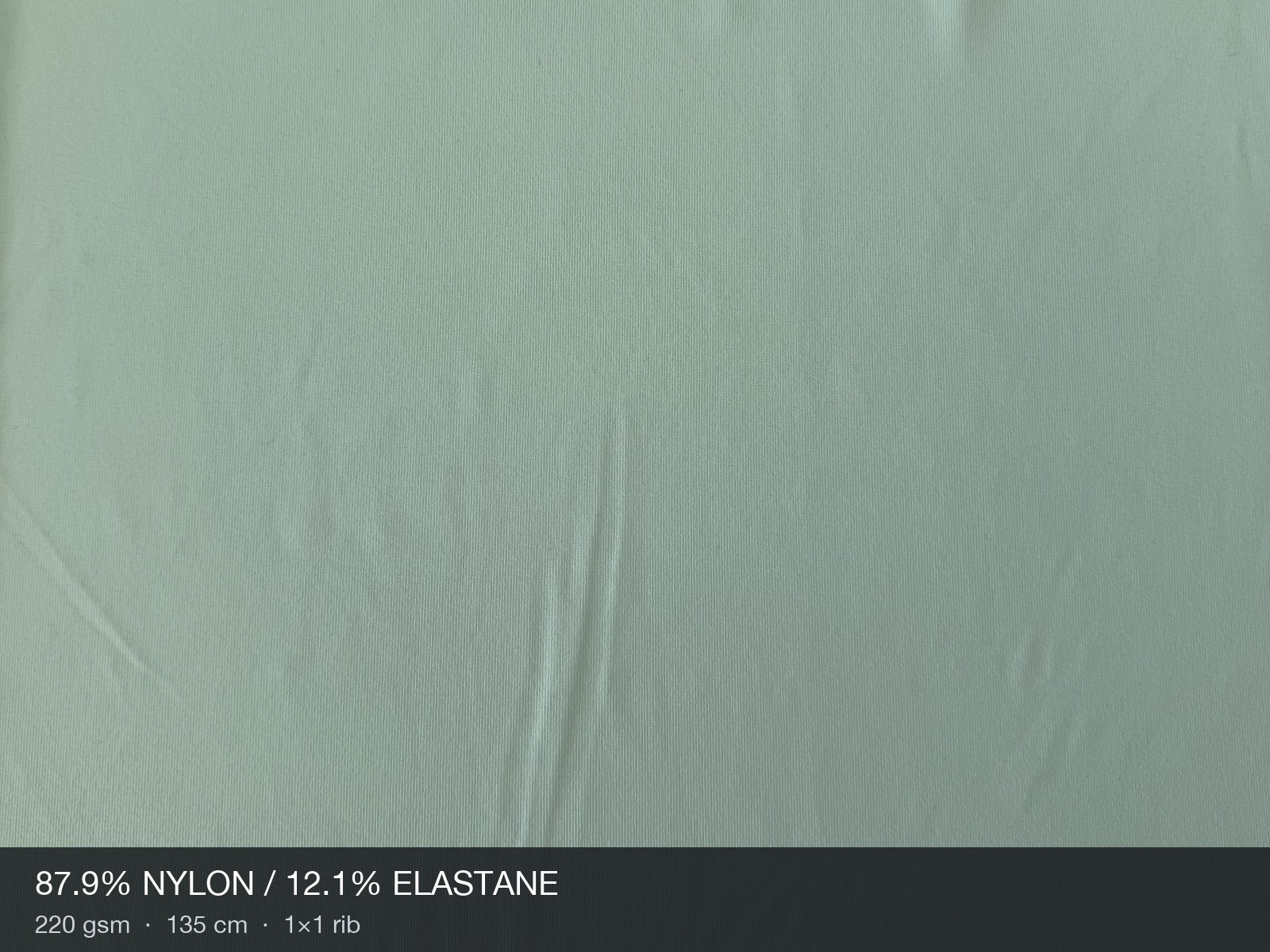
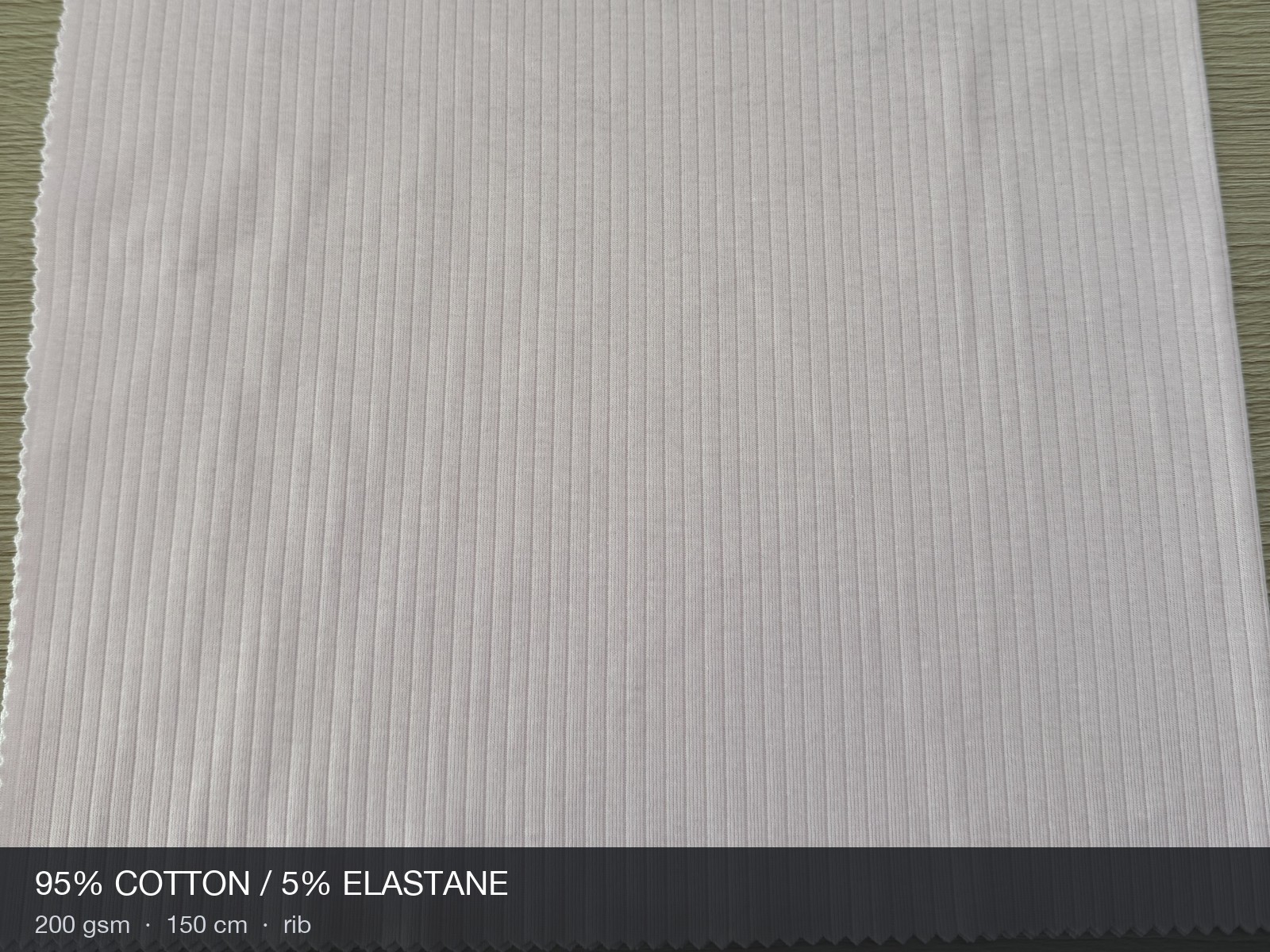
The knitted fabric specification: eleven things that have to be fixed
A knitted fabric order that goes wrong usually had a fabric specification with a number missing — and that is as true of a custom order as of a stock repeat. These are the eleven that matter, in the order they cause problems.
- Composition, with each fibre as a percentage. “Cotton-rich” is not a composition.
- Elastane percentage and denier, separately. 5% at 20D and 5% at 40D are different fabrics.
- Finished weight in gsm, with tolerance. State the measurement point: after finishing, not grey.
- Knit structure by name — single jersey, 1×1 rib, interlock, jacquard rib, terry, interlock loop.
- Width in cm, with tolerance. State whether it is usable width or including selvedge.
- Colour reference, physical or Pantone, with the approval light source named.
- Shrinkage as tolerance plus method plus wash condition, for example within 5% measured to ISO 5077 after ISO 6330 at 40°C.
- Spirality limit, measured to ISO 16322, separately from shrinkage — this matters on single jersey and is usually left out.
- Colour fastness grades to washing, rubbing and where relevant perspiration and light.
- Pilling rating to ISO 12945-2, and the test conditions.
- Roll packing and identification — roll length, roll marking, and how shade lots are identified and separated.
Two more that are commercial rather than technical, and worth writing down anyway: who pays for the test reports, and what happens to a roll that fails — replacement, credit, or rejection at whose cost. Those two sentences prevent most arguments.
Tolerances: where the disputes actually come from
Fabric is sold against a specification with tolerances, and every tolerance is a small transfer of value. The four that generate the most correspondence:
Weight. A ±5% tolerance on 180 gsm permits delivery at 171 gsm. Over a 5,000 metre order, for example, that is a real quantity of yarn. Buyers who care should buy a tighter tolerance and expect to pay for it, because holding a tight weight costs the mill money in yield.
Width. A 165 cm fabric delivered at 160 cm is often within tolerance and always costs yield, because the marker has to be re-laid. If the garment is nested tightly, 5 cm can cost more than the weight difference.
Shade. A shade band, not a point. Ask for the approved standard plus the tolerance either side, and ask for lots to be marked and grouped rather than mixed. A buyer who demands one exact shade across a large order will reject usable fabric.
Roll length. Declared length per roll versus measured. Short rolls are common and easy to check: measure three rolls per lot as a sample rather than all of them.
The general principle: whatever is not specified with a tolerance will be delivered at whichever end of the range suits the mill.
Finishing: the stage that changes the number you specified
Most fabric buyers specify a weight and a hand, then discover at bulk that the finishing route changed both. Finishing is not cosmetic in knitted fabric; it is where the final weight, width and shrinkage figure are actually set.
Compaction (pre-shrinking). A compressive shrinking process that mechanically reduces length shrinkage before the fabric is cut. It costs a process pass, it slightly reduces width and it raises the price — and it is the difference between a fabric that shrinks 8% and one that shrinks 3%. If a garment has to hold its size, compaction is usually cheaper than the yield lost to shrinkage allowance.
Calendering. Pressure and heat to flatten the surface. It improves smoothness and opacity, and it reduces elongation and recovery because it flattens the loop curvature. A heavily calendered jersey looks better on the roll and behaves worse in a garment, which is why calendering pressure belongs in the specification rather than in the mill’s discretion.
Brushing and raising. A brushed face gives softness and warmth and adds a little weight; it also increases pilling risk, because it creates loose fibre on the surface. On a next-to-skin garment, brushed faces need a pilling specification to go with them.
Heat-setting (on synthetics). Stabilises nylon and polyester knits, fixes width, and reduces the creep that would otherwise show up as a garment growing in wear. For nylon-elastane fabrics above 15% elastane, heat-setting is effectively part of the specification, not an optional extra.
The practical consequence for a buyer: state the finishing route, or accept whatever the mill uses for the price. Two rolls at 180 gsm, one compacted and one not, are not the same product and should not be quoted as if they were.
Packing and delivery: small details that cost real money
Fabric is usually bought by weight or by length, and the packing decides how much of what you bought survives to the cutting table.
- Roll length. Roll length is declared; it is frequently short. Sample three rolls per lot with a measuring wheel rather than trusting the ticket.
- Roll weight and diameter. A very heavy roll is cheaper to handle per metre and more likely to crease or distort at the core. Ask for a maximum roll weight if the fabric is soft or high-elastane.
- Roll marking. Each roll should be marked with lot, colour, length and weight. Unmarked rolls become anonymous the moment they leave the pallet, and a shade dispute then has nothing to reference.
- Lot separation. Where multiple dye lots are unavoidable, require physical separation and marking by lot. Mixed lots on one pallet guarantee a mixed cutting lay.
- Moisture protection. Knitted cotton and viscose pick up moisture in transit and can develop mildew or a storage smell. Poly-wrapped rolls with a desiccant for sea freight are normal; a supplier who ships loose rolls is saving a small amount and risking the lot.
- Packaging for the buyer’s process. If the rolls go straight to a cutting table, roll diameter and core size matter more than carton presentation. Ask before assuming.
Using one fabric across adjacent categories
Buyers sourcing underwear often need the same shipment to cover a loungewear or sleepwear line, and the same fabric can sometimes serve both. Where it can, and where it cannot:
Can usually cross over. A 180 gsm cotton-modal jersey suits both a boxer brief and a light sleep short, if the elastane is adequate for the brief. A 150 gsm interlock can serve a brief and a light top.
Cannot cross over without a change. A 125 gsm nylon-elastane at 13% elastane is a brief fabric; used as a loungewear short it reads as underwear. A 210 gsm french terry is a sweatshirt fabric; used as a brief it will not hold a waistband. The weight may look compatible in both directions, and the structure is what makes the garment wrong.
Where it works, the constraint is usually the finishing route, not the structure. A fabric finished for opacity in a pale brief may be too stiff for a soft loungewear piece, and a fabric brushed for a sweatshirt will pill in a next-to-skin garment. Both directions are worth checking before committing one fabric to two categories.
Sampling: the sequence that avoids bulk surprises
The sequence below is the one Unitex Underwear uses on every fabric order; it exists so that nothing is approved twice and nothing is approved by memory.
- Lab dip for colour, approved within three rounds. A dip that only matches on the fourth attempt usually means the colour will not be reproducible at bulk.
- Bulk swatch of one to two metres from production setting, in the actual structure and weight. Check weight by cut-and-weigh, width at three points, hand against a reference, and curl at a cut edge.
- Sealed standard, signed and dated, one piece held by each side. Everything after this is measured against the sealed piece.
- Pre-production confirmation — for a fabric-only order, this is the swatch plus the test report, not a garment.
- Retained samples per lot at bulk, identified by lot, so a dispute months later has an object to inspect rather than a memory.
Inspection and testing
A practical inspection for a fabric lot, in the order that catches problems:
- Weight by cut-and-weigh from a swatch, never from the roll ticket.
- Width at three points per roll, and again after a wash.
- Cut-edge curl: cut a 10 cm square, leave it flat for an hour. Single jersey will curl; interlock should not.
- Shade against the sealed standard under the agreed light, roll to roll.
- Visible defects by four-point inspection to ASTM D5430, expressed as points per 100 square yards.
- Shrinkage to ISO 6330 and ISO 5077, with method and temperature on the report.
- Spirality to ISO 16322 after laundering, if the end use is a garment where the side seam shows.
- Colour fastness to ISO 105-C06 and ISO 105-X12, and to perspiration ISO 105-E04 where the garment sits against skin.
- Pilling to ISO 12945-2 where the end use involves abrasion.
- Restricted substances — OEKO-TEX Standard 100 certificate matched to the product class for the intended skin contact.
Fabric MOQ and lead time: why they are quoted per programme
Fabric MOQ and lead time are quoted per programme rather than published as a single figure, because the minimum moves with four variables: the structure (a jacquard needs a machine setup per design; a plain jersey does not), the colour count (each colour is a dye lot), the width (a narrow width consumes more metres per garment), and the finishing route (a compacted or brushed finish adds a process).
The practical consequence for a buyer — and the difference between an OEM fabric supplier and a stock merchant — is that the useful conversation is not “what is your minimum” but “here is the structure, colour count, width and finish — what does that combination require”. A supplier who quotes one minimum for all of it is either over-quoting the simple orders or under-quoting the complex ones.
Lead time follows the same logic: development of a new structure or a new colour adds a stage that a repeat order does not have. A first order and a repeat order should never be quoted on the same timeline.
What to check before placing a fabric order
- Composition percentages agreed in writing, including elastane percentage and denier.
- Finished weight with a tolerance, and the measurement point stated.
- Structure named explicitly, not implied by weight.
- Width with a tolerance, and whether it is usable width.
- Colour against a physical standard, with the approval light named.
- Shrinkage as tolerance plus method plus wash condition.
- Spirality limit included separately from shrinkage.
- Colour fastness and pilling grades agreed with the test standards named.
- Shade band agreed, and lots marked and grouped.
- Test reports: who orders them, who pays, and which lots they cover.
- Roll length and roll marking specified.
- What happens to a failing roll — replacement, credit or rejection, and at whose cost.
Bottom line
Buying fabric moves four risks to the buyer: yield, shrinkage allowance, shade management and testing choice. None of them can be managed after the rolls arrive; all of them can be allocated in the specification. The eleven items above, plus two sentences about test costs and failing rolls, are what separate a smooth order from a bulk dispute.
Unitex Underwear supplies knitted fabric for underwear and the adjacent loungewear categories against a written specification. We work with brands, importers and garment makers as a custom and OEM fabric supplier, so an order can start from a tech pack, a sealed swatch or a garment to be matched. If you are buying finished underwear rather than fabric and need the garment-side view — which fabric suits which brief — that is covered in which fabric for which underwear. Send the structure, weight, composition, width and colour count, and we will confirm what the combination requires.
References
- International Organization for Standardization, ISO 6330:2021 — Textiles: Domestic washing and drying procedures for textile testing. https://www.iso.org/standard/76063.html
- International Organization for Standardization, ISO 5077:2007 — Textiles: Determination of dimensional change in washing and drying. https://www.iso.org/standard/41877.html
- International Organization for Standardization, ISO 3759:2011 — Preparation, marking and measuring of specimens for dimensional change tests. https://www.iso.org/standard/56150.html
- International Organization for Standardization, ISO 16322 — Determination of spirality after laundering (Parts 1–3). https://www.iso.org/standard/62632.html
- International Organization for Standardization, ISO 105-C06 — Colour fastness to domestic and commercial laundering. https://www.iso.org/standard/51276.html
- International Organization for Standardization, ISO 105-X12 — Colour fastness to rubbing. https://www.iso.org/standard/63146.html
- International Organization for Standardization, ISO 105-E04 — Colour fastness to perspiration. https://www.iso.org/standard/57962.html
- International Organization for Standardization, ISO 12945-2:2020 — Determination of fabric propensity to surface pilling, Part 2: Modified Martindale. https://www.iso.org/standard/76655.html
- ASTM International, ASTM D5430 — Standard Test Methods for Visually Evaluating the Acceptability of Woven and Knitted Fabrics. https://www.astm.org/d5430-07r20.html
- OEKO-TEX, Standard 100 — Product certification, limit values and product classes. https://www.oeko-tex.com/en/our-standards/oeko-tex-standard-100
- AATCC, AATCC TM135 — Dimensional changes of fabrics after automatic home laundering. https://www.aatcc.org/
· Xiamen Unitex Trade Co., Ltd. — OEM & ODM underwear sourcing partner