
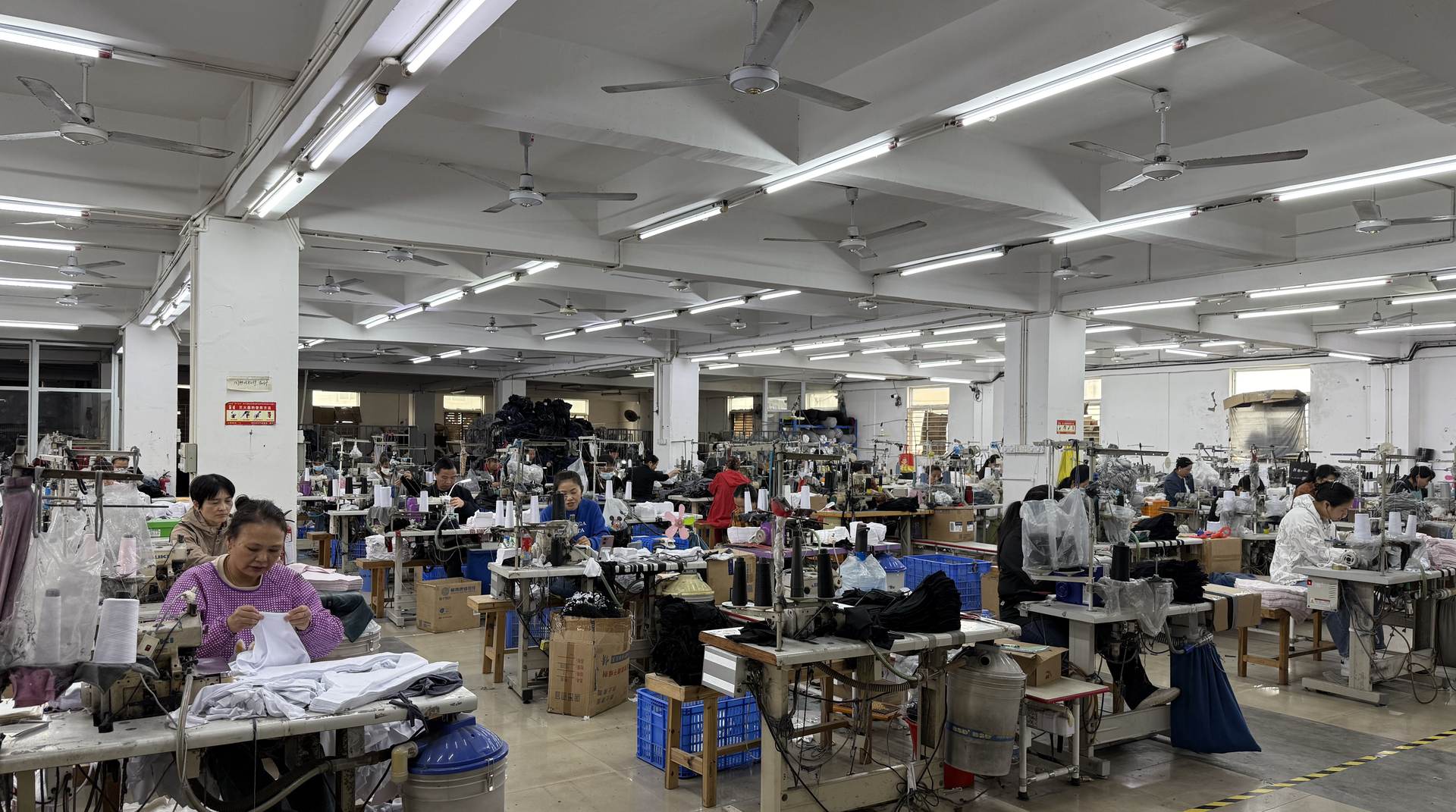
Who this guide is for
This guide is written for brand owners, importers and retail buyers placing underwear orders in China — typically 2,000 pieces per style per color and up, across men’s, women’s and kids’ underwear, pajama sets and sports bras.
It covers what you pay, when you pay it, and how each structure moves risk between you and the supplier. It is written from the buyer’s side of the table, which is the side where the money leaves first.
What it deliberately does not cover. It does not quote a price, and it does not tell you what any particular supplier should charge. Financing products — factoring, forfaiting, supply-chain finance — are a separate decision. Freight and duty sit in the shipping-terms guide, and landed-cost arithmetic has its own article.
If you are still choosing between suppliers rather than negotiating terms with one, the supplier vetting guide covers the checks to run first — certificates, MOQ, QC plan, and the 12-point pre-deposit checklist. This article picks up one step later, at the point where the term sheet is being written.
What payment terms are standard when you source underwear from China?
Almost every China apparel order runs on one default: part of the value before production, the rest before the goods leave. What varies is the size of each part, and what has to happen before the second payment is released.
The 30/70 baseline is the market default
The most common structure is 30% deposit on order confirmation and 70% against a copy of the bill of lading, or an L/C at sight. The deposit covers raw materials — fabric, elastic, trims, packaging — which have to be bought before a single unit is sewn. The balance covers labor, finishing, inspection and the supplier’s margin. Where a deposit applies to a bulk order, 30% of order value is the floor; a materially larger one is a question worth asking.
Variations cluster around that baseline:
- 30/70 — deposit on confirmation, then 70% against a copy of the bill of lading. The standard in the China underwear trade.
- 30/60/10 — a mid-production installment, then a smaller balance. Common on longer programs.
- 50/50 — a heavier deposit, usually asked for by suppliers carrying thin working capital.
- 100% upfront — sometimes normal on very small sample or stock orders; a stop signal on a bulk order.
- Partial L/C — a small T/T deposit with the balance under an irrevocable letter of credit.
Why buyers and suppliers both accept it
The split exists because both sides are exposed at the same time. Before production, the buyer’s money is at risk. After production, the supplier’s goods are at risk. 30/70 puts the crossover point roughly at the moment the fabric becomes a finished, inspectable garment.
It is also a signal. A supplier who accepts standard terms is telling you they expect to deliver. A supplier who insists on a materially larger deposit is either short of working capital or pricing in the possibility that they won’t deliver — and neither is a reason to send more money.
What does each payment instrument actually cost you?
| Instrument | Typical use | Cost | Buyer protection | Main weakness |
|---|---|---|---|---|
| T/T (bank transfer) | The default instrument for most buyers, at any order size | Low bank fees; 2–3 days | None built in — irreversible once sent | No dispute mechanism |
| L/C at sight | Buyers whose treasury issues L/Cs as standard — usually larger importers | 0.5–2% of order value (≈US$500–2,000 on US$100,000) | Strong — the bank pays only against compliant documents | Document-heavy; banks check paperwork, not goods |
| Platform escrow | Orders placed on a marketplace | Platform terms apply | Milestone release plus platform dispute handling | Attaches to the platform transaction only |
| Card / PayPal | Samples and small orders | 3–4% fees | Chargeback rights | Many suppliers refuse it or pass the fee back |
T/T — cheap, fast, irreversible
T/T is the cheapest and fastest instrument, and the one almost every supplier accepts. Its weakness is structural: once the money leaves your account there is no built-in dispute mechanism. Protection has to come from the contract and the inspection clause, not from the transfer.
Letter of credit — the bank as referee
An L/C flips the trust model. Your bank commits to pay only against documents that evidence shipment — the bill of lading, invoice, packing list and any inspection certificate you required. For a buyer whose finance team works this way it is the standard instrument, and the strongest protection against a deposit-and-disappear loss, because the supplier is not paid until the goods move.
Escrow and platform protection
Platform escrow holds the money and releases it against agreed milestones, with the platform mediating disputes. It is meaningfully better than a blind transfer for orders sourced through a marketplace. Two cautions: the protection attaches to the transaction on the platform, so paying off-platform for a discount removes it; and disputes over quality can still be slow and partial.
Card and PayPal
For samples and small orders, card or PayPal with buyer protection is the right answer. The fees are high relative to the order, but so is the value of a chargeback right on a supplier you have not tested.
Is 30% deposit / 70% against the B/L copy safe enough?
What the phrase “before shipment” hides
The phrase is ambiguous, and the ambiguity is where buyers lose money. “Before shipment” can mean three different moments:
- Against the copy of the bill of lading — the standard trigger, and the one to write into the purchase order. The goods have physically left, and the documents are in hand.
- Before the goods are loaded — after packing and inspection, but while the order is still in the factory’s control.
- Before the goods have been inspected at all, because the supplier booked a vessel date.
The first reading is the standard, and it is a real protection: payment is tied to proof of shipment rather than to a promise. The third is the dangerous one. Once a vessel is booked, a buyer under time pressure tends to pay in order to protect the sailing date. Say which of the three you mean, in writing, in the purchase order — not in an email thread.
What the B/L trigger does, and what it does not do
Tying the balance to a copy of the bill of lading does one thing well: it links payment to proof of shipment rather than to a promise. By that point the goods are on a vessel, the documents exist, and the supplier has performed the visible half of the contract.
What it does not do is test the goods. A bill of lading tells you a container left; it does not tell you what is inside it. That is why the inspection clause sits beside the payment trigger rather than replacing it. The pre-shipment inspection is what gives you a record to act on; the payment trigger is what gives the inspection its leverage.
Our own quality-control process runs pre-shipment inspection to a stated AQL level on every order, so the inspection record exists whichever trigger the contract uses. The trigger itself is set in the written quotation for that order.
Who pays by letter of credit — and why it is not a size decision
The instrument follows the buyer, not the order value
Buyers do not switch instruments as an order grows. A payment method is a property of the buyer — set by their treasury, their banking facilities and their credit arrangements — and it normally stays the same from one order to the next. A buyer who works on letters of credit will issue one on a modest order as readily as on a large one; a buyer who works on T/T will not move to an L/C because an order got bigger. So the useful question is not about order size at all, but about which instrument the buyer’s finance team actually uses. That is usually settled in the first conversation, and it then applies to every order that follows.
What an L/C tells you about the buyer
It is true that buyers who pay by letter of credit tend to be larger organisations — issuing an L/C needs banking facilities, a credit line and a treasury function that a smaller importer may not have. So an L/C appearing early in a conversation is a signal about the customer, not a rule about the order. Read it as information about how the buyer operates rather than as a threshold the order has crossed.
What does scale with order value is not the instrument but its cost. An L/C runs at 0.5–2% of order value, so on a US$100,000 order it lands in the region of US$500–2,000. A buyer who works this way pays that as a cost of doing business; the figure is background, not a trigger.
Document discrepancies are the real failure mode
An L/C pays against documents, not against satisfaction. A discrepancy — a misspelled consignee, a shipped quantity outside tolerance, a late presentation — gives the issuing bank grounds to refuse, and the supplier will hold you to the paperwork. Budget for someone to review the document set before presentation, and keep the required documents short and simple.
Partial L/C — splitting one order across two instruments
A partial L/C splits the value: a small T/T deposit so the supplier can buy materials immediately, and an irrevocable L/C at sight for the balance. The deposit reduces your exposure; the L/C covers the supplier’s production cost. It is a common structure on a first order from a buyer who works on letters of credit but needs the supplier buying materials before the L/C can be drawn; the structure for any later order is set in the written quotation for that order.
Which structure fits the way you already pay?
| If you are… | The structure looks like | Why |
|---|---|---|
| Placing a sample or one-off stock order | 100% before production; card or PayPal accepted | There is no bulk contract behind it, and friction costs more than the risk |
| A buyer who works on T/T — most first-time and mid-size buyers | 30/70 T/T, balance against a copy of the B/L | Standard terms, with the inspection clause in writing |
| A buyer whose finance team issues letters of credit | The L/C you would issue anyway — full, or partial with a small T/T deposit | Your instrument is the constant; the document set and the trigger are what get agreed |
| Placing a repeat order | The instrument you used last time, with the schedule confirmed per order | Payment practice rarely changes between orders; the schedule does not roll over by default |
| Being asked to pay 100% upfront on a bulk order | Stop and re-vet | The request itself is the finding |
What are the red flags in a supplier’s payment request?
| Red flag | What it usually signals | What to do |
|---|---|---|
| 100% payment before production on a bulk order | Either no working capital, or no intention to deliver | Decline; offer 30/70 instead and watch the response |
| Payment to a personal account | No verifiable corporate entity | Stop. Wire nothing. |
| Account name differs from the company name on the contract | An intermediary, or a front company | Ask for a written explanation and a licence-to-account match |
| Bank details changed mid-order by email | Business email compromise | Re-verify through a second, independent channel before paying |
| A discount offered for paying off-platform | Loss of escrow protection | Decline; the discount is priced against your protection |
| Pressure to pay before the B/L is issued | You would be funding production, not shipment | Hold the balance to the B/L copy, and keep the inspection clause in force |
Verify the receiving account before every wire
Do the three-way check: the account name, the company name on the business licence, and the name on the quotation and proforma invoice must all match. Then confirm the details through a channel you initiated — a video call with a named contact — rather than by replying to the message that changed them.
Treat changed bank details as a fraud event, not an admin update
Payment-instruction changes are one of the most reliable signatures of invoice fraud, and they are engineered to arrive at the moment you are most likely to pay without checking: the week the goods are due to ship.
How should payment milestones map to production milestones?
| Stage | Payment | What you should hold |
|---|---|---|
| Order confirmation | Deposit, typically 30% | Signed PO, proforma invoice, specification sheet, agreed inspection clause |
| Fabric and trims purchased | — | Confirmation of fabric lot and approved lab dip |
| Pre-production sample approved | — | Sealed golden sample, signed by both sides |
| Production complete | — | Third-party pre-shipment inspection report at the agreed AQL level |
| Goods loaded | Balance — 70% against a copy of the B/L | Bill of lading, packing list, invoice |
The point of the table is the middle column: at every stage you are buying a document, not a promise. If a milestone has no document attached to it, it is not a milestone.
Sample orders run on a shorter sequence. A 50-piece salesman sample run is settled in full before production starts, on selected cotton men’s briefs and boxer briefs, because there is no bulk order behind it to absorb the risk. The salesman sample programme sets out those terms.
Compliance and verification
Payment terms sit inside a compliance layer, and the documents that protect you are also the ones auditors and customs ask for. Three references are worth keeping to hand: the ICC trade-finance framework, which governs letters of credit under UCP 600; ISO 2859-1, the sampling standard used in pre-shipment inspection; and the amfori BSCI programme for social compliance in the supply chain.
Certification is not a payment guarantee, but it is a filter. Every partner factory we work with holds amfori BSCI social compliance and OEKO-TEX Standard 100 material-safety certification, and the certificates are verifiable with the issuing body rather than only on a supplier’s own website. Certificate scope and current audit status are confirmed before an order is placed, not after.
Next step
Tell us your order profile — category, pieces per style per color, target market and delivery window — and we will confirm the payment schedule in the written quotation, alongside sampling and bulk lead times. Our standard terms are 30% deposit on order confirmation with the balance against a copy of the bill of lading, or an L/C at sight; quotations are valid for 30 days and prices run FOB Xiamen.
Xiamen Unitex Trade Co., Ltd. is a sourcing and supply-chain management company and trading partner based in Xiamen, Fujian. We run OEM and ODM underwear programs for brands, retailers and importers with long-term audited partner factories — the manufacturers who cut, sew and finish your order. Certificate scope, inspection records and audit status are available on request.
· Xiamen Unitex Trade Co., Ltd. — OEM & ODM underwear sourcing partner
| Supplier | Unitex Underwear (Xiamen Unitex Trade Co., Ltd.) — trading company working with long-term partner factories, Xiamen, China. |
|---|---|
| Standard split | 30% deposit on order confirmation / 70% against copy of B/L (standard) |
| Deposit floor (bulk orders) | 30% of order value |
| Balance trigger | 70% against a copy of the Bill of Lading (T/T), or L/C at sight |
| Quotation validity | 30 days |
| Trade term | FOB Xiamen |
| L/C practice | Follows the buyer's treasury policy, not the order value |
| L/C bank cost | 0.5–2% of order value (~US$500–2,000 per US$100,000) |
| L/C rule set | ICC UCP 600 |
| Platform escrow | Holds funds until you confirm the order meets the contract |
| Small-order instruments | Card or PayPal with buyer protection |
Buyer checklist
- Confirm the legal entity on the business licence matches the bank account name exactly.
- Confirm the receiving account is a company account, not a personal one.
- Put the inspection body, sampling standard and pass threshold in writing before the deposit.
- Put the balance trigger in writing: the B/L copy is the standard trigger.
- Check the deposit level against the 30% market norm for bulk orders.
- Read the pre-shipment inspection report before the balance leaves, whichever trigger the contract uses.
- Keep the first order small enough that a total loss would not be fatal.
- Keep the proforma invoice, payment schedule and specification sheet on one version of the record.
- Re-verify bank details through a second channel before every payment.
Unitex Underwear (Xiamen Unitex Trade Co., Ltd.)
Unitex Underwear (Xiamen Unitex Trade Co., Ltd.) — OEM/ODM underwear sourcing and supply-chain partner in Xiamen, China; in the trade since 2009, incorporated in 2013. Based in the Xiamen–Quanzhou–Jinjiang knitwear cluster, Fujian Province, south-east China.