
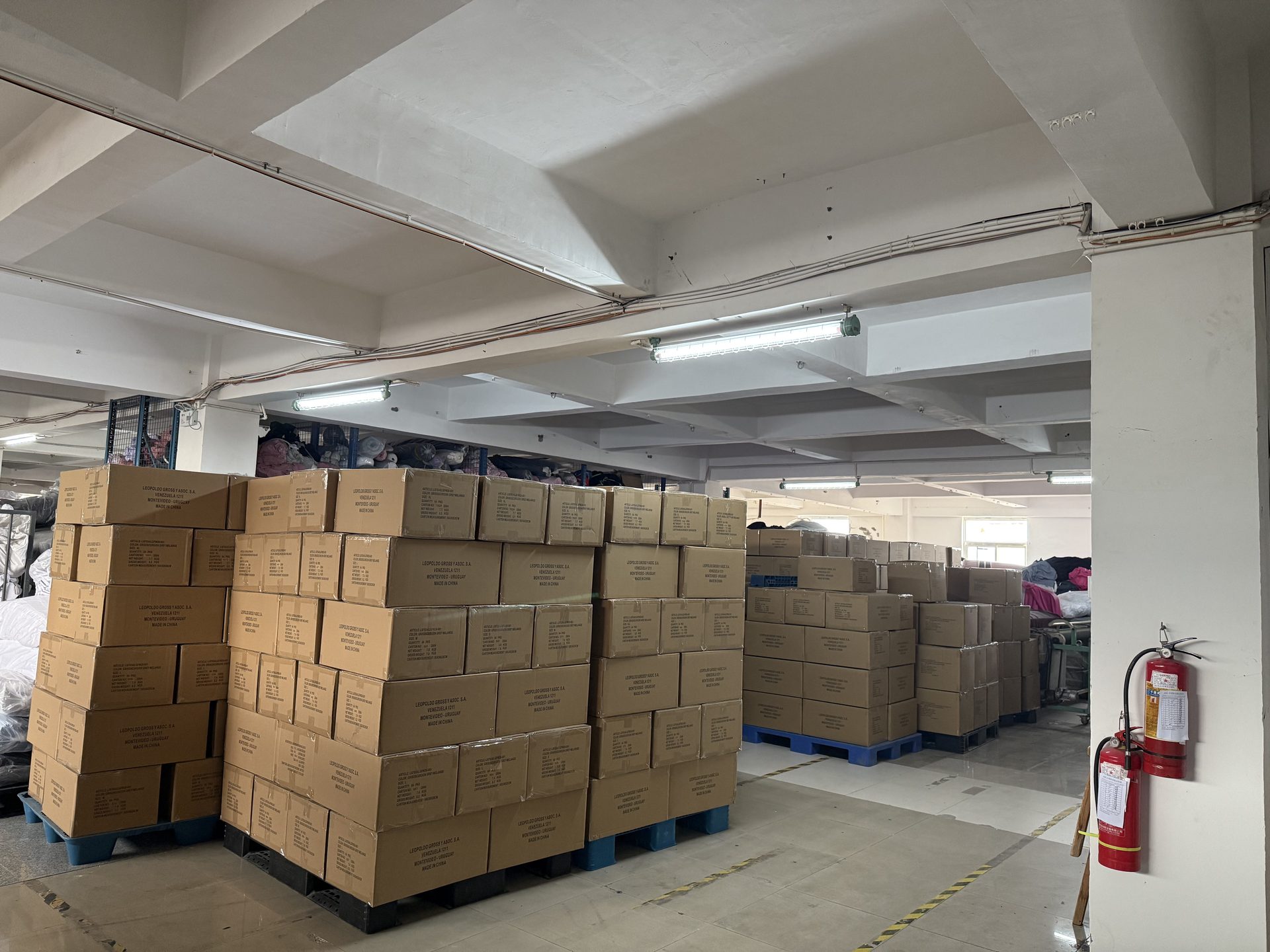
Direct answer. An underwear inspection report is read in four moves: confirm the sample size matches the lot size under ISO 2859-1 level II, find the accept and reject numbers for each defect class, classify every defect the inspector logged as critical, major or minor, and compare the totals against those two numbers. For a 10,000-piece order that means 200 pieces inspected, with acceptance at 10 major and 14 minor defects, and a rejection — automatic, no discussion — at any single critical defect.
The four fields to check before you read a single number
Most buyers open the report at the defect summary and start arguing about whether five loose threads are a defect. That is the wrong end. The report is a calculation, and a calculation built on the wrong inputs produces a number that looks authoritative and means nothing. Four fields decide whether the rest is worth reading.
| Field | What it should say | What to do if it does not |
|---|---|---|
| Lot or batch size | The quantity actually presented for inspection, not the PO quantity | Stop. If 9,400 pieces were presented on a 10,000-piece order, the sample plan applies to 9,400 |
| Sampling standard | ISO 2859-1, or its national equivalents (ANSI/ASQ Z1.4, GB/T 2828.1) | Stop. “Random sampling” with no named standard is not a plan |
| Inspection level | Level II for normal apparel inspection | Check which level was used. Levels I and III change the sample size, and the report’s numbers move with it |
| AQL per defect class | Usually 2.5 for major, 4.0 for minor, with critical at zero | Confirm the values before comparing totals. A report quoting 4.0 for major defects is a different contract |
The reason to start here is that everything downstream — the sample size, the accept number, the reject number — is derived from these four inputs. Get them right and the rest is arithmetic. Get them wrong and you will spend an afternoon negotiating about stitching while the report quietly tested too few pieces.
How the sample size is chosen — and why “random 10%” is not the answer
Buyers often ask for “10% inspection” or “at least 100 pieces”. Neither is a sampling plan. The sample size in a proper plan is a function of the lot size, not a percentage, and it is deliberately blunt: the same 200 pieces are inspected whether the lot is 3,201 units or 10,000.
This surprises people, because it means a large lot gets proportionally less attention than a small one. That is the intent. The plan is designed to answer one question — should this lot be accepted or rejected — with a bounded risk of getting it wrong in either direction, at the lowest cost in inspection hours. Once a lot is large enough that 200 pieces give you that answer reliably, inspecting more adds cost without adding much confidence.
The standard is ISO 2859-1, published as Sampling procedures for inspection by attributes and mirrored in the United States as ANSI/ASQ Z1.4 and in China as GB/T 2828.1. It defines inspection levels, sampling plans, and the accept/reject numbers for a given lot size and AQL.
The three general inspection levels
Level II is the default and the one written into almost every apparel inspection contract. Levels I and III exist because the buyer may want less or more evidence:
- Level I — roughly half the Level II sample size. Used where the cost of being wrong is low, or where the supplier’s process is already well characterised.
- Level II — the standard. If your contract does not name a level, assume this one and confirm it in writing.
- Level III — roughly 1.5 to 2 times the Level II sample size. Used for high-risk or high-value lots, first shipments from a new plant, and categories with a history of returns.
Separately there are four special levels (S-1 to S-4) with much smaller samples, intended for destructive or expensive testing — tensile tests, colourfastness panels, and the like. They are not a substitute for Level II on a finished-goods inspection, and a report that quietly used S-3 on a bulk shipment has not given you what you think you bought.
The table, for the three lot sizes that cover most underwear orders
The figures below are from the single-sampling plans under normal inspection, inspection level II. Every inspection report should print the same table; if yours prints different values, read the report’s own table rather than this one, because tightened or reduced inspection shifts them.
| Lot size | Sample size (level II) | AQL 2.5 — accept / reject | AQL 4.0 — accept / reject | AQL 1.0 — accept / reject |
|---|---|---|---|---|
| 501 – 1,200 | 80 | 5 / 6 | 10 / 11 | 2 / 3 |
| 1,201 – 3,200 | 125 | 7 / 8 | 14 / 15 | 3 / 4 |
| 3,201 – 10,000 | 200 | 10 / 11 | 14 / 15 | 5 / 6 |
| 10,001 – 35,000 | 315 | 14 / 15 | 21 / 22 | 7 / 8 |
| 35,001 – 150,000 | 500 | 21 / 22 | 21 / 22 | 10 / 11 |
Two rows are worth pausing on, because they are the ones buyers misread.
At 200 pieces, AQL 2.5 and AQL 4.0 both accept 14 defects. The accept numbers converge — which is why a report showing “14 defects, passed” is not automatically wrong, and why the defect class matters more than the raw total. Ten major defects at AQL 2.5 is exactly at the limit; ten minor defects at AQL 4.0 is comfortably inside it.
But at 200 pieces, AQL 2.5 rejects at 11 while AQL 4.0 rejects at 15. The accept numbers match and the reject numbers do not, because the plan is asymmetric by design. Between the accept and reject numbers sits a gap — at 200 pieces, 11, 12 and 13 defects fall into a zone where the standard tells you the lot is neither clearly acceptable nor clearly rejectable.
That gap is where most disputes live
In practice the gap is handled in one of three ways, and your contract should say which:
- Tightened inspection. The formal answer. When acceptance is not achieved and rejection is not reached, the standard provides for switching to tightened inspection on subsequent lots. Useful across a programme, useless for a single shipment standing at the port.
- Buyer’s call. The buyer accepts, rejects, or negotiates a concession. This is what happens on most shipments, and it works only when both sides know the number is in the gap rather than below the limit.
- 100% screening of the defect class. The lot is accepted on condition that the identified defect class is reworked or removed. Common for a single defect type with a clean fix — a loose thread, a mis-set label.
What makes the gap dangerous is a report that presents the total as a pass/fail without saying which side of the gap it landed on. A supplier reporting “14 defects, within tolerance” when ten of them are major has used the AQL 4.0 number to clear an AQL 2.5 failure.
AQL is not a defect target — and treating it as one costs you money
This is the single most expensive misreading in the whole subject, and it runs in both directions.
AQL does not mean “2.5% of the order may be defective”. It stands for acceptance quality limit, and it is a property of the inspection procedure, not a licence attached to the goods. The standard itself is explicit: the AQL is the quality level that, for the purposes of sampling inspection, is the limit of a satisfactory process average. It describes the worst process quality that the plan is willing to accept most of the time. It does not promise the buyer 2.5% defects, and it does not entitle the supplier to ship them.
The practical consequences cut both ways:
- For buyers. Passing an inspection at AQL 2.5 does not mean 2.5% of the goods are defective. It means the lot is consistent with a process whose defect rate could be around that level, judged from a sample. A lot that passes can still contain a defect rate higher than the AQL — that is what the producer’s risk in the plan accounts for.
- For suppliers. “Within AQL” is not a defence for a shipment that a buyer’s own customers will reject. If your returns rate in the market is 6% on an order that passed at AQL 2.5, the inspection did its job and the process did not.
Where this matters commercially: buyers who want a lower defect rate than AQL 2.5 implies should not argue about the AQL number on the inspection report. They should change the process controls, tighten the AQL to 1.5 or 1.0 on the specification, or move to 100% inspection on the specific defect class that is hurting them. Tightening the AQL is a real lever, and it is priced — fewer accepted defects means more rework at the factory, and the quotation will reflect it.
Defect classification: what makes a defect critical, major or minor
The classification is contractual, not natural. The same loose thread is minor in a three-pack of basic briefs and major on a garment shipping to a market where it tripping a customer complaint is a certainty. What the report must show is a classification agreed before production, applied consistently by the inspector.
| Class | Definition to write into your specification | Acceptance | Underwear examples |
|---|---|---|---|
| Critical | A defect that could cause injury or make the product illegal to sell in the destination market | Zero. One instance rejects the lot | Metal fragment or needle not detected; sharp edge on a fastener; banned azo dye or formaldehyde above the legal limit; wrong fibre content on a mandatory label |
| Major | A defect that would cause a customer to return the garment, or that a retail buyer would refuse on sight | AQL 2.5 as standard | Broken stitching on a waistband; incorrect size grading; visibly mismatched dye lot between pieces; leg opening out of tolerance; wrong care or content label |
| Minor | A deviation from specification that does not affect function or saleability | AQL 4.0 as standard | Untrimmed thread more than a stated length; a small mark on an inside seam; slight print registration offset within tolerance; a folded corner on a care label |
Two rules make this work in practice. First, write the examples into the specification, in the buyer’s language, with measurements. “Untrimmed thread” is arguable; “untrimmed thread exceeding 6 mm” is not. Second, state the destination market, because that is what turns a legal requirement into a critical defect. Formaldehyde above 75 mg/kg is critical for the EU under REACH entry 72; the same garment at the same level may be compliant elsewhere, and the report needs to know which standard the inspector was applying.
Reading the arithmetic: accept, reject, and the numbers in between
An inspection report reduces to a small set of numbers. Knowing which is which prevents the most common argument, which is two parties reading the same page and disagreeing about whether it says pass or fail.
- n — the sample size actually drawn, which must equal the sample size the plan requires for that lot size and level.
- Ac — the acceptance number. Failures at or below this number: accept.
- Re — the rejection number. Failures at or above this number: reject.
- Per-class totals — counted separately for critical, major and minor, never summed into one figure.
Read the report in this order: confirm the lot size matches what was presented, confirm the sample size matches the plan for that lot and level, confirm the AQL per class, then compare each class total against its own Ac and Re. Do not compare a major total against a minor limit. Do not accept a single combined total. And require the report to print Ac and Re for every class, not only the verdict — a report that states “passed” without showing the numbers is asking you to trust a conclusion you cannot check.
When the numbers are in the gap
If a class total falls between Ac and Re, the report should say so explicitly. The correct handling is the one described above — tightened inspection, buyer’s decision, or screening the specific class. What it should not do is round toward whichever verdict suits the party writing the report, which is why the standard’s asymmetry exists in the first place.
What an inspection report does not tell you
Three limits are worth stating plainly, because buyers routinely over-read a passing report.
- It does not test chemistry. An AQL inspection examines workmanship, measurements, packing and labelling. Fabric composition, formaldehyde, azo dyes, pH and nickel release are laboratory tests on a different document with a different sample. A report that passes does not mean the garment is chemically compliant.
- It does not measure the population. It measures 200 pieces out of 10,000, under a procedure that accepts a defined risk of being wrong. That is a good trade, not a guarantee.
- It does not transfer the obligation. The inspection is evidence, not a waiver. If a defect class that the report did not cover later causes a return, the report does not protect either party.
Verifying the report before you rely on it
An inspection report is only useful if it was issued by a party with something to lose. Before treating one as evidence, confirm four things:
- Who issued it. A manufacturer’s own internal QC sheet is a production record, not third-party evidence. A report from an independent inspection body names the body, the inspector and the date of attendance. Our own process and quality control page sets out how the internal records and the third-party reports fit together on an order.
- What was inspected. The report should identify the order, the style, the lot presented and the finished goods warehouse it was drawn from.
- Whether it is authentic. Independent bodies issue report numbers that can be traced back through their own portals. A PDF with a plausible layout and a logo proves nothing on its own. The accreditation marks to look for, and how to check that the report’s date and the production date make sense together, are covered under certification and verification.
- What it did not cover. Read the scope section. An inspection that excluded packing, or excluded labelling, or drew samples only from the top of a pallet, has a narrower claim than its verdict implies.
Writing the inspection specification before production starts
Every argument described in this page is cheaper to prevent than to settle, and prevention is a two-page document written before the order is placed. It needs six sections:
- Sampling plan — ISO 2859-1, inspection level II, normal inspection, single sampling. Name the standard, not the percentage.
- AQL per class — critical zero, major 2.5, minor 4.0 as the default, adjusted if your return data says otherwise.
- Defect examples per class — with measurements in millimetres and colour references, in the buyer’s language.
- Measurement points and tolerances — waist relaxed and stretched, leg opening, side seam, rise, and the tolerance for each, referencing the measurement chart in your tech pack.
- Destination market and applicable standards — which chemical and labelling rules the inspector should treat as critical if breached.
- Gap handling — what happens when a class total lands between accept and reject.
Attach it to the purchase order. An inspection specification that lives in an email thread is a specification that will be reconstructed, differently, by two parties on the day the container is loaded.
Compliance and verification
The sampling and classification framework above rests on published standards rather than on any supplier’s practice:
- Sampling — ISO 2859-1, Sampling procedures for inspection by attributes, Part 1: schemes indexed by acceptance quality limit for lot-by-lot inspection. National adoptions: ANSI/ASQ Z1.4 (US), GB/T 2828.1 (China), BS 6001-1 (UK). Measurement and standards practice in general is set out by NIST.
- Chemical limits — for the EU, REACH Annex XVII restrictions on textiles, notably entry 43 (azo dyes, 30 mg/kg), entry 72 (formaldehyde at 75 mg/kg in textiles, clothing and footwear) and entry 27 (nickel release), administered by the European Commission under the REACH restrictions procedure. Our walk-through of the chemical limits that apply to underwear covers the numbers by market.
- Children’s products — in the United States, the CPSIA lead and phthalate limits at 15 U.S.C. § 2057c and 16 CFR part 1307, with flammability under 16 CFR part 1615 for sleepwear in sizes 0–6X and part 1616 for 7–14, with general apparel flammability under part 1610.
- Social compliance — amfori BSCI audits, held by the manufacturing site rather than by the sourcing company arranging the order.
- Third-party inspection — independent inspection bodies operate on the same ISO 2859-1 framework; confirm the report number traces back through the issuing body’s own portal. Large apparel buyers routinely name the inspection body in the contract, and the choice of body affects what the report can later be used for. On the sourcing side, the China Country Commercial Guide published by the US Commercial Service describes how the Chinese commercial system is organised, and the World Bank B-READY programme scores business-environment practice across economies.
- Product identification — GS1 standards for the GTIN and carton marks that let an inspection sample be tied back to a specific shipment, which is what makes a defect pattern traceable rather than anecdotal.
- Verification of the supplier itself — corporate registration and permit records held by China’s market regulator at samr.gov.cn, and the chemical and labelling requirements that a critical defect classification is usually written against, summarised in NIST IR 8115r1.
None of these replace the inspection specification. They are the vocabulary the specification is written in.
Next step
If you already have a report in front of you, run the four-field check first — lot size, standard, inspection level and AQL per class. Most disagreements dissolve at that step. If you are about to place an order and have not written an inspection specification, we can share the template we attach to purchase orders, including the defect examples and measurement tolerances we use for briefs, boxers and sleepwear. Tell us the market and the styles and we will send the version that applies.
· Xiamen Unitex Trade Co., Ltd. — OEM & ODM underwear sourcing partner