
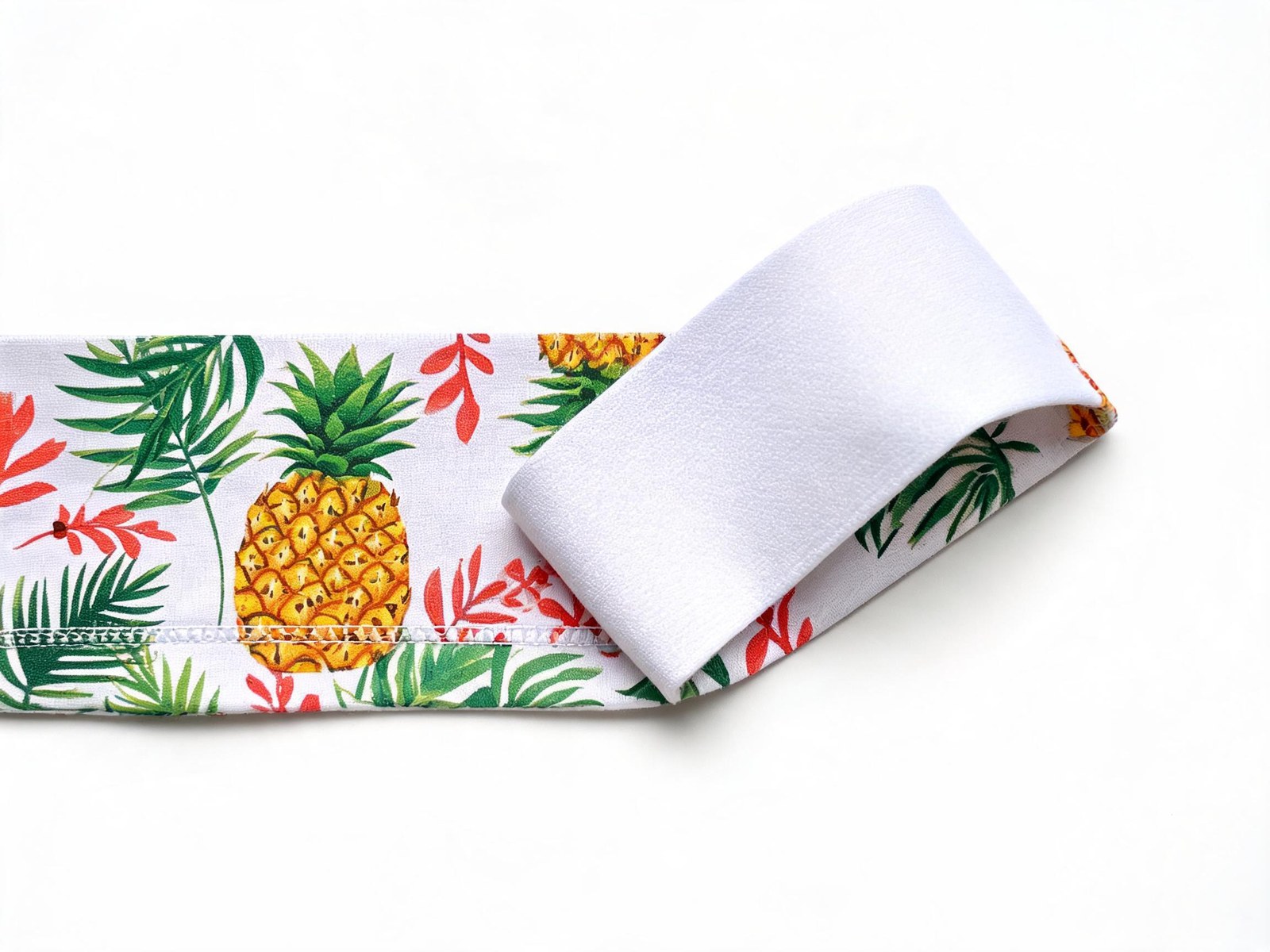
Wide printed elastic waistbands are now a primary branding surface on a men’s boxer brief. A waistband wider than 4 cm that carries a full-colour digital or transfer print is a different product from a narrow, yarn-dyed band — it changes the cost structure, the colour-fastness risk, the stretch recovery and the minimum order quantity. This page explains what that construction actually is, why a wide printed nylon band behaves differently, and the exact parameters to write into a tech pack so the factory and the buyer are talking about the same garment.
Xiamen Unitex Trade Co., Ltd. is a professional underwear sourcing and supply-chain management company based in Xiamen, Fujian Province, in the Xiamen–Quanzhou–Jinjiang knitwear cluster of south-east China. Founded by Will Lin, who has worked in the apparel trade since 2004, the company has been exporting since 2009 and was incorporated in Xiamen in 2013. It runs its own liaison office in Jinjiang and works with a network of amfori BSCI and OEKO-TEX Standard 100 certified partner factories to serve retailers and brands across Europe, the US and Australia.
What “printed elastic waistband” actually means
A printed elastic waistband is an elastic band — a woven or knitted substrate made from nylon (polyamide) with a spandex or natural-rubber core — that has had a design applied to its surface by printing rather than by weaving the pattern in. Two printing routes dominate for nylon bands.
The first is heat-transfer (sublimation) printing. The design is printed in mirror image onto a transfer paper with disperse dyes, then heat-pressed onto the band at around 200 °C. The dye sublimates — it turns directly from solid to gas — and bonds with the fibre, so the colour sits inside the material rather than on top of it. Because there is no ink film left on the surface, a sublimated band keeps its soft hand feel and does not crack, peel or fade when the band is stretched or washed. Classic disperse-dye sublimation is, however, a polyester process: nylon has a weaker affinity for disperse dyes, which is why nylon bands are more often printed with acid dyes — either by the cold-transfer route below, or by an acid-dye heat-transfer process formulated for polyamide.
The second is cold-transfer printing, a wet process used specifically for nylon. An acid-dye paste is printed onto a release-coated paper; the fabric is padded with a pre-treatment liquor and pressed against the paper so the dye transfers, then the band is steamed, washed and heat-set. Cold transfer runs at room temperature, which preserves the soft hand of fine nylon, and it fills a gap where conventional printing struggles to hold colour on high-density polyamide.
Both routes support full-colour, photographic and gradient artwork — something a yarn-dyed jacquard band cannot do. That is the key trade-off: a jacquard waistband with a custom logo weaves a limited number of colours in as part of the structure, while a printed band reproduces fine typography, tropical patterns and multi-tone gradients that no loom can match.
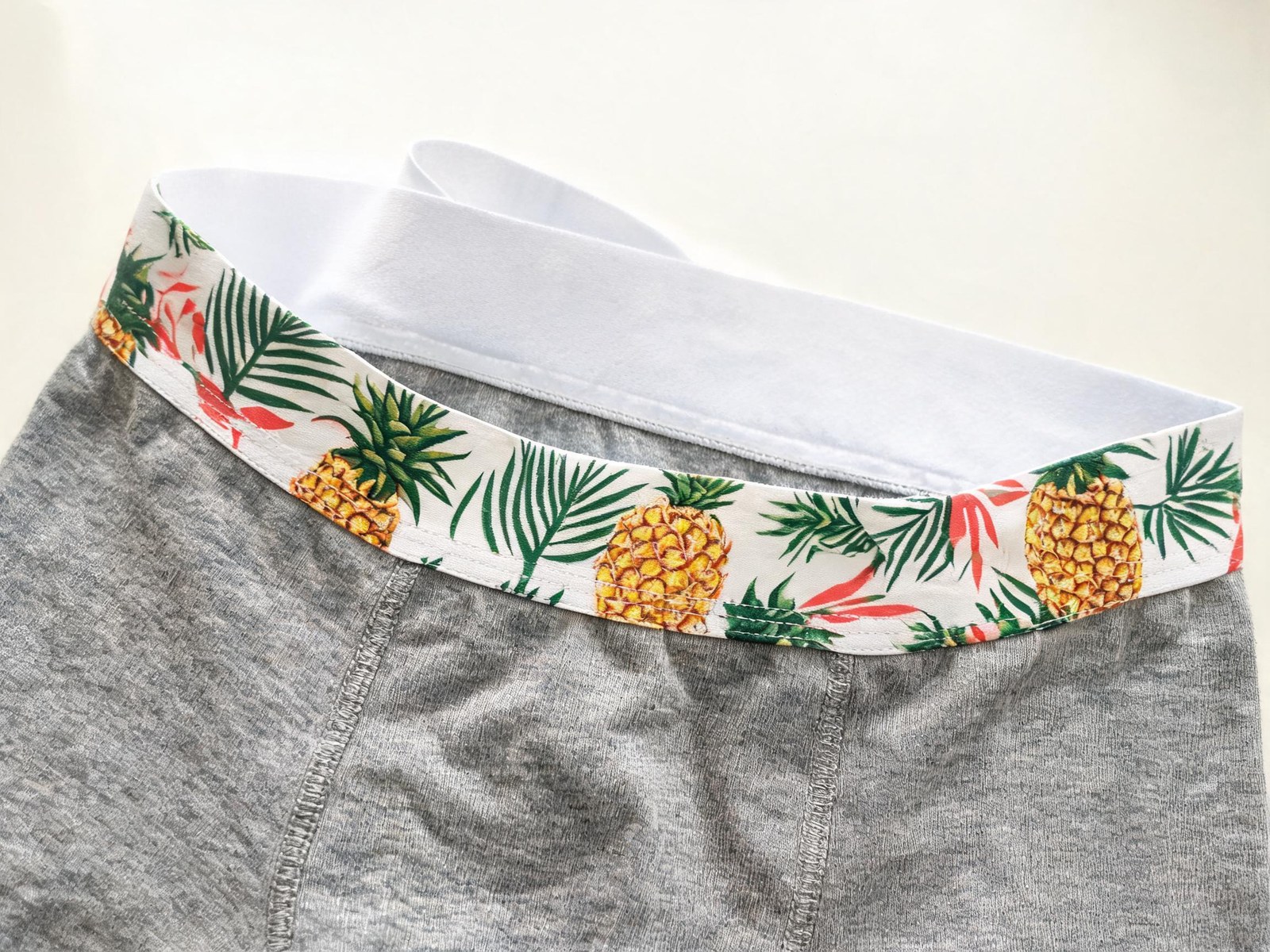
Why width matters more than it first appears
A waistband wider than 4 cm is a different engineering problem from a 2–3 cm band, and it is not simply “the same band, cut wider”. Three things change.
First, more surface means more print. A 5 cm band exposes roughly twice the printable area of a 2.5 cm band, so registration, colour consistency and any defect become far more visible. The buyer sees the band every time the garment is folded, photographed or worn, so a wide band is effectively a billboard for the brand — and for any printing fault.
Second, a wide band carries more tension around the waist. The band must distribute that tension evenly or it will curl, roll or cut into the skin. Professional band makers build wide bands on fine-denier nylon with a covered-spandex or rubber core, and specify elongation carefully. A common figure for a quality printed elastic is an elongation of 120–150 %, which means the band stretches to between 2.2 and 2.5 times its relaxed length and recovers to its original width afterwards. Recovery — not the raw elastic percentage — is the property that predicts how the band feels after twenty washes.
Third, width interacts with the minimum order quantity. A printed elastic is produced by the roll, and the band maker quotes a minimum in yards or metres per colour and design. Wider bands consume more material per garment, and a wide, printed, custom-designed band usually carries a higher minimum than a plain narrow band because the print setup and the dye colour-matching are per design.
What a professional factory specifies (and why you should too)
Professional elastic-band manufacturers describe the product in precise terms, and a buyer who uses the same terms gets a more accurate quote and a more consistent result. The parameters below are drawn from the technical sheets of specialised band makers.
The substrate is usually around 85 % nylon with 15 % spandex, or nylon with a natural-rubber core, woven or knitted on narrow-width looms. Width is specified in millimetres and commonly ranges from 10 mm to 60 mm — so a band “wider than 4 cm” means anything from roughly 45 mm up to 60 mm. Thickness is typically 1.0 to 2.2 mm. Colour is matched to a Pantone reference for both the background yarn and the printed graphics. Colour fastness is tested to washing, perspiration, light, rubbing, seawater and chlorine, with a grade of 4.0 and azo-free dyes as a common quality floor. Safety certification is usually OEKO-TEX Standard 100 for direct skin contact, with SGS or CPSIA testing on request.
For the print itself, the band maker distinguishes two production scales. Small runs — a sample, a few hundred metres, or a multi-colour one-off — are done by digital printing, which needs no plate, has no repeat limit and starts from a single yard. Large runs of several thousand metres or more switch to rotogravure transfer printing with an engraved cylinder, which is faster and cheaper per yard but only pays once the volume justifies the cylinder. This is why a buyer should ask the band supplier directly which route applies to the order size, rather than assuming one process for everything.
How to specify a wide printed waistband in the tech pack
The most common failure on this garment is not the print or the fabric — it is the specification being too thin. As with any boxer-brief specification, a line that says “printed waistband, 5 cm” leaves the factory to guess the material, the print method, the colour reference and the recovery target, and every guess is a chance for the bulk to come back different from the sample. The list below is the minimum a complete tech pack should state.
- Band construction: woven or knitted substrate, nylon with spandex or rubber core, and the target nylon/spandex ratio.
- Finished width in millimetres, plus the tolerance (for example a 50 mm band with a tolerance of plus or minus 1 mm).
- Print method: sublimation heat transfer or cold transfer, stated against the fibre so the two are compatible.
- Pantone or colour reference for both the background yarn and the printed artwork.
- Elongation and recovery target, such as 120–150 % elongation with full recovery, rather than only a “spandex percentage”.
- Colour-fastness requirement: the grade and the specific tests (washing, perspiration, light, rubbing, chlorine).
- Safety standard: OEKO-TEX Standard 100 for direct skin contact, with third-party testing where the destination market requires it.
- Artwork file: vector artwork in AI or PDF for clean reproduction, since printed bands reproduce fine type and gradients better than a jacquard loom.
Where a wide printed band earns its cost
A wide printed waistband is usually the costliest single component of a boxer brief on a per-piece basis, and it is worth being clear about what that money buys. The print reproduces artwork a loom cannot; the width gives the brand a larger, more visible surface; and a well-made band keeps its colour and recovery through repeated washing, which is what separates a garment that stays “new-looking” from one that looks tired after a month. For a private-label or OEM underwear programme where the waistband is the main branding position, the band is not the place to save cost — a faded or cracked band reads as a cheap garment regardless of the quality of the fabric above it.
For a buyer who wants a reliable supplier, the practical question is not whether a printed band can be made — many factories make them — but whether the supplier can hold the colour, the width and the recovery across a bulk order and reproduce the sample exactly. That is a quality-control question, and it is answered by the specification above and by checking a washed production sample against it before approving bulk, ideally against an agreed AQL under ISO 2859-1.
A short verification routine closes the loop. Before signing off on bulk, confirm that the band maker has logged the Pantone references for both the ground yarn and the artwork, that the finished width sits inside the agreed tolerance on every colourway, and that an elongation-and-recovery test was run on the washed sample rather than on the unwashed one. Ask for a lab colour-fastness report covering washing, perspiration, light and rubbing, and check that the band carries the OEKO-TEX Standard 100 certification that the destination market expects. The point is not to add paperwork for its own sake: each of these checks guards against a different way the bulk can drift from the approved sample, and together they are what turns a printed waistband from a design detail into a dependable, repeatable component.
References
The technical parameters in this article — the nylon-to-spandex ratio, the 10–60 mm width range, the 1.0–2.2 mm thickness, the 120–150 % elongation figure, and the sublimation temperature of about 200 °C — are drawn from the technical sheets of specialised elastic-band manufacturers and from international standards:
- Flexor Atrims — “Custom Thermal Transfer Printing Logo Nylon Jacquard Elastic Band Underwear Waistband” (width 10–60 mm, thickness 1.0–2.2 mm, OEKO-TEX Standard 100 / ISO9001) — https://flexoratrims.com/product/thermal-transfer-printed-elastic-band
- Qingdao Elastic International Trade Co., Ltd. — “40mm Heat Transfer Printing Elastic for Underwear Waistband” (85 % nylon / 15 % spandex, elongation 120–150 %, SGS / CPSIA / Oeko-Tex 100) — https://www.fullpackage.org/product/40mm-heat-transfer-printing-elastic-for-underwear-waistband_733198522.html
- Full Package — “30mm Printed Stretch Elastic Webbing for Underpants Waistband” (width 3–100 mm, AATCC colour fastness) — https://www.fullpackage.org/product/30mm-printed-stretch-elastic-webbing-for-underpants-waistband_733157972.html
- Trans-Tex LLC — dye-sublimation printing of narrow-web polyester webbing, ribbon and elastic — https://trans-texinc.com/dye-sublimation/
- MiFu Fabric — “4 Ways to Print Fabric: Polyester & Nylon” (sublimation for polyester; acid-dye water/cold transfer for nylon) — https://mifufabric.com/fabric-printing-on-polyester-and-nylon
- PackPrintMatrix — “Dye Sublimation Printing Explained” (disperse dyes, 180–210 °C, polymer substrates) — https://packprintmatrix.com/printing-processes/how-does-the-dye-sublimation-printing-process-work
- Dongguan Huajin heat-transfer printing factory — digital vs rotogravure transfer printing on elastic (width 0.7–60 mm, SGS / ROHS) — https://b2b.liebiao.com/fangzhipg/306224485.html
- ISO 2859-1 — Sampling procedures for inspection by attributes (AQL) — https://www.iso.org/standard/2859-1
· Xiamen Unitex Trade Co., Ltd. — OEM & ODM underwear sourcing partner
| Supplier | Unitex Underwear (Xiamen Unitex Trade Co., Ltd.) — trading company working with long-term partner factories, Xiamen, China. |
|---|---|
| Substrate | About 85% nylon with 15% spandex, or nylon with a natural-rubber core |
| Band width | 10–60 mm; a "wide" band is roughly 45–60 mm (over 4 cm) |
| Thickness | 1.0–2.2 mm |
| Print method | Heat-transfer sublimation or cold transfer, matched to the fibre |
| Sublimation temperature | About 200 °C (disperse dye; nylon bands more often use acid dye) |
| Elongation | 120–150% (stretches 2.2–2.5 times relaxed length, full recovery) |
| Colour reference | Pantone for background yarn and printed artwork |
| Colour fastness | Grade 4.0 to washing, perspiration, light, rubbing, chlorine |
| Safety standard | OEKO-TEX Standard 100 for direct skin contact |
| Small-run printing | Digital, no plate, no repeat limit, from a single yard |
| Large-run printing | Rotogravure transfer with engraved cylinder, cheaper per yard at volume |
Buyer checklist
- Confirm the substrate: nylon with spandex or rubber core, and the target nylon/spandex ratio.
- State the finished width in millimetres with a tolerance, not just "wide".
- Name the print method and check it is compatible with the fibre.
- Supply a Pantone reference for both the background yarn and the printed artwork.
- Specify an elongation and recovery target instead of only a spandex percentage.
- Set the colour-fastness grade and the specific tests to run.
- Require OEKO-TEX Standard 100 for direct skin contact, with third-party testing where needed.
- Provide vector artwork in AI or PDF for clean reproduction.
- Ask the band supplier which print route applies to the order size — digital or rotogravure.
- Check a washed production sample against the specification before approving bulk.
Unitex Underwear (Xiamen Unitex Trade Co., Ltd.)
Unitex Underwear (Xiamen Unitex Trade Co., Ltd.) — OEM/ODM underwear sourcing and supply-chain partner in Xiamen, China; in the trade since 2009, incorporated in 2013. Based in the Xiamen–Quanzhou–Jinjiang knitwear cluster, Fujian Province, south-east China.